Results by title
4 books match the query 'Eighties'
Politics and Economics in the Eighties
Edited by Alberto Alesina and Geoffrey Carliner
University of Chicago Press, 1991
Certain to provoke controversy, this interdisciplinary volume brings together policy experts to provide a coherent analysis of the most important economic policy changes of the 1980s. Through a detailed examination of voting patterns, monetary and fiscal policies, welfare spending, tax reform, minimum wage legislation, the savings and loan collapse, and international trade policy, the authors explore how politics can influence the direction of economic policymaking.
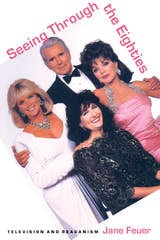
Seeing Through the Eighties
Television and ReaganismJane Feuer
Duke University Press, 1995
With a cast of characters including Michael, Hope, Elliot, Nancy, Melissa, and Gary; Alexis, Krystle, Blake, and all the other Carringtons; not to mention Maddie and David; even Crockett and Tubbs, Feuer smoothly blends close readings of well-known programs and analysis of television’s commercial apparatus with a thorough-going theoretical perspective engaged with the work of Baudrillard, Fiske, and others. Her comparative look at Yuppie TV, Prime Time Soaps, and made-for-TV-movie Trauma Dramas reveals the contradictions and tensions at work in much prime-time programming and in the frustrations of the American popular consciousness. Seeing Through the Eighties also addresses the increased commodification of both the producers and consumers of television as a result of technological innovations and the introduction of new marketing techniques. Claiming a close relationship between television and the cultures that create and view it, Jane Feuer sees the eighties through televison while seeing through television in every sense of the word.
The Death Penalty in the Eighties
An Examination of the Modern System of Capital PunishmentWelsh S. White
University of Michigan Press, 1987
The Films of the Eighties
A Social HistoryWilliam J. Palmer
Southern Illinois University Press, 1995
In this remarkable sequel to his Films of the Seventies: A Social History, William J. Palmer examines more than three hundred films as texts that represent, revise, parody, comment upon, and generate discussion about major events, issues, and social trends of the eighties.
Palmer defines the dialectic between film art and social history, taking as his theoretical model the "holograph of history" that originated from the New Historicist theories of Hayden White and Dominick LaCapra. Combining the interests and methodologies of social history and film criticism, Palmer contends that film is a socially conscious interpreter and commentator upon the issues of contemporary social history. In the eighties, such issues included the war in Vietnam, the preservation of the American farm, terrorism, nuclear holocaust, changes in Soviet-American relations, neoconservative feminism, and yuppies.
Among the films Palmer examines are Platoon, The Killing Fields, The River, Out of Africa, Little Drummer Girl, Kiss of the Spiderwoman, Silkwood, The Day After, Red Dawn, Moscow on the Hudson, Troop Beverly Hills, and Fatal Attraction. Utilizing the principles of New Historicism, Palmer demonstrates that film can analyze and critique history as well as present it.