Results by title
5 books match the query 'Ejército Zapatista de Liberación Nacional (Mexico)'

Reinventing the Lacandón
Subaltern Representations in the Rain Forest of ChiapasBrian Gollnick
University of Arizona Press, 2008

Subcommander Marcos
The Man and the MaskNick Henck
Duke University Press, 2007
In this, the first English-language biography of Subcommander Marcos, Nick Henck describes the thought, leadership, and personality of this charismatic rebel spokesperson. He traces Marcos’s development from his provincial middle-class upbringing, through his academic career and immersion in the clandestine world of armed guerrillas, to his emergence as the iconic Subcommander. Henck reflects on what motivated an urbane university professor to reject a life of comfort in Mexico City in favor of one of hardship as a guerrilla in the mountainous jungles of Chiapas, and he examines how Marcos became a conduit through which impoverished indigenous Mexicans could communicate with the world.
Henck fully explores both the rebel leader’s renowned media savvy and his equally important flexibility of mind. He shows how Marcos’s speeches and extensive writings demonstrate not only the Subcommander’s erudition but also his rejection of Marxist dogmatism. Finally, Henck contextualizes Marcos, locating him firmly within the Latin American guerrilla tradition.
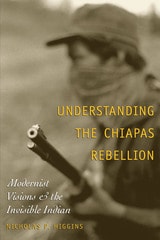
Understanding the Chiapas Rebellion
Modernist Visions and the Invisible IndianBy Nicholas P. Higgins
University of Texas Press, 2004
To many observers in the late 1980s and early 1990s, Mexico appeared to be a modern nation-state at last assuming an international role through its participation in NAFTA and the OECD (Organization of Economic Cooperation and Development). Then came the Zapatista revolt on New Year's Day 1994. Wearing ski masks and demanding not power but a new understanding of the indigenous peoples of Mexico, Subcomandante Marcos and his followers launched what may be the first "post" or "counter" modern revolution, one that challenges the very concept of the modern nation-state and its vision of a fully assimilated citizenry.
This book offers a new way of understanding the Zapatista conflict as a counteraction to the forces of modernity and globalization that have rendered indigenous peoples virtually invisible throughout the world. Placing the conflict within a broad sociopolitical and historical context, Nicholas Higgins traces the relations between Maya Indians and the Mexican state from the conquest to the present—which reveals a centuries-long contest over the Maya people's identity and place within Mexico. His incisive analysis of this contest clearly explains how the notions of "modernity" and even of "the state" require the assimilation of indigenous peoples. With this understanding, Higgins argues, the Zapatista uprising becomes neither surprising nor unpredictable, but rather the inevitable outcome of a modernizing program that suppressed the identity and aspirations of the Maya peoples.

Zapatista!
Reinventing Revolution in MexicoEdited by John Holloway and Eloina Pelaez
Pluto Press, 1998
Zapatistas
The Chiapas Revolt and What It Means For Radical PoliticsMihalis Mentinis
Pluto Press, 2006
The Zapatista Army for National Liberation burst onto the world stage on 1 January 1994. Zapatista commander Subcomandante Marcos announced a revolution, and declared war on the Mexican government and global capitalism. Since then, the Zapatistas have inspired thousands of activists across the world. They have attracted much attention from political theorists and analysts. Despite this, there is little consensus about the real nature and efficacy of the movement.
Zapatistas provides a bold new approach to understanding the insurrection. Mentinis spent nine months visiting the Zapatista autonomous zone, and the result is this unique exploration of the indigenous political theory emerging within the movement. Combining this with an analysis of the integrity of the Zaptista project, Mentinis draws on the concept of the 'event' from Badiou, ideas from Situationism, the 'project of autonomy' of Cornelius Castoriadis and the 'constituent power' of Antonio Negri, to present a rigourous account of the movement and the impact it has had on radical political theory.