Results by title
9 books match the query 'Electric power distribution'

Code of Practice for Low and Extra Low Voltage Direct Current Power Distribution in Buildings
The Institution of Engineering and Technology
The Institution of Engineering and Technology, 2015
Low voltage direct current distribution of power within buildings offers advantages over the traditional mains power supply solutions for an increasing number of services.
[more]
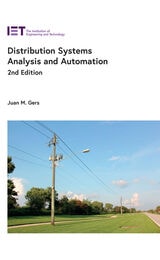
Distribution Systems Analysis and Automation
Juan Manuel Gers
The Institution of Engineering and Technology, 2020
Distribution systems analysis employs a set of techniques to simulate, analyse, and optimise power distribution systems. Combined with automation, these techniques underpin the concept of the smart grid. In recent years, distribution systems have been facing growing challenges, due to increasing demand as well as the rising shares of distributed and volatile renewable energy sources.
[more]
Electricity Distribution Network Design
E. Lakervi
The Institution of Engineering and Technology, 2003
Distribution networks represent a huge capital investment. To make sensible decisions about their investments, electricity utilities need to form clear-cut design policies and adopt the most accurate systemdesign procedures.
[more]
Failure by Design
The California Energy Crisis and the Limits of Market PlanningGeorg Rilinger
University of Chicago Press, 2024
A new framework for studying markets as the product of organizational planning and understanding the practical limits of market design.
The Western energy crisis was one of the great financial disasters of the past century. The crisis began in April 2000, when price spikes started to rattle California’s electricity markets. Decades later, some blame economic fundamentals and ignorant politicians, while others accuse the energy sellers who raided the markets. In Failure by Design, sociologist Georg Rilinger offers a different explanation, one that focuses on the practical challenges of market design. The unique physical attributes of electricity made it exceedingly difficult to introduce markets into the coordination of the electricity system, so market designers were brought in to construct the infrastructures that coordinate how market participants interact. An exercise in social engineering, these infrastructures were intended to guide market actors toward behavior that would produce optimal market results and facilitate grid management. Yet, though these experts spent their days worrying about incentive misalignment and market manipulation, they unintentionally created a system riddled with opportunities for destructive behavior. Rilinger’s analysis not only illuminates the California energy crisis but also develops a broader theoretical framework for thinking about markets as the products of organizational planning and the limits of social engineering, contributing broadly to sociological and economic thinking about the nature of markets.
The Western energy crisis was one of the great financial disasters of the past century. The crisis began in April 2000, when price spikes started to rattle California’s electricity markets. Decades later, some blame economic fundamentals and ignorant politicians, while others accuse the energy sellers who raided the markets. In Failure by Design, sociologist Georg Rilinger offers a different explanation, one that focuses on the practical challenges of market design. The unique physical attributes of electricity made it exceedingly difficult to introduce markets into the coordination of the electricity system, so market designers were brought in to construct the infrastructures that coordinate how market participants interact. An exercise in social engineering, these infrastructures were intended to guide market actors toward behavior that would produce optimal market results and facilitate grid management. Yet, though these experts spent their days worrying about incentive misalignment and market manipulation, they unintentionally created a system riddled with opportunities for destructive behavior. Rilinger’s analysis not only illuminates the California energy crisis but also develops a broader theoretical framework for thinking about markets as the products of organizational planning and the limits of social engineering, contributing broadly to sociological and economic thinking about the nature of markets.
[more]
High Voltage Engineering and Testing
Hugh M. Ryan
The Institution of Engineering and Technology, 2001
Based on a successful IEE International Vacation School series, this book aims to give an appreciation of present day high voltage transmission and distribution systems.
[more]
High-Voltage Engineering and Testing
Hugh M. Ryan
The Institution of Engineering and Technology, 2013
This 3rd edition of High Voltage Engineering Testing describes strategic developments in the field and reflects on how they can best be managed. All the key components of high voltage and distribution systems are covered including electric power networks, UHV and HV. Distribution systems including HVDC and power electronic systems are also considered. In the book, particular consideration is given to recent developments in UHV, AC and DC transmission systems abroad. Recent developments in renewable energy techniques and environmental issues are also discussed and assessed. This new edition gives details of design and testing techniques and considers recent developments in testing and measuring technology and reviews them together with appropriate strategic technological assessments of some applications.
[more]
Protection of Electricity Distribution Networks
Juan M. Gers
The Institution of Engineering and Technology, 2011
High quality electrical service is everyday more stringent in utilities and industrial facilities around the world. One of the main players to achieve this is the protection system, which has to be reliable, fast and with a good cost/benefit ratio. This book refers to most aspects of electrical protections, with emphasis on Distribution Systems. Protection of generation and transmission systems are also treated in the text. References to modern topics such as the Distributed Generation, Smart Grid and Standard IEC 61850 have been introduced. Written by two well experienced engineers who combine a comprehensive theoretical background with examples and exercises, this book will allow the reader to easily follow the ideas explored. The book will be valuable to pre and postgraduate students, design, maintenance and consulting engineers as well as instructors looking for proper references.
[more]
Protection of Electricity Distribution Networks, 2nd Edition
Juan M. Gers
The Institution of Engineering and Technology, 2004
Written by two practicing electrical engineers, this second edition of the bestselling Protection of Electricity Distribution Networks offers both practical and theoretical coverage of the technologies, from the classical electromechanical relays to the new numerical types, which protect equipment on networks and in electrical plants.
A properly coordinated protection system is vital to ensure that an electricity distribution network can operate within preset requirements for safety for individual items of equipment, staff and public, and the network overall. Suitable and reliable equipment should be installed on all circuits and electrical equipment and to do this, protective relays are used to initiate the isolation of faulted sections of a network in order to maintain supplies elsewhere on the system. This then leads to an improved electricity service with better continuity and quality of supply.
A properly coordinated protection system is vital to ensure that an electricity distribution network can operate within preset requirements for safety for individual items of equipment, staff and public, and the network overall. Suitable and reliable equipment should be installed on all circuits and electrical equipment and to do this, protective relays are used to initiate the isolation of faulted sections of a network in order to maintain supplies elsewhere on the system. This then leads to an improved electricity service with better continuity and quality of supply.
[more]
The City Electric
Infrastructure and Ingenuity in Postsocialist TanzaniaMichael Degani
Duke University Press, 2022
Over the last twenty years of neoliberal reform, the power supply in Dar es Salaam, Tanzania’s metropolis, has become less reliable even as its importance has increased. Though mobile phones, televisions, and refrigerators have flooded the city, the electricity required to run these devices is still supplied by the socialist-era energy company Tanesco, which is characterized by increased fees, aging infrastructure, and a sluggish bureaucracy. While some residents contemplate off-grid solutions, others repair, extend, or tap into the state network with the assistance of freelance electricians or moonlighting utility employees. In The City Electric Michael Degani explores how electricity and its piracy has become a key site for urban Tanzanians to enact, experience, and debate their social contract with the state. Moving from the politics of generation contracts down to the street-level experience of blackouts and disconnection patrols, he reveals the logics of infrastructural modification and their effects on everyday life. As politicians, residents, electricians, and utility inspectors all redistribute flows of payment and power, they reframe the energy grid both as a technical system and as an ongoing experiment in collective interdependence.
[more]