Results by title
5 books match the query 'Electric power production'
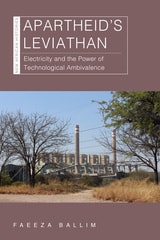
Apartheid’s Leviathan
Electricity and the Power of Technological AmbivalenceFaeeza Ballim
Ohio University Press, 2023
A fascinating study that shows how the intersection of technology and politics has shaped South African history since the 1960s. This book details the development of an interconnected technological system of a coal mine and of the Matimba and Medupi power stations in the Waterberg, a rural region of South Africa near the country’s border with Botswana. South Africa’s state steel manufacturing corporation, Iscor, which has since been privatized, developed a coal mine in the region in the 1970s. This set the stage for the national electricity provider, Eskom, to build coal-fueled power stations in the Waterberg. Faeeza Ballim follows the development of these technological systems from the late 1960s, a period of heightened repression as the apartheid government attempted to realize its vision of racial segregation, to the deeply fraught construction of the Medupi power station in postapartheid South Africa. The Medupi power station was planned toward the end of the first decade of the twenty-first century as a measure to alleviate the country’s electricity shortage, but the continued delay of its completion and the escalation of its costs meant that it failed to realize those ambitions while public frustration and electricity outages grew. By tracing this story, this book highlights the importance of technology to our understanding of South African history. This characterization challenges the idea that the technological state corporations were proxies for the apartheid government and highlights that their activities in the Waterberg did not necessarily accord with the government’s strategic purposes. While a part of the broader national modernization project under apartheid, they also set the stage for worker solidarity and trade union organization in the Waterberg and elsewhere in the country. This book also argues that the state corporations, their technology, and their engineers enjoyed ambivalent relationships with the governments of their time, relationships that can be characterized as both autonomous and immersive. In the era of democracy, while Eskom has been caught up in government corruption—a major scourge to the fortunes of South Africa—it has also retained a degree of organizational autonomy and offered a degree of resistance to those who sought to further corruption. The examination of the workings of these technological systems, and the state corporations responsible for them, complicates conventional understandings of the transition from the authoritarian rule of apartheid to democratic South Africa, which coincided with the transition from state-led development to neoliberalism. This book is an indispensable case study on the workings of industrial and political power in Africa and beyond.
[more]
Ecologics
Wind and Power in the AnthropoceneCymene Howe
Duke University Press, 2019
Between 2009 and 2013 Cymene Howe and Dominic Boyer conducted fieldwork in Mexico's Isthmus of Tehuantepec to examine the political, social, and ecological dimensions of moving from fossil fuels to wind power. Their work manifested itself as a new ethnographic form: the duograph—a combination of two single-authored books that draw on shared fieldsites, archives, and encounters that can be productively read together, yet can also stand alone in their analytic ambitions.
In her volume, Ecologics, Howe narrates how an antidote to the Anthropocene became both failure and success. Tracking the development of what would have been Latin America's largest wind park, Howe documents indigenous people's resistance to the project and the political and corporate climate that derailed its renewable energy potential. Using feminist and more-than-human theories, Howe demonstrates how the dynamics of energy and environment cannot be captured without understanding how human aspirations for energy articulate with nonhuman beings, technomaterial objects, and the geophysical forces that are at the heart of wind and power.
In her volume, Ecologics, Howe narrates how an antidote to the Anthropocene became both failure and success. Tracking the development of what would have been Latin America's largest wind park, Howe documents indigenous people's resistance to the project and the political and corporate climate that derailed its renewable energy potential. Using feminist and more-than-human theories, Howe demonstrates how the dynamics of energy and environment cannot be captured without understanding how human aspirations for energy articulate with nonhuman beings, technomaterial objects, and the geophysical forces that are at the heart of wind and power.
[more]
Embedded Generation
Nick Jenkins
The Institution of Engineering and Technology, 2000
The use of combined heat and power (CHP) plants and renewable energy sources reduces the amount of greenhouse gases released into the atmosphere and helps to alleviate the consequent climate change. The policies of many governments suggest that the proportion of electrical energy produced by these sources will increase dramatically over the next two decades. Unlike traditional generating units, these new types of power plant are usually 'embedded' in the distribution system or 'dispersed' around the network. As a result, conventional design and operating practices are no longer applicable; for example, power protection principles have to be revised and complex economic questions need to be resolved.
[more]
Energopolitics
Wind and Power in the AnthropoceneDominic Boyer
Duke University Press, 2019
Between 2009 and 2013 Cymene Howe and Dominic Boyer conducted fieldwork in Mexico's Isthmus of Tehuantepec to examine the political, social, and ecological dimensions of moving from fossil fuels to wind power. Their work manifested itself as a new ethnographic form: the duograph—a combination of two single-authored books that draw on shared fieldsites, archives, and encounters that can be productively read together, yet can also stand alone in their analytic ambitions.
In his volume, Energopolitics, Boyer examines the politics of wind power and how it is shaped by myriad factors, from the legacies of settler colonialism and indigenous resistance to state bureaucracy and corporate investment. Drawing on interviews with activists, campesinos, engineers, bureaucrats, politicians, and bankers, Boyer outlines the fundamental impact of energy and fuel on political power. Boyer also demonstrates how large conceptual frameworks cannot adequately explain the fraught and uniquely complicated conditions on the isthmus, illustrating the need to resist narratives of anthropocenic universalism and to attend to local particularities.
In his volume, Energopolitics, Boyer examines the politics of wind power and how it is shaped by myriad factors, from the legacies of settler colonialism and indigenous resistance to state bureaucracy and corporate investment. Drawing on interviews with activists, campesinos, engineers, bureaucrats, politicians, and bankers, Boyer outlines the fundamental impact of energy and fuel on political power. Boyer also demonstrates how large conceptual frameworks cannot adequately explain the fraught and uniquely complicated conditions on the isthmus, illustrating the need to resist narratives of anthropocenic universalism and to attend to local particularities.
[more]
Modelling Distributed Energy Resources in Energy Service Networks
Salvador Acha
The Institution of Engineering and Technology, 2013
The smart-grid concept can mean many things, however there is a consensus that its objective involves seamlessly adopting new technologies to existing infrastructures and maximising the use of resources. Modelling Distributed Energy Resources in Energy Service Networks focuses on modelling two key infrastructures in urban energy systems with embedded technologies. These infrastructures are natural gas and electricity networks and the embedded technologies include cogeneration and electric vehicle devices. The subject is addressed using a holistic modelling framework which serves as a means to an end; this end being to optimise in a coordinated manner the operation of natural gas and electrical infrastructures under the presence of distributed energy resources, thus paving the way in which smart-grids should be managed. The modelling approach developed and presented in this book, under the name 'time coordinated optimal power flow' (TCOPF), functions as a decision maker entity that aggregates and coordinates the available DERs according to multiple criteria such as energy prices and utility conditions. The examples prove the TCOPF acts effectively as an unbiased intermediary entity that manages cost-effective interactions between the connected technologies and the distribution network operators, therefore showcasing an integral approach on how to manage new technologies for the benefit of all stakeholders.
[more]