Results by title
11 books match the query 'Electric utilities'
Economic Evaluation of Projects in the Electricity Supply Industry
Hisham Khatib
The Institution of Engineering and Technology, 2003
In the highly capital-intensive electricity supply industry, it is essential that both engineers and managers understand the methodologies of project evaluation in order to comprehend and analyse investment proposals and decisions. This fully revised and updated edition of Economic Evaluation of Projects in the Electricity Supply Industry (1996) takes a broad introductory approach, covering market and environmental issues, financial analysis and evaluation, and clean environmental technologies and costs. New topics include electricity trading and risk management, evolving electricity utilities and new and future generation technologies in a carbon-constrained world.
[more]
Economic Evaluation of Projects in the Electricity Supply Industry
Hisham Khatib
The Institution of Engineering and Technology, 2014
In the highly capital-intensive electricity supply industry, it is essential that both engineers and managers understand the methodologies of project evaluation in order to comprehend and analyse investment proposals and decisions. This updated and expanded edition of Economic Evaluation of Projects in the Electricity Supply Industry takes a broad introductory approach, covering planning and investment, financial analysis and evaluation, risk management, electricity trading, and strategies, technologies, national requirements and global agreements for electricity generation in a carbon-constrained world.
[more]
Electricity Deregulation
Choices and ChallengesEdited by James M. Griffin and Steven L. Puller
University of Chicago Press, 2005
The electricity market has experienced enormous setbacks in delivering on the promise of deregulation. In theory, deregulating the electricity market would increase the efficiency of the industry by producing electricity at lower costs and passing those cost savings on to customers. As Electricity Deregulation shows, successful deregulation is possible, although it is by no means a hands-off process—in fact, it requires a substantial amount of design and regulatory oversight.
This collection brings together leading experts from academia, government, and big business to discuss the lessons learned from experiences such as California's market meltdown as well as the ill-conceived policy choices that contributed to those failures. More importantly, the essays that comprise Electricity Deregulation offer a number of innovative prescriptions for the successful design of deregulated electricity markets. Written with economists and professionals associated with each of the network industries in mind, this comprehensive volume provides a timely and astute deliberation on the many risks and rewards of electricity deregulation.
This collection brings together leading experts from academia, government, and big business to discuss the lessons learned from experiences such as California's market meltdown as well as the ill-conceived policy choices that contributed to those failures. More importantly, the essays that comprise Electricity Deregulation offer a number of innovative prescriptions for the successful design of deregulated electricity markets. Written with economists and professionals associated with each of the network industries in mind, this comprehensive volume provides a timely and astute deliberation on the many risks and rewards of electricity deregulation.
[more]

Electricity Economics and Planning
T.W. Berrie
The Institution of Engineering and Technology, 1992
This book is unique in gathering under one over all the elements of electricity economics and planning, both for the traditional approach and for the new developments of the 1990s, e.g. privatisation, competition, deregulation and more efficient markets and pricing. All the fundamental institutional aspects of electricity in the 1990s are also discussed, particularly relevant at a time when the utilities of the developed world are being restructured, those of the ex-centrally planned economies are being profoundly reorganised and those of developing countries have enormous debt problems. The book describes how these challenges of the 1990s are to be understood and met.
[more]
Failure by Design
The California Energy Crisis and the Limits of Market PlanningGeorg Rilinger
University of Chicago Press, 2024
A new framework for studying markets as the product of organizational planning and understanding the practical limits of market design.
The Western energy crisis was one of the great financial disasters of the past century. The crisis began in April 2000, when price spikes started to rattle California’s electricity markets. Decades later, some blame economic fundamentals and ignorant politicians, while others accuse the energy sellers who raided the markets. In Failure by Design, sociologist Georg Rilinger offers a different explanation, one that focuses on the practical challenges of market design. The unique physical attributes of electricity made it exceedingly difficult to introduce markets into the coordination of the electricity system, so market designers were brought in to construct the infrastructures that coordinate how market participants interact. An exercise in social engineering, these infrastructures were intended to guide market actors toward behavior that would produce optimal market results and facilitate grid management. Yet, though these experts spent their days worrying about incentive misalignment and market manipulation, they unintentionally created a system riddled with opportunities for destructive behavior. Rilinger’s analysis not only illuminates the California energy crisis but also develops a broader theoretical framework for thinking about markets as the products of organizational planning and the limits of social engineering, contributing broadly to sociological and economic thinking about the nature of markets.
The Western energy crisis was one of the great financial disasters of the past century. The crisis began in April 2000, when price spikes started to rattle California’s electricity markets. Decades later, some blame economic fundamentals and ignorant politicians, while others accuse the energy sellers who raided the markets. In Failure by Design, sociologist Georg Rilinger offers a different explanation, one that focuses on the practical challenges of market design. The unique physical attributes of electricity made it exceedingly difficult to introduce markets into the coordination of the electricity system, so market designers were brought in to construct the infrastructures that coordinate how market participants interact. An exercise in social engineering, these infrastructures were intended to guide market actors toward behavior that would produce optimal market results and facilitate grid management. Yet, though these experts spent their days worrying about incentive misalignment and market manipulation, they unintentionally created a system riddled with opportunities for destructive behavior. Rilinger’s analysis not only illuminates the California energy crisis but also develops a broader theoretical framework for thinking about markets as the products of organizational planning and the limits of social engineering, contributing broadly to sociological and economic thinking about the nature of markets.
[more]
Planning as Persuasive Storytelling
The Rhetorical Construction of Chicago's Electric FutureJames A. Throgmorton
University of Chicago Press, 1996
Planning as Persuasive Storytelling is a revealing look at the world of political conflict surrounding the Commonwealth Edison Company's ambitious nuclear power plant construction program in northern Illinois during the 1980s. Examining the clash between the utility, consumer groups, community-based groups, the Illinois Commerce Commission, and the City of Chicago, Throgmorton argues that planning can best be thought of as a form of persuasive storytelling. A planner's task is to write future-oriented texts that employ language and figures of speech designed to persuade their constituencies of the validity of their vision. Juxtaposing stories about efforts to construct Chicago's electric future, Planning as Persuasive Storytelling suggests a shift in how we think about planning. In order to account for the fragmented and conflicted nature of contemporary American life and politics, that shift would be away from "science" and the "experts" and toward rhetoric and storytelling.
[more]
Scenarios for a Future Electricity Supply
Cost-optimised variations on supplying Europe and its neighbours with electricity from renewable energiesGregor Czisch
The Institution of Engineering and Technology, 2011
This book pursues the fundamental idea of using renewable energies in a rational and economic way in order to develop a climate-friendly electricity supply. As the most cost efficient solution, an electricity network for the whole of Europe and parts of Africa and Asia must be found. The sources of renewable and partly decentralised electricity generation could be connected in a comprehensive power supply to meet the electricity needs of an entire region.
[more]
Selling Power
Economics, Policy, and Electric Utilities Before 1940John L. Neufeld
University of Chicago Press, 2016
We remember Thomas Edison as the inventor of the incandescent light bulb, but he deserves credit for something much larger, an even more singular invention that profoundly changed the way the world works: the modern electric utility industry. Edison’s light bulb was the first to work within a system where a utility generated electricity and distributed it to customers for lighting. The story of how electric utilities went within one generation from prototype to an indispensable part of most Americans’ lives is a story about the relationships between political and technological change.
John L. Neufeld offers a comprehensive historical treatment of the economics that shaped electric utilities. Compared with most industries, the organization of the electric utility industry is not—and cannot be—economically efficient. Most industries are kept by law in a state of fair competition, but the capital necessary to start an electric company—generators, transmission and distribution systems, and land and buildings—is so substantial that few companies can enter the market and compete. Therefore, the natural state of the electric utility industry since its inception has been a monopoly subject to government oversight. These characteristics of electric utilities—and electricity’s importance—have created over time sharp political controversies, and changing public policies have dramatically changed the industry’s structure to an extent matched by few other industries. Neufeld outlines the struggles that shaped the industry’s development, and shows how the experience of electric utilities provides insight into the design of economic institutions, including today’s new large-scale markets.
John L. Neufeld offers a comprehensive historical treatment of the economics that shaped electric utilities. Compared with most industries, the organization of the electric utility industry is not—and cannot be—economically efficient. Most industries are kept by law in a state of fair competition, but the capital necessary to start an electric company—generators, transmission and distribution systems, and land and buildings—is so substantial that few companies can enter the market and compete. Therefore, the natural state of the electric utility industry since its inception has been a monopoly subject to government oversight. These characteristics of electric utilities—and electricity’s importance—have created over time sharp political controversies, and changing public policies have dramatically changed the industry’s structure to an extent matched by few other industries. Neufeld outlines the struggles that shaped the industry’s development, and shows how the experience of electric utilities provides insight into the design of economic institutions, including today’s new large-scale markets.
[more]
Social Experimentation
Edited by Jerry A. Hausman and David A. Wise
University of Chicago Press, 1985
Since 1970 the United States government has spent over half a billion dollars on social experiments intended to assess the effect of potential tax policies, health insurance plans, housing subsidies, and other programs. Was it worth it? Was anything learned from these experiments that could not have been learned by other, and cheaper, means? Could the experiments have been better designed or analyzed? These are some of the questions addressed by the contributors to this volume, the result of a conference on social experimentation sponsored in 1981 by the National Bureau of Economic Research.
The first section of the book looks at four types of experiments and what each accomplished. Frank P. Stafford examines the negative income tax experiments, Dennis J. Aigner considers the experiments with electricity pricing based on time of use, Harvey S. Rosen evaluates housing allowance experiments, and Jeffrey E. Harris reports on health experiments. In the second section, addressing experimental design and analysis, Jerry A. Hausman and David A. Wise highlight the absence of random selection of participants in social experiments, Frederick Mosteller and Milton C. Weinstein look specifically at the design of medical experiments, and Ernst W. Stromsdorfer examines the effects of experiments on policy. Each chapter is followed by the commentary of one or more distinguished economists.
The first section of the book looks at four types of experiments and what each accomplished. Frank P. Stafford examines the negative income tax experiments, Dennis J. Aigner considers the experiments with electricity pricing based on time of use, Harvey S. Rosen evaluates housing allowance experiments, and Jeffrey E. Harris reports on health experiments. In the second section, addressing experimental design and analysis, Jerry A. Hausman and David A. Wise highlight the absence of random selection of participants in social experiments, Frederick Mosteller and Milton C. Weinstein look specifically at the design of medical experiments, and Ernst W. Stromsdorfer examines the effects of experiments on policy. Each chapter is followed by the commentary of one or more distinguished economists.
[more]
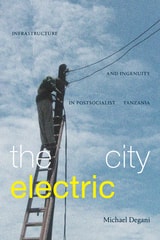
The City Electric
Infrastructure and Ingenuity in Postsocialist TanzaniaMichael Degani
Duke University Press, 2022
Over the last twenty years of neoliberal reform, the power supply in Dar es Salaam, Tanzania’s metropolis, has become less reliable even as its importance has increased. Though mobile phones, televisions, and refrigerators have flooded the city, the electricity required to run these devices is still supplied by the socialist-era energy company Tanesco, which is characterized by increased fees, aging infrastructure, and a sluggish bureaucracy. While some residents contemplate off-grid solutions, others repair, extend, or tap into the state network with the assistance of freelance electricians or moonlighting utility employees. In The City Electric Michael Degani explores how electricity and its piracy has become a key site for urban Tanzanians to enact, experience, and debate their social contract with the state. Moving from the politics of generation contracts down to the street-level experience of blackouts and disconnection patrols, he reveals the logics of infrastructural modification and their effects on everyday life. As politicians, residents, electricians, and utility inspectors all redistribute flows of payment and power, they reframe the energy grid both as a technical system and as an ongoing experiment in collective interdependence.
[more]
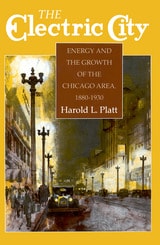
The Electric City
Energy and the Growth of the Chicago Area, 1880-1930Harold L. Platt
University of Chicago Press, 1991
No symbol of progress in our century is more galvanizing than electricity—electric power and the technology it has spawned. The "invisible world" of electric energy that was emerging at the turn of the century is one we take for granted, but its influence on the growth and quality of city life was, and remains, profound. Using Chicago as a test case, Harold L. Platt investigates the emergence of an urban-based, energy-intensive society over the course of half a century in this first book-length history of energy use in the city.
[more]