Results by title
7 books match the query 'Electrification'
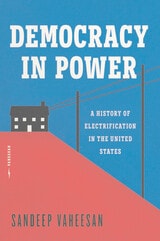
Democracy in Power
A History of Electrification in the United StatesSandeep Vaheesan
University of Chicago Press, 2024
Private money, public good, and the original fight for control of America’s energy industry.
Until the 1930s, financial interests dominated electrical power in the United States. That changed with President Franklin D. Roosevelt’s New Deal, which restructured the industry. The government expanded public ownership, famously through the Tennessee Valley Authority, and promoted a new kind of utility: the rural electric cooperative that brought light and power to millions in the countryside. Since then, public and cooperative utilities have persisted as an alternative to shareholder control. Democracy in Power traces the rise of publicly governed utilities in the twentieth-century electrification of America.
Sandeep Vaheesan shows that the path to accountability in America’s power sector was beset by bureaucratic challenges and fierce private resistance. Through a detailed and critical examination of this evolution, Vaheesan offers a blueprint for a publicly led and managed path to decarbonization. Democracy in Power is at once an essential history, a deeply relevant accounting of successes and failures, and a guide on how to avoid repeating past mistakes.
Democracy in Power
A History of Electrification in the United StatesSandeep Vaheesan
University of Chicago Press, 2024
This is an auto-narrated audiobook version of this book.
Private money, public good, and the original fight for control of America’s energy industry.
Until the 1930s, financial interests dominated electrical power in the United States. That changed with President Franklin D. Roosevelt’s New Deal which restructured the industry. The government expanded public ownership, famously through the Tennessee Valley Authority, and promoted a new kind of utility: the rural electric cooperative that brought light and power to millions in the countryside. Since then, public and cooperative utilities have persisted as an alternative to shareholder control. Democracy in Power traces the rise of publicly governed utilities in the twentieth-century electrification of America.
Sandeep Vaheesan shows that the path to accountability in America’s power sector was beset by bureaucratic challenges and fierce private resistance. Through a detailed and critical examination of this evolution, Vaheesan offers a blueprint for a publicly led and managed path to decarbonization. Democracy in Power is at once an essential history, a deeply relevant accounting of successes and failures, and a guide on how to avoid repeating past mistakes.

Electric Railways
1880-1990Michael C. Duffy
The Institution of Engineering and Technology, 2003
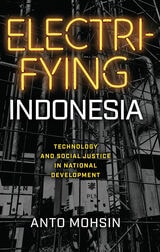
Electrifying Indonesia
Technology and Social Justice in National DevelopmentAnto Mohsin
University of Wisconsin Press, 2023
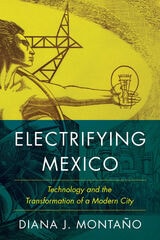
Electrifying Mexico
Technology and the Transformation of a Modern CityBy Diana J. Montaño
University of Texas Press, 2021
2022 Alfred B. Thomas Book Award, Southeastern Council of Latin American Studies (SECOLAS)
2022 Bolton-Johnson Prize, Conference on Latin American History (CLAH)
2022 Best Book in Non-North American Urban History, Urban History Association (Co-winner)
2023 Honorable Mention, Best Book in the Humanities, Latin American Studies Association Mexico Section
2023 Turriano Book Prize, International Committee for the History of Technology
2023 Michael C. Meyer Award for Best Book on Mexican History in a Five-Year Period, Rocky Mountain Council for Latin American Studies
Many visitors to Mexico City’s 1886 Electricity Exposition were amazed by their experience of the event, which included magnetic devices, electronic printers, and a banquet of light. It was both technological spectacle and political messaging, for speeches at the event lauded President Porfirio Díaz and bound such progress to his vision of a modern order.
Diana J. Montaño explores the role of electricity in Mexico’s economic and political evolution, as the coal-deficient country pioneered large-scale hydroelectricity and sought to face the world as a scientifically enlightened “empire of peace.” She is especially concerned with electrification at the social level. Ordinary electricity users were also agents and sites of change. Montaño documents inventions and adaptations that served local needs while fostering new ideas of time and space, body and self, the national and the foreign. Electricity also colored issues of gender, race, and class in ways specific to Mexico. Complicating historical discourses in which Latin Americans merely use technologies developed elsewhere, Electrifying Mexico emphasizes a particular national culture of scientific progress and its contributions to a uniquely Mexican modernist political subjectivity.
Technologies for the Electrification of Land and Sea Transportation
Muhyaddin J.H. Rawa
The Institution of Engineering and Technology, 2025
The Electric City
Energy and the Growth of the Chicago Area, 1880-1930Harold L. Platt
University of Chicago Press, 1991