Results by title
6 books match the query 'Electronic data processing'
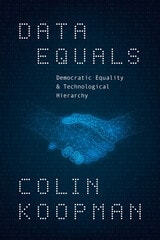
Data Equals
Democratic Equality and Technological HierarchyColin Koopman
University of Chicago Press, 2025
When we gave algorithms power over our world, we hoped that the apparent neutrality of machine thinking would create a more egalitarian age. Yet we are more divided than ever, staring down threats to democracy itself. In Data Equals, Colin Koopman argues that data technologies fail us so often because we built them around a deficient notion of equality.
It is not enough, Koopman explains, that algorithms engage everyone’s data with the same measuring stick. The data themselves are all too often structured in ways that obscure and exacerbate stratifying distinctions. Koopman contends that we must also work to ensure that those people subject to computational assessment enter data systems on equal terms. Part philosophical argument, part practical guide (replete with case studies from education technology), Data Equals offers novel methods for realizing democratic equality in a digital age.
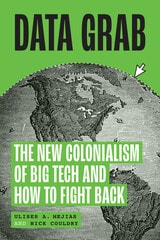
Data Grab
The New Colonialism of Big Tech and How to Fight BackUlises A. Mejias and Nick Couldry
University of Chicago Press, 2024
Large technology companies like Meta, Amazon, and Alphabet have unprecedented access to our daily lives, collecting information when we check our email, count our steps, shop online, and commute to and from work. Current events are concerning—both the changing owners (and names) of billion-dollar tech companies and regulatory concerns about artificial intelligence underscore the sweeping nature of Big Tech’s surveillance and the influence such companies hold over the people who use their apps and platforms.
As trusted tech experts Ulises A. Mejias and Nick Couldry show in this eye-opening and convincing book, this vast accumulation of data is not the accidental stockpile of a fast-growing industry. Just as nations stole territories for ill-gotten minerals and crops, wealth, and dominance, tech companies steal personal data important to our lives. It’s only within the framework of colonialism, Mejias and Couldry argue, that we can comprehend the full scope of this heist.
Like the land grabs of the past, today’s data grab converts our data into raw material for the generation of corporate profit against our own interests. Like historical colonialism, today’s tech corporations have engineered an extractive form of doing business that builds a new social and economic order, leads to job precarity, and degrades the environment. These methods deepen global inequality, consolidating corporate wealth in the Global North and engineering discriminatory algorithms. Promising convenience, connection, and scientific progress, tech companies enrich themselves by encouraging us to relinquish details about our personal interactions, our taste in movies or music, and even our health and medical records. Do we have any other choice?
Data Grab affirms that we do. To defy this new form of colonialism we will need to learn from previous forms of resistance and work together to imagine entirely new ones. Mejias and Couldry share the stories of voters, workers, activists, and marginalized communities who have successfully opposed unscrupulous tech practices. An incisive discussion of the digital media that’s transformed our world, Data Grab is a must-read for anyone concerned about privacy, self-determination, and justice in the internet age.
Data Privacy Protection and the Conduct of Applied Research
Methods, Approaches, and New FindingsEdited by V. Joseph Hotz, Ruobin Gong, and Ian M. Schmutte
University of Chicago Press, 2026
A necessary exploration into the mechanics of data privacy protections within empirical social science research.
The explosion of computational power and data availability has revolutionized empirical social science research, but it has also created unprecedented challenges for protecting the privacy of individuals and businesses. As computational tools make it increasingly possible to breach data anonymity in government surveys by combining the survey data with additional information from external sources, statistical agencies face mounting pressure to develop new privacy protection methods while maintaining data quality essential for research and policymaking. This volume explores how innovations in data privacy protection, including differential privacy and synthetic data methods, affect the conduct of empirical analysis in economics, computer science, and statistics. Contributors explore critical questions about the trade-offs between privacy and data usability: How do new protection methods impact statistical inference and parameter estimation? What standards should data providers adopt? The chapters examine frameworks for characterizing privacy protection, disclosure limitation challenges for survey data, methodological innovations for privacy-preserving statistical analysis, regulatory considerations in modern data governance, and strategies for balancing confidentiality with research access.
This volume provides researchers, statistical agencies, and policymakers with essential guidance for navigating the complex landscape where data protection meets scientific inquiry.

Digital Energetics
Anne Pasek
University of Minnesota Press, 2023
Exploring the connections between energy and media—and what those connections mean for our current moment
Energy and media are the entangled middles of social life—and also of each other. This volume traces the contours of both a media analytic of energy and an energy analytic of media across the cultural, environmental, and economic relations they undergird. Digital Energetics argues that media and energy require joint theorization—not only in their potential to universalize but also in the many contingent and intermeshed relations that they bind together across contemporary informational and fossil regimes. Focusing specifically on digital operations, the coauthors analyze how data and energy have jointly modulated the character of the materiality and labor of digital systems in a warming world.
Anne Pasek provides a brief energy history of the bit, tracing how the electrification and digitization of American computing propelled a turn toward efficiency as both a solution and instigator of parallel crises in the workforce and the climate. Zane Griffin Talley Cooper traces these concerns within cryptographic proof-of-work systems and the heat they necessarily produce and seek to manage. Following heat through the twinned histories of thermodynamics and information theory, he argues that such systems are best approached as a paradigmatic, rather than exceptional, example of computing infrastructures. Cindy Kaiying Lin focuses on the practical and political frictions created as database and management designs move from the Global North to South, illustrating how the energy constraints and software cultures of Indonesia open new spaces of autonomy within environmental governance. Finally, Jordan B. Kinder offers a theorization of “platform energetics,” demonstrating how public energy discourses and settler land claims are entangled in the digital infrastructures of data colonialism in Canada.

The Tbilisi Symposium on Logic, Language and Computation
Selected PapersEdited by Jonathan Ginzburg, Zurab Khasidashvili, Carl Vogel, Jean-Jacques Lévy,
CSLI, 1998
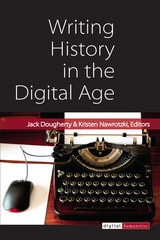
Writing History in the Digital Age
Jack Dougherty and Kristen Nawrotzki, editors
University of Michigan Press, 2013
Writing History in the Digital Age began as a “what-if” experiment by posing a question: How have Internet technologies influenced how historians think, teach, author, and publish? To illustrate their answer, the contributors agreed to share the stages of their book-in-progress as it was constructed on the public web.
To facilitate this innovative volume, editors Jack Dougherty and Kristen Nawrotzki designed a born-digital, open-access, and open peer review process to capture commentary from appointed experts and general readers. A customized WordPress plug-in allowed audiences to add page- and paragraph-level comments to the manuscript, transforming it into a socially networked text. The initial six-week proposal phase generated over 250 comments, and the subsequent eight-week public review of full drafts drew 942 additional comments from readers across different parts of the globe.
The finished product now presents 20 essays from a wide array of notable scholars, each examining (and then breaking apart and reexamining) if and how digital and emergent technologies have changed the historical profession.