Results by title
72 books match the query 'Elementary' and 2 start with a
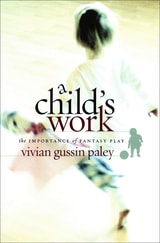
A Child's Work
The Importance of Fantasy PlayVivian Gussin Paley
University of Chicago Press, 2004
The buzz word in education today is accountability. But the federal mandate of "no child left behind" has come to mean curriculums driven by preparation for standardized tests and quantifiable learning results. Even for very young children, unstructured creative time in the classroom is waning as teachers and administrators are under growing pressures to measure school readiness through rote learning and increased homework. In her new book, Vivian Gussin Paley decries this rapid disappearance of creative time and makes the case for the critical role of fantasy play in the psychological, intellectual, and social development of young children.
A Child's Work goes inside classrooms around the globe to explore the stunningly original language of children in their role-playing and storytelling. Drawing from their own words, Paley examines how this natural mode of learning allows children to construct meaning in their worlds, meaning that carries through into their adult lives. Proof that play is the work of children, this compelling and enchanting book will inspire and instruct teachers and parents as well as point to a fundamental misdirection in today's educational programs and strategies.
A Child's Work goes inside classrooms around the globe to explore the stunningly original language of children in their role-playing and storytelling. Drawing from their own words, Paley examines how this natural mode of learning allows children to construct meaning in their worlds, meaning that carries through into their adult lives. Proof that play is the work of children, this compelling and enchanting book will inspire and instruct teachers and parents as well as point to a fundamental misdirection in today's educational programs and strategies.
[more]
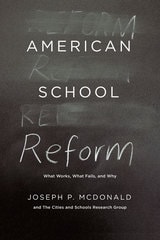
American School Reform
What Works, What Fails, and WhyJoseph P. McDonald and the Cities and Schools Research Group
University of Chicago Press, 2014
Dissecting twenty years of educational politics in our nation’s largest cities, American School Reform offers one of the clearest assessments of school reform as it has played out in our recent history. Joseph P. McDonald and his colleagues evaluate the half-billion-dollar Annenberg Challenge—launched in 1994—alongside other large-scale reform efforts that have taken place in New York, Chicago, Philadelphia, and the San Francisco Bay Area. They look deeply at what school reform really is, how it works, how it fails, and what differences it can make nonetheless.
McDonald and his colleagues lay out several interrelated ideas in what they call a theory of action space. Frequently education policy gets so ambitious that implementing it becomes a near impossibility. Action space, however, is what takes shape when talented educators, leaders, and reformers guide the social capital of civic leaders and the financial capital of governments, foundations, corporations, and other backers toward true results. Exploring these extraordinary collaborations through their lifespans and their influences on future efforts, the authors provide political hope—that reform efforts can work, and that our schools can be made better.
McDonald and his colleagues lay out several interrelated ideas in what they call a theory of action space. Frequently education policy gets so ambitious that implementing it becomes a near impossibility. Action space, however, is what takes shape when talented educators, leaders, and reformers guide the social capital of civic leaders and the financial capital of governments, foundations, corporations, and other backers toward true results. Exploring these extraordinary collaborations through their lifespans and their influences on future efforts, the authors provide political hope—that reform efforts can work, and that our schools can be made better.
[more]