Results by title
7 books match the query 'Elephants'
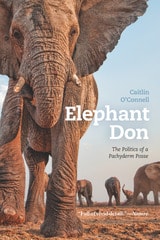
Elephant Don
The Politics of a Pachyderm PosseCaitlin O'Connell
University of Chicago Press, 2015
In Elephant Don, O’Connell, one of the leading experts on elephant communication and social behavior, offers a rare inside look at the social world of African male elephants. Elephant Don tracks Greg and his group of bulls as O’Connell tries to understand the vicissitudes of male friendship, power struggles, and play. A frequently heart-wrenching portrayal of commitment, loyalty, and affection between individuals yearning for companionship, it vividly captures an incredible repertoire of elephant behavior and communication. Greg, O’Connell shows, is sometimes a tyrant and other times a benevolent dictator as he attempts to hold onto his position at the top. Though Elephant Don is Greg’s story, it is also the story of O’Connell and the challenges and triumphs of field research in environs more hospitable to lions and snakes than scientists.
Readers will be drawn into dramatic tales of an elephant society at once exotic and surprisingly familiar, as O’Connell’s decades of close research reveal extraordinary discoveries about a male society not wholly unlike our own. Surely we’ve all known a Greg or two, and through this book we may come to know them in a whole new light.
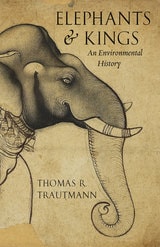
Elephants and Kings
An Environmental HistoryThomas R. Trautmann
University of Chicago Press, 2015
Trautmann traces the history of the war elephant in India and the spread of the institution to the west—where elephants took part in some of the greatest wars of antiquity—and Southeast Asia (but not China, significantly), a history that spans 3,000 years and a considerable part of the globe, from Spain to Java. He shows that because elephants eat such massive quantities of food, it was uneconomic to raise them from birth. Rather, in a unique form of domestication, Indian kings captured wild adults and trained them, one by one, through millennia. Kings were thus compelled to protect wild elephants from hunters and elephant forests from being cut down. By taking a wide-angle view of human-elephant relations, Trautmann throws into relief the structure of India’s environmental history and the reasons for the persistence of wild elephants in its forests.
Plantation Worlds
Maan Barua
Duke University Press, 2024
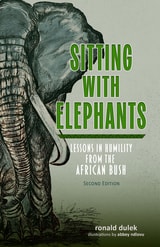
Sitting with Elephants
Lessons in Humility from the African Bush, Enhanced and Expanded Second EditionRonald Dulek, Illustrations by Abbey Ndlovu
University of Alabama Press, 2026
A professor of communication and strategy reveals deep lessons from life in the African bush.
Sitting with Elephants is a heartfelt memoir that follows a middle-aged American professor and his wife as they trade suburban life for a remote bush house in South Africa. What begins as a spontaneous decision becomes a life-changing experience—one shaped by lions at the backdoor, baboons in the rafters, and above all, a herd of elephants who frequent their yard like neighbors.
Told through a series of emails to their adult children and brought to life by vivid illustrations from Abbey Ndlovu, Ronald Dulek’s narrative explores the profound lessons nature teaches: patience, humility, and deep respect for the wild. As the couple learns to communicate with elephants and navigate the rhythms of bush life, they also reflect on the unexpected beauty of slowing down and embracing the unknown.
Blending lighthearted anecdotes with moments of quiet insight, Sitting with Elephants invites readers into a story of transformation—both personal and environmental. This second edition includes expanded content with new stories and reflections, offering a deeper look into the couple’s unforgettable time in the African bush.
The Memory of Elephants
A NovelBoman Desai
University of Chicago Press, 2001
The Story of Babar
Jean de Brunhoff was a French artist and illustrator who wrote seven books in the Babar the Elephant series. His work had a major influence on the development of the picture book.
Bodleian Library Publishing, 2016
The Thieves of Summer
Linda Sillitoe
Signature Books, 2014
Prin-cess Al-ice in Liberty Park
Munch-es ba-nan-as ’til way after dark.
Princess Alice is an elephant the children of Utah purchased by donating nickels and dimes to a circus. The girls don’t know this, but her handler takes the mammoth princess out on late-night strolls around the park when the moon is out. What they do know is that the elephant sometimes escapes and goes on a rampage, crashing through front-yard fences and collecting collars of clothesline laundry around her neck, a persistent train of barking dogs following behind. The girls’ father is a police officer who is investigating a boy’s disappearance. As the case unfolds, the perception of the park, with its eighty acres of trees and grass, will change from the epitome of freedom to a place to be avoided, even as Princess Alice moves to a secure confinement at a new zoo at the mouth of Emigration Canyon. The story is loosely based on the exploits of a real live elephant that lived in Liberty Park a decade before Sillitoe’s childhood in the neighborhood.