Results by title

9 books match the query 'Eliot, T. S. (Thomas Stearns)'
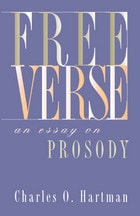
cover of Free Verse: An Essay on Prosody

Free Verse

An Essay on Prosody

Charles O. Hartman

Northwestern University Press, 1996
To make sense of "free verse" in theory of in practice, the study of prosody—the function of rhythm in poetry—must be revised and rethought. In Free Verse: An Essay on Prosody, Charles Hartman develops a theory of prosody that includes the most characteristic form of twentieth-century poetry.
[more]
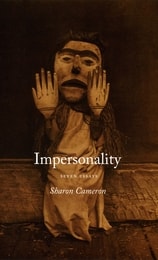
cover of Impersonality: Seven Essays

Impersonality

Seven Essays

Sharon Cameron

University of Chicago Press, 2007
Philosophers have long debated the subjects of person and personhood. Sharon Cameron ushers this debate into the literary realm by considering impersonality in the works of major American writers and figures of international modernism—writers for whom personal identity is inconsequential and even imaginary. In essays on William Empson, Jonathan Edwards, Ralph Waldo Emerson, Herman Melville, T. S. Eliot, and Simone Weil, Cameron examines the impulse to hollow out the core of human distinctiveness, to construct a voice that is no one’s voice, to fashion a character without meaningful attributes, a being that is virtually anonymous.

“To consent to being anonymous,” Weil wrote, “is to bear witness to the truth. But how is this compatible with social life and its labels?” Throughout these essays Cameron examines the friction, even violence, set in motion from such incompatibility—from a “truth” that has no social foundation. Impersonality investigates the uncompromising nature of writing that suspends, eclipses, and even destroys the person as a social, political, or individual entity, of writing that engages with personal identity at the moment when its usual markers vanish or dissolve.

[more]
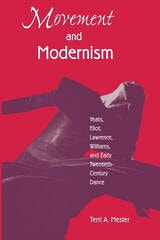
cover of Movement and Modernism: Yeats, Eliot, Williams, and Early Twentieth-Century Dance

Movement and Modernism

Yeats, Eliot, Williams, and Early Twentieth-Century Dance

Terri A. Mester

University of Arkansas Press, 1997

In this critical study, Terri Mester makes solid biographic, thematic, technical, and figurative cases that W. B. Yeats, T. S. Eliot, D. H. Lawrence, and William Carlos Williams turned to dance and dancers—actual and mythic—to reinvigorate their literary practices.
[more]
cover of On The Modernist Long Poem

On The Modernist Long Poem

Margaret Dickie

University of Iowa Press, 1986

Beyond Lionel Trilling's classic definition of Modernism as anticultural and subversive, Margaret Dickie posits American Modernist poetry as both conservative and affirmative—conservative because it was dominated by the composition of the long poem, affirmative because these poems aimed to restore public themes to poetry, to instruct and improve, to "affirm the gold thread in the pattern," as Ezra Pound claimed.

Each poet discussed in this new study—T. S. Eliot, Hart Crane, William Carlos Williams, and Ezra Pound—began his career as an experimenter in brief lyrics and then, paradoxically, developed an ambition to write a long public poem. The poems they wrote—The Waste Land, The Bridge, Paterson, and The Cantos—differed in length, in program, and in composition, but all were alike in their idealization of form, their commitment to the long poem, and the troubled and difficult process of their composition. Read together, they offer a new understanding of the Modernist sense of form shared by these quite different writers.

Tracing the development of each poem from the poet's initial announced plans through the lengthy writing and reconsideration of purpose, Dickie offers a new history not only of each poem but of the American Modernists and the ways they adapted the avant-garde tendencies of European Modernism to their own native needs.
[more]
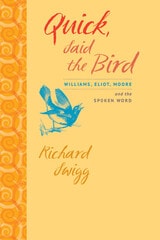
cover of Quick, Said the Bird: Williams, Eliot, Moore, and the Spoken Word

Quick, Said the Bird

Williams, Eliot, Moore, and the Spoken Word

Richard Swigg

University of Iowa Press, 2012
When William Carlos Williams said, “It’s all in / the sound,” when T. S. Eliot hailed the invigorating force of the “auditory imagination,” or when Marianne Moore applauded “the clatter and true sound” of Williams’s verse, each poet invoked the dimension that bound them together. In Quick, Said the Bird, Richard Swigg makes the case for acoustics as the basis of the linkages, kinships, and inter-illuminations of a major twentieth-century literary relationship. Outsiders in their home terrain who nevertheless continued to reach back to their own American vocal identities, Williams, Eliot, and Moore embody a unique lineage that can be traced from their first significant works (1909–1918) to the 1960s.
 
In reconstructing the auditory dimension in the work of the three poets, Quick, Said the Bird does not neglect the visual text. Whether in the form of Moore’s quirky patternings, Eliot’s expandable verse-frames, or Williams’s springy stanzas, the printed shape on the page is here brought together with the spoken word in vital interplay: the eye-read text cut against by sequential utterance in a restoration of the poetry’s full effect. By seeing and hearing the verse at the same moment—together with reading side-by-side discussions of the quarrels, friendships, mutual borrowings, and shared energies of Williams, Eliot, and Moore—the reader gains a remarkable new understanding of their individual achievements.By sound and sight, Quick, Said the Bird takes the reader straight into the physical textures of the finest works by three outstanding figures of twentieth-century American poetry.
[more]
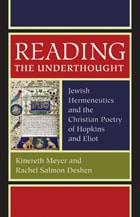
cover of Reading the Underthought: Jewish Hermeneutics and the Christian Poetry of Hopkins and Eliot

Reading the Underthought

Jewish Hermeneutics and the Christian Poetry of Hopkins and Eliot

Kinereth Meyer

Catholic University of America Press, 2010
Reading the Underthought explores the question of how readers from one tradition can approach the poetry of another
[more]
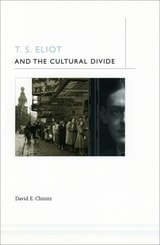
cover of T. S. Eliot and the Cultural Divide

T. S. Eliot and the Cultural Divide

David E. Chinitz

University of Chicago Press, 2003

The modernist poet T. S. Eliot has been applauded and denounced for decades as a staunch champion of high art and an implacable opponent of popular culture. But Eliot's elitism was never what it seemed. T. S. Eliot and the Cultural Divide refurbishes this great writer for the twenty-first century, presenting him as the complex figure he was, an artist attentive not only to literature but to detective fiction, vaudeville theater, jazz, and the songs of Tin Pan Alley.

David Chinitz argues that Eliot was productively engaged with popular culture in some form at every stage of his career, and that his response to it, as expressed in his poetry, plays, and essays, was ambivalent rather than hostile. He shows that American jazz, for example, was a major influence on Eliot's poetry during its maturation. He discusses Eliot's surprisingly persistent interest in popular culture both in such famous works as The Waste Land and in such lesser-known pieces as Sweeney Agonistes. And he traces Eliot's long, quixotic struggle to close the widening gap between high art and popular culture through a new type of public art: contemporary popular verse drama.

What results is a work that will persuade adherents and detractors alike to return to Eliot and find in him a writer who liked a good show, a good thriller, and a good tune, as well as a "great" poem.
[more]
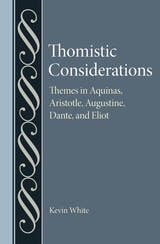
cover of Thomistic Considerations: Themes in Aquinas, Aristotle, Augustine, Dante and Eliot

Thomistic Considerations

Themes in Aquinas, Aristotle, Augustine, Dante and Eliot

Kevin White

Catholic University of America Press, 2026
This collection of essays considers a variety of themes in philosophy, theology, and poetry, three ways of thinking that share a certain openness and comprehensiveness. The essays show how philosophy, theology, and poetry are ways of thinking in the medium of words—in large part in the medium of written words—against the background of all things and from the point of view of all of human life. As the essays make clear, philosophy, theology, and poetry are special ways of thinking and speaking, but they are the contrary of specializations. Many of the themes are perennial preoccupations in philosophy: being, time, number, friendship, pleasure, purpose, choice, reason, and order. Others are particular concerns of theology and poetry, such as the divine presence and absence in the world, and poetic form. The volume is divided into two parts: a first part consisting of eight essays on themes in Aquinas’s work, and a second part consisting of five essays on other authors whose thought, in one way or another, has an affinity with the thought of Aquinas: Aristotle, Augustine, Anselm, Dante, T. S. Eliot, and Robert Sokolowski. The volume’s title pays homage to Aquinas’s use of the Latin word consideratio, a favorite term of the scholastics that could refer to any careful attending to what one knows. The essays illustrate ways in which considerations undertaken in philosophy, theology, and poetry provide points of survey from which to take in, to the extent we can, the great panorama of the whole of things.
[more]
cover of Victorian and Modern Poetics

Victorian and Modern Poetics

Carol T. Christ

University of Chicago Press, 1984

[more]