Results by title
6 books match the query 'Ellington, Duke'
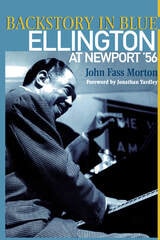
Backstory in Blue
Ellington at Newport '56John Fass Morton
Rutgers University Press, 2008
Certificate of Merit for the 2009 Association for Recorded Sound Collections Award for Excellence in Historical Recorded Sound Research
It may be that the song most baby boomers identify from July 1956 is a simple twelve-bar blues, hyped on national television by a twenty-one-year-old Elvis Presley and his handlers. But it is a very different song, with its elongated fourteen-bar choruses of rhythm and dissonance, played on the night of July 7, 1956, by a fifty-seven-year-old Duke Ellington and his big band that got everybody on their feet and moving as one. More than fifty years later, “Diminuendo and Crescendo in Blue,” recorded at the 1956 Newport Jazz Festival, still makes a profound statement about postwar America—how we got there and where it all went.
Backstory in Blue is a behind-the-scenes look at this epic moment in American cultural history. It is the story of who and what made Ellington’s composition so compelling and how one piece of music reflected the feelings and shaped the sensibilities of the postwar generation. As John Fass Morton explains, it was music expressed as much by those who performed offstage as by those who performed on.
Written from the point of view of the audience, this unique account draws on interviews with fans and music professionals of all kinds who were there and whose lives were touched, and in some cases changed, by the experience. Included are profiles of George Avakian, who recorded and produced Ellington at Newport 1956; Paul Gonsalves, the tenor sax player responsible for the legendary twenty-seven choruses that enabled the rebirth of Ellington’s career; and the “Bedford Blonde,” Elaine Anderson, whose dance ignited both the band and the crowd.
Duke Ellington once remarked, “I was born at Newport.” Here we learn that Newport was much more than the turning point for Ellington’s career. It was the tipping point for a generation and a musical genre.
Blutopia
Visions of the Future and Revisions of the Past in the Work of Sun Ra, Duke Ellington, and Anthony BraxtonGraham Lock
Duke University Press, 2000
A century after Ellington’s birth, Lock reassesses his use of music as a form of black history and compares the different approaches of Ra, a band leader who focused on the future and cosmology, and Braxton, a contemporary composer whose work creates its own elaborate mythology. Arguing that the majority of writing on black music and musicians has—even if inadvertently—incorporated racial stereotypes, he explains how each artist reacted to criticism and sought to break free of categorical confines. Drawing on social history, musicology, biography, cultural theory, and, most of all, statements by the musicians themselves, Lock writes of their influential work.
Blutopia will be a welcome contribution to the literature on twentieth-century African American music and creativity. It will interest students of jazz, American music, African American studies, American culture, and cultural studies.
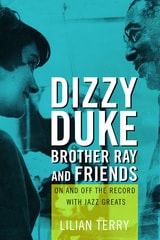
Dizzy, Duke, Brother Ray, and Friends
On and Off the Record with Jazz GreatsLillian Terry
University of Illinois Press, 2017
Drawing on Terry’s long friendships and professional associations, Dizzy, Duke, Brother Ray, and Friends offers readers a rare opportunity to hear intimate conversations with some of the world’s greatest musical figures. Dizzy Gillespie offers his thoughts on playing with “sanctified” rhythm and the all-important personal touch in performance. Duke Ellington discourses on jazz history and concludes an interview to sing a self-written ditty in Italian. Ray Charles gives candid thoughts on race and politics while taking charge of Terry’s tape recorder. Abbey Lincoln, Max Roach, Horace Silver, Bill Evans—all provide Terry and her readers with unforgettable encounters. The result is a collection of profiles, some stretching over a decade or more, that reveal these performers in ways that illuminate their humanity and expand our appreciation of their art.
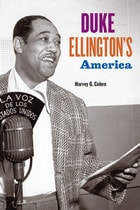
Duke Ellington's America
Harvey G. Cohen
University of Chicago Press, 2010
Few American artists in any medium have enjoyed the international and lasting cultural impact of Duke Ellington. From jazz standards such as “Mood Indigo” and “Don’t Get Around Much Anymore,” to his longer, more orchestral suites, to his leadership of the stellar big band he toured and performed with for decades after most big bands folded, Ellington represented a singular, pathbreaking force in music over the course of a half-century. At the same time, as one of the most prominent black public figures in history, Ellington demonstrated leadership on questions of civil rights, equality, and America’s role in the world.
With Duke Ellington’s America, Harvey G. Cohen paints a vivid picture of Ellington’s life and times, taking him from his youth in the black middle class enclave of Washington, D.C., to the heights of worldwide acclaim. Mining extensive archives, many never before available, plus new interviews with Ellington’s friends, family, band members, and business associates, Cohen illuminates his constantly evolving approach to composition, performance, and the music business—as well as issues of race, equality and religion. Ellington’s own voice, meanwhile, animates the book throughout, giving Duke Ellington’s America an intimacy and immediacy unmatched by any previous account.
By far the most thorough and nuanced portrait yet of this towering figure, Duke Ellington’s America highlights Ellington’s importance as a figure in American history as well as in American music.
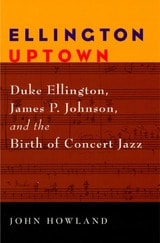
Ellington Uptown
Duke Ellington, James P. Johnson, and the Birth of Concert JazzJohn Howland
University of Michigan Press, 2009
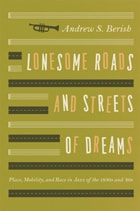
Lonesome Roads and Streets of Dreams
Place, Mobility, and Race in Jazz of the 1930s and '40sAndrew S. Berish
University of Chicago Press, 2012