Results by title
4 books match the query 'Embodied'
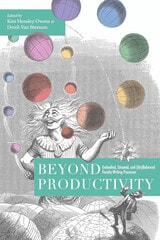
Beyond Productivity
Embodied, Situated, and (Un)Balanced Faculty Writing ProcessesKim Hensley Owens
Utah State University Press, 2023
This collection positions scholarly writers' ways of writing as a form of flexible, evolving knowledge. By exhibiting what is lost and gained through successive rounds of transformation and adaptation over time, the contributors offer a sustainable understanding and practice of process—one that looks beyond productivity as the primary measure of success. Each presents a fluid understanding of the writing process, illustrating its deeply personal nature and revealing how fragmented and disjointed methods and experiences can highlight what is precious about writing.
Beyond Productivity determines anew the use and value of scholarly writing and the processes that produce it, both within and beyond the context of the losses, constraints, and adaptations associated with the COVID-19 pandemic.
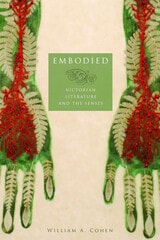
Embodied
Victorian Literature and the SensesWilliam A. Cohen
University of Minnesota Press, 2008
Making sense of the body in Victorian literature
What does it mean to be human? British writers in the Victorian period found a surprising answer to this question. What is human, they discovered, is nothing more or less than the human body itself. In literature of the period, as well as in scientific writing and journalism, the notion of an interior human essence came to be identified with the material existence of the body. The organs of sensory perception were understood as crucial routes of exchange between the interior and the external worlds.
Anatomizing Victorian ideas of the human, William A. Cohen considers the meaning of sensory encounters in works by writers including Charles Dickens, Charlotte Brontë, Anthony Trollope, Thomas Hardy, and Gerard Manley Hopkins. Rather than regarding the bodily exterior as the primary location in which identity categories—such as gender, sexuality, race, and disability—are expressed, he focuses on the interior experience of sensation, whereby these politics come to be felt. In these elegant engagements with literary works, cultural history, and critical theory, Cohen advances a phenomenological approach to embodiment, proposing that we encounter the world not through our minds or souls but through our senses.
Grotowski's Bridge Made of Memory
Embodied Memory, Witnessing and Transmission in the Grotowski WorkDominika Laster
Seagull Books, 2016
Considered one of the most influential theatre practitioners of the 20th century, Polish director Jerzy Grotowski revolutionized contemporary theatre in multiple ways. Perhaps best known for his notion of ‘poor theatre,’ Grotowski went beyond the confines of conventional theatre to systematically explore the possibilities of the human being in a performative context. In Grotowski’s Bridge Made of Memory, Dominika Laster analyzes core aspects of Grotowski’s work such as body-memory, vigilance, witnessing, verticality, and transmission, arguing that these performance praxes involve a deliberate blurring of the boundaries of the self and other.
This comprehensive study traces key thematic threads across Grotowski’s research, examining lesser-known aspects of his work such as performance compositions structured around African and Afro-Caribbean traditional songs and ritual movement as well as textual material from the Christian Gnostic tradition. As an active process of research and questioning conducted through the “body-being” of the performer, Grotowski’s work represents a practical realization of the often highly theoretical and abstract discussions of one of the field’s main preoccupations: embodied practice as a way of knowing.
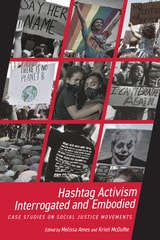
Hashtag Activism Interrogated and Embodied
Case Studies on Social Justice Movementsedited by Melissa Ames & Kristi McDuffie
Utah State University Press, 2022
The chapters capture twenty-first-century digital activism unfolding in different social and geopolitical climates. Delving into hashtag activism in various forms (tweets, memes, and personal narratives) and spaces (Twitter, Facebook, and in-person protests), these chapters reveal how participants question and construct online and offline identities and imagined and actualized communities. They also showcase the complicated ways hashtag activism intersects with consumer, popular, and celebrity cultures.
Hashtag Activism Interrogated and Embodied calls for broader inclusion in what is considered hashtag activism, such as digital fandom, how hashtags are co-opted for nefarious purposes, the effects of anti-activism, and the role of journalism and the media. It will appeal to a range of disciplines including rhetoric and composition, internet studies, communication studies, media studies, feminist studies, affect studies, cultural studies, technical communication, and sociology.
Contributors: Robert Barry, André Brock, Elizabeth Buchanan, Rosemary Clark-Parsons, Gabriel I. Green, Neha Gupta, Jeffrey J. Hall, Kyesha Jennings, Morgan K. Johnson, Salma Kalim, Megan McIntyre, Sean Milligan, Avishek Ray, Sarah Riddick, Stephanie Vie, Erin B. Waggoner, Holly M. Wells, William I. Wolff