Results by title
2 books match the query 'Emerging infectious diseases'
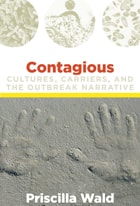
Contagious
Cultures, Carriers, and the Outbreak NarrativePriscilla Wald
Duke University Press, 2008
Wald traces how changing ideas about disease emergence and social interaction coalesced in the outbreak narrative. She returns to the early years of microbiology—to the identification of microbes and “Typhoid Mary,” the first known healthy human carrier of typhoid in the United States—to highlight the intertwined production of sociological theories of group formation (“social contagion”) and medical theories of bacteriological infection at the turn of the twentieth century. Following the evolution of these ideas, Wald shows how they were affected by—or reflected in—the advent of virology, Cold War ideas about “alien” infiltration, science-fiction stories of brainwashing and body snatchers, and the HIV/AIDS pandemic. Contagious is a cautionary tale about how the stories we tell circumscribe our thinking about global health and human interactions as the world imagines—or refuses to imagine—the next Great Plague.
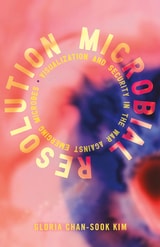
Microbial Resolution
Visualization and Security in the War against Emerging MicrobesGloria Chan-Sook Kim
University of Minnesota Press, 2024
An interdisciplinary study charting the war against microbial futures leads to a new theory of contemporary vision and visuality
In 1989, a group of U.S. government scientists met to discuss some surprising findings: new diseases were appearing around the world, and viruses that they thought long vanquished were resurfacing. Their appearance heralded a future perpetually threatened by unforeseeable biological risks, sparking a new concept of disease: the “emerging microbe.” With the Cold War nearing its end, American scientists and security experts turned to confront this new “enemy,” redirecting national security against its risky horizons. In order to be fought, emerging microbes first needed to be made perceptible; but how could something immaterial, unknowable, and ever mutating be coaxed into visibility, knowability, and operability?
Microbial Resolution charts the U.S.-led war on the emerging microbe to show how their uncertain futures were transformed into objects of global science and security. Moving beyond familiar accounts that link scientific knowledge production to optical practices of visualizing the invisible, Gloria Chan-Sook Kim develops a theory of “microbial resolution” to analyze the complex problematic that arises when dealing with these entities: what can be seen when there is nothing to see? Through a syncretic analysis of data mining, animal-tracking technologies, media networks, computer-modeled futures, and global ecologies and infrastructures, she shows how a visual impasse—the impossibility of seeing microbial futures—forms the basis for new modes of perceiving, knowing, and governing in the present.
Timely and thought provoking, Microbial Resolution opens up the rich paradoxes, irreconcilabilities, and failures inherent in this project and demonstrates how these tensions profoundly animate twenty-first-century epistemologies, aesthetics, affects, and ecologies.