Results by title
6 books match the query 'Emigration'
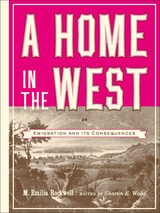
A Home in the West
Or, Emigration and Its ConsequencesRockwell, M. Emilia
University of Iowa Press, 2005
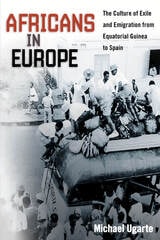
Africans in Europe
The Culture of Exile and Emigration from Equatorial Guinea to SpainMichael Ugarte
University of Illinois Press, 2013
Based on personal stories of people forced to leave and those who left of their own accord, Africans in Europe captures the nuanced realities and widespread impact of mobile populations. By focusing on the geographical, emotional, and intellectual dynamics of Equatorial Guinea's human movements, readers gain an inroad to "the consciousness of an age" and an understanding of the global realities that will define the cultural, economic, and political currents of the twenty-first century.
Domesticity, Imperialism, and Emigration in the Victorian Novel
Diana C. Archibald
University of Missouri Press, 2002

Exporting Japan
Politics of Emigration to Latin AmericaToake Endoh
University of Illinois Press, 2008
Exporting Japan examines the domestic origins of the Japanese government's policies to promote the emigration of approximately three hundred thousand native Japanese citizens to Latin America between the 1890s and the 1960s. This imperialist policy, spanning two world wars and encompassing both the pre-World War II authoritarian government and the postwar conservative regime, reveals strategic efforts by the Japanese state to control its populace while building an expansive nation beyond its territorial borders.
Toake Endoh compellingly argues that Japan's emigration policy embodied the state's anxieties over domestic political stability and its intention to remove marginalized and radicalized social groups by relocating them abroad. Documenting the disproportionate focus of the southwest region of Japan as a source of emigrants, Endoh considers the state's motivations in formulating emigration policies that selected certain elements of the Japanese population for "export." She also recounts the situations migrants encountered once they reached Latin America, where they were often met with distrust and violence in the "yellow scare" of the pre-World War II period.
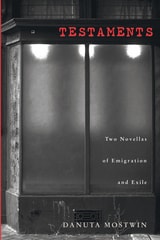
Testaments
Two Novellas of Emigration and ExileDanuta Mostwin
Ohio University Press, 2005
Translated from Polish by Marta Erdman and Nina Dyke.
Polish émigrés have written poignantly about the pain of exile in letters, diaries, and essays; others, more recently, have recreated Polish-American communities in works of fiction. But it is Danuta Mostwin’s fiction, until now unavailable in English translation, that bridges the divide between Poland and America, exile and emigration.
Mostwin and her husband survived the ravages of World War II, traveled to Britain, and then emigrated to the United States. Mostwin devoted her scholarly career to the study of immigrants trapped between cultural worlds. Winner of international awards for her fiction, Danuta Mostwin here offers two novellas, translated by the late Marta Erdman, which are the first of her works published in English in the United States.
Deeply melancholic and moving in its unsentimental depiction of ordinary people trying to make sense of their uprooted lives, Testaments presents two powerful vignettes of life in immigrant America, The Last Will of Blaise Twardowski and Jocasta. This timely publication provides an introduction to Mostwin’s work that will ensure that she is recognized as the creator of one of the most nuanced and deeply moving pictures of emigration and exile in Polish-American literature.
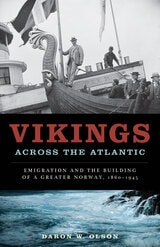
Vikings across the Atlantic
Emigration and the Building of a Greater Norway, 1860-1945Daron W. Olson
University of Minnesota Press, 2013
Around the year 1000 a Viking ship landed on the Atlantic coast of what would one day be North America. Nearly a millennium later, on June 7, 1945, Norway’s King Haakon VII returned from exile under guard of the American Ninety-ninth—or “Viking”—Battalion. In Vikings across the Atlantic, Daron W. Olson reveals how these two moments form narrative poles for the vision of a Greater Norway that expanded the boundaries of the Norwegian nation.
Looking at matters of religion, literature, media, and ethnicity, Olson explores how Norwegian Americans’ myths about themselves changed over time in relation to a broader Anglo-American culture, while at the same time influencing and being influenced by the burgeoning national culture of their homeland. Beginning in the 1920s, homeland Norwegian identity-makers framed the concept of the Greater Norway, which viewed the Norwegian nation as having two halves: Norwegians who resided in the homeland and those who had emigrated from Norway, especially those in America. Far from being merely symbolic, this idea, Olson shows, was actually tested by the ordeal of World War II, when Norwegians the world over demonstrated their willingness to sacrifice and even die for the Greater Norway.
In its transnational approach, Olson’s book brings a new perspective to immigrant studies and theories of nationalism; Vikings across the Atlantic depicts the nation as a larger community in which membership is constructed or imagined, a status of belonging defined not by physical proximity but through qualities such as culture and shared traditions.