Results by title
9 books match the query 'Emotions (Philosophy)'

Aquinas on Emotion's Participation in Reason
Nicholas Kahm
Catholic University of America Press, 2019

Moral Emotions
Reclaiming the Evidence of the HeartAnthony J. Steinbock
Northwestern University Press, 2014
Moral Emotions builds upon the philosophical theory of persons begun in Phenomenology and Mysticism and marks a new stage of phenomenology. Author Anthony J. Steinbock finds personhood analyzing key emotions, called moral emotions. Moral Emotions offers a systematic account of the moral emotions, described here as pride, shame, and guilt as emotions of self-givenness; repentance, hope, and despair as emotions of possibility; and trusting, loving, and humility as emotions of otherness.
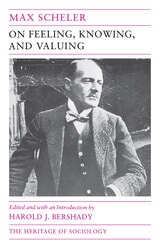
On Feeling, Knowing, and Valuing
Selected WritingsMax Scheler
University of Chicago Press, 1992
1928) ranks with Max Weber, Edmund Husserl, and Ernst
Troeltsch as being among the most brilliant minds of his
generation. Yet Scheler is now known chiefly for his
philosophy of religion, despite his groundbreaking work in
the sociology of knowledge, the sociology of emotions, and
phenomenological sociology. This volume comprises some of
Scheler's most interesting work—including an analysis of the
role of sentiments in social interaction, a sociology of
knowledge rooted in global social and cultural comparisons,
and a cross-cultural theory of values—and identifies some of
his important contributions to the discussion of issues at
the forefront of the social sciences today.
Editor Harold J. Bershady provides a richly detailed
biographical portrait of Scheler, as well as an incisive
analysis of how his work extends and integrates problems of
theory and method addressed by Durkheim, Weber, and Parsons,
among others.
Harold J. Bershady, professor of sociology at the University
of Pennsylvania, is the author of Ideology and Social
Knowledge and the editor of Social Class and
Democratic Leadership.
Heritage of Sociology series

Stoicism and Emotion
Margaret Graver
University of Chicago Press, 2007
In this elegant and clearly written work, Margaret Graver gives a compelling new interpretation of the Stoic position. Drawing on a vast range of ancient sources, she argues that the chief demand of Stoic ethics is not that we should suppress or deny our feelings, but that we should perfect the rational mind at the core of every human being. Like all our judgments, the Stoics believed, our affective responses can be either true or false and right or wrong, and we must assume responsibility for them. Without glossing over the difficulties, Graver also shows how the Stoics dealt with those questions that seem to present problems for their theory: the physiological basis of affective responses, the phenomenon of being carried away by one’s emotions, the occurrence of involuntary feelings and the disordered behaviors of mental illness. Ultimately revealing the deeper motivations of Stoic philosophy, Stoicism and Emotion uncovers the sources of its broad appeal in the ancient world and illuminates its surprising relevance to our own.

The Secret History of Emotion
From Aristotle's Rhetoric to Modern Brain ScienceDaniel M. Gross
University of Chicago Press, 2006
Through a radical rereading of Aristotle, Seneca, Thomas Hobbes, Sarah Fielding, and Judith Butler, among others, Daniel M. Gross reveals a persistent intellectual current that considers emotions as psychosocial phenomena. In Gross’s historical analysis of emotion, Aristotle and Hobbes’s rhetoric show that our passions do not stem from some inherent, universal nature of men and women, but rather are conditioned by power relations and social hierarchies. He follows up with consideration of how political passions are distributed to some people but not to others using the Roman Stoics as a guide. Hume and contemporary theorists like Judith Butler, meanwhile, explain to us how psyches are shaped by power. To supplement his argument, Gross also provides a history and critique of the dominant modern view of emotions, expressed in Darwinism and neurobiology, in which they are considered organic, personal feelings independent of social circumstances.
The result is a convincing work that rescues the study of the passions from science and returns it to the humanities and the art of rhetoric.

Tropes of Transport
Hegel and EmotionKatrin Pahl
Northwestern University Press, 2012
Intervening in the multidisciplinary debate on emotion, Tropes of Transport offers a fresh analysis of Hegel’s work that becomes an important resource for Pahl’s cutting-edge theory of emotionality. If it is usually assumed that the sincerity of emotions and the force of affects depend on their immediacy, Pahl explores to what extent mediation—and therefore a certain degree of manipulation but also of sympathy—is constitutive of emotionality. Hegel serves as a particularly helpful interlocutor not only because he offers a sophisticated analysis of mediation, but also because, rather than locating emotion in the heart, he introduces impersonal tropes of transport, such as trembling, release, and shattering.
Turning Emotion Inside Out
Affective Life beyond the SubjectEdward S. Casey
Northwestern University Press, 2022
This book begins with a brief critique of internalist views of emotion that hold that feelings are sequestered within a subject. Casey affirms that while certain emotions are felt as resonating within our subjectivity, many others are experienced as occurring outside any such subjectivity. These include intentional or expressive feelings that transpire between ourselves and others, such as an angry exchange between two people, as well as emotions or affects that come to us from beyond ourselves. Casey claims that such far‑out emotions must be recognized in a full picture of affective life. In this way, the book proposes to “turn emotion inside out.”
Uncomfortable Situations
Emotion between Science and the HumanitiesDaniel M. Gross
University of Chicago Press, 2017
Science and the humanities typically offer two different paradigms for thinking about emotion—the first rooted in brain and biology, the second in a social world. With rhetoric as a field guide, Uncomfortable Situations establishes common ground between these two paradigms, focusing on a theory of situated emotion. Daniel M. Gross anchors the argument in Charles Darwin, whose work on emotion has been misunderstood across the disciplines as it has been shoehorned into the perceived science-humanities divide. Then Gross turns to sentimental literature as the single best domain for studying emotional situations. There’s lost composure (Sterne), bearing up (Equiano), environmental hostility (Radcliffe), and feeling mixed (Austen). Rounding out the book, an epilogue written with ecological neuroscientist Stephanie Preston provides a different kind of cross-disciplinary collaboration. Uncomfortable Situations is a conciliatory work across science and the humanities—a groundbreaking model for future studies.

Wild Experiment
Feeling Science and Secularism after DarwinDonovan O. Schaefer
Duke University Press, 2022