Results by title
5 books match the query 'Empire, 30 B.C.-476 A.D'
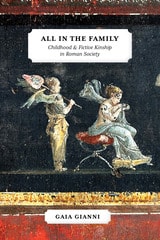
All in the Family
Childhood and Fictive Kinship in Roman SocietyGaia Gianni
University of Michigan Press, 2025
Gaia Gianni’s All in the Family explores how children shaped the development of pseudo-familial bonds, or fictive kinship, in Roman society during the early imperial period. Previous scholarship on the Roman family has primarily emphasized the patriarchal and nuclear structure of the Roman family, with children often represented as passive actors in a vacuum. Believing this to be an oversimplification of how the Roman family functioned, Gianni in her study focuses on the ways in which Roman families raised children and formed long-term relationships with individuals outside of the nuclear family, such as friends, neighbors, nurses, and caretakers, who gradually became full-fledged members of the family unit. Through a wide variety of literary works, legal documents, and funerary epitaphs for children set up by their families and caregivers, Gianni borrows from modern sociological and anthropological theories to argue that children acted as catalysts or connecting nodes in the creation of fictive kinship with individuals who were not part of the biologically determined family. In addition to illuminating the roles and experiences of these figures, All in the Family reveals how this social network was integrated into the family both in practice and in ideology, presenting a more complex view of the Roman family than the traditional nuclear structure.
[more]
Life, Death, and Entertainment in the Roman Empire
D. S. Potter and D. J. Mattingly, Editors
University of Michigan Press, 1999
Life, Death, and Entertainment gives those who have a general interest in Roman antiquity a starting point informed by the latest developments in scholarship for understanding the extraordinary range of Roman society. Family structure, gender identity, food supply, religion, and entertainment are all crucial to an understanding of the Roman world. As views of Roman history have broadened in recent decades to encompass a wider range of topics, the need has grown for a single volume that can offer a starting point for these diverse subjects, for readers of all backgrounds.
This collection fills such a need by uniting a series of general introductions on each of these topics for the non-specialist. Each essay brings readers into contact with broadly ranging evidence, as well as with a wide variety of approaches that are needed to study basic questions about the Roman world.
Essays explore the Roman family, gender definition, demography, Roman food supply, Roman religion, and the wide variety of public entertainments throughout the empire. The volume brings together an unparalleled range of methodologies and topics. It will enable the modern reader to understand the Roman world in all its complexity. The general reader will welcome this approachable and timely text.
Contributors to the volume include Greg Aldrete, Hazel Dodge, Bruce W. Frier, Maud Gleason, Ann Hanson, David Mattingly, and David Potter.
D. S. Potter is Arthur F. Thurnau Professor of Greek and Latin, University of Michigan.
D. J. Mattingly is Professor of Roman Archaeology, University of Leicester.
[more]
Roman Coins and Public Life under the Empire
E. Togo Salmon Papers IIGeorge M. Paul and Michael Ierardi, Editors
University of Michigan Press, 1999
Roman coins often shed light on Roman public life and society through the legends, portraits, and images they bear. The papers collected in this volume were originally presented at the Second E. Togo Salmon Conference on Roman Studies. The eight contributors are specialists in Roman coins or Roman history and in the relations between them.
Coins are a unique source of information about the Roman world. In the case of the Roman Empire they were issued by or with the approval of the ruling power. The representations and legends they show therefore present an official view of contemporary affairs. The coins themselves, minted for official purposes such as paying the army, when studied carefully can help reconstruct official policies. They can also occasionally reveal what monuments now lost may have looked like.
It is not infrequent to come across pleas that the ancient historian should make more frequent use of numismatic evidence. These essays make clear that efforts are being made both by numismatists and by historians to bring the two disciplines together. At the same time the papers reveal that the task is by no means a straightforward one. The survival of Roman coins is variable, and so attempts to reconstruct the size and distribution of issues calls for skilled and experienced analysis. This collection of papers provides evidence for the kind of deductions that the historian may make from Roman coins as well as the illustrations of the pitfalls that await the unwary.
Those interested in Roman history, amateur coin collectors, and professional numismatists will all find much here to widen their knowledge of the public context of Roman coins.
George Paul is Professor of Classics, McMaster University. Michael Ierardi is Lecturer in Classics, McMaster University.
[more]
Soldiers, Cities, and Civilians in Roman Syria
Nigel Pollard
University of Michigan Press, 2000
When one mentions "empire," one place probably comes to mind: Rome. The Romans conquered an empire that covered almost the complete extent of their known world. With a territory that large, there was, of course, a huge cultural diversity between the different corners of the empire. How could the central authority in Rome bring together all the different cultures, religions and customs under one administrative umbrella? Soldiers, Cities and Civilians in Roman Syria explores some of the interactions between the imperial authority and the subjected peoples in the territory of Syria. It looks at how the imperial power controlled its subjects, how the agents of the imperial power (administrators, soldiers, etc.) interacted with those subjects, and what impact the imperial power had on the culture of ruled territories. The Roman empire had few civilian administrators, so soldiers were the representatives of imperial government to be encountered by many provincial civilians. Soldiers, Cities and Civilians in Roman Syria employs the evidence of Roman texts and documents and modern archaeological excavation as well as "alternative" sources, such as the literature of the subject peoples and informal texts such as graffiti, to examine the relationship between soldiers and civilians in the important frontier province of Syria.
Nigel Pollard is currently a Research Assistant at the Institute of Archaeology, University of Oxford.
Nigel Pollard is currently a Research Assistant at the Institute of Archaeology, University of Oxford.
[more]
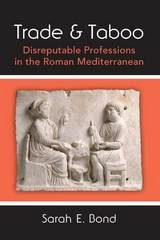
Trade and Taboo
Disreputable Professions in the Roman MediterraneanSarah E. Bond
University of Michigan Press, 2016
Trade and Taboo addresses the legal, literary, social, and institutional creation of disrepute in ancient Roman society. Tracking the shifting application of stigmas of disrepute between the Republic and Late Antiquity, it follows particular groups of professionals—funeral workers, criers, tanners, mint workers, and even bakers—asking how they coped with stigmatization.
In this book, Sarah E. Bond reveals the construction and motivations for these attitudes, and to show how they created inequalities, informed institutions, and changed over time. Additionally, she shows how political and cultural shifts mutated these taboos, reshaping economic markets and altering the status of professionals at work within these markets.
Bond investigates legal stigmas in the form of infamia and other marks of legal disrepute. She expands on anthropological theories of pollution, closely studying individuals who regularly came into contact with corpses and other polluting materials, and considering communication and network formation through the disrepute attached to town criers, or praecones. Ideas of disgust and the language of invective are brought forward looking at tanners. The book closes with an exploration of caste-like systems created in the later Roman Empire. Collectively, these professionals are eloquent about economies and changes experienced within Roman society between 45 BCE and 565 CE.
Trade and Taboo will interest those studying Roman society, issues of historiographical method, and the topic of taboo in preindustrial cultures.
[more]