Results by title
2 books match the query 'Empirical Analysis'
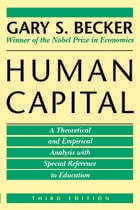
Human Capital
A Theoretical and Empirical Analysis, with Special Reference to Education, 3rd EditionGary S. Becker
University of Chicago Press, 1993
WINNER OF THE NOBEL PRIZE!
Human Capital is Gary ecker's classic study of how investment in an individual's education and training is similar to business investments in equipment. Recipient of the 1992 Nobel Prize in Economic Science, Gary S. Becker is a pioneer of applying economic analysis to human behavior in such areas as discrimination, marriage, family relations, and education. Becker's research on human capital was considered by the Nobel committee to be his most noteworthy contribution to economics.
This expanded edition includes four new chapters, covering recent ideas about human capital, fertility and economic growth, the division of labor, economic considerations within the family, and inequality in earnings.
This expanded edition includes four new chapters, covering recent ideas about human capital, fertility and economic growth, the division of labor, economic considerations within the family, and inequality in earnings.
[more]
Trade Policy Issues and Empirical Analysis
Edited by Robert E. Baldwin
University of Chicago Press, 1988
Interest in U.S. trade policy has been stimulated in recent years by the massive American trade deficit, by the belief that intervention by foreign governments in international markets has given other countries a competitive edge over the United States, and by concern about the increase in protectionism among industrial countries. In turn, major analytical developments in international economics have revolutionized trade theory, broadening its scope both by introducing in a more formal manner such concepts as imperfect competition, increasing returns, product differentiation, and learning effects and by including the study of political and economic factors that shape trade policy decisions. This collection of papers—the result of a conference held by the NBER—applies these "new" trade theories to existing world cases and also presents complementary empirical studies that are grounded in more traditional trade theories.
The volume is divided into four parts. The papers in part 1 consider the problem of imperfect competition, empirically assessing the economic effect of various trade policies introduced in industries in which the "new" trade theory seems to apply. Those in part 2 isolate the effects of protection from the influences of the many economic changes that accompany actual periods of protection and also examine how the effects from exogenous changes in economic conditions vary with the form of protection. Part 3 provides new empirical evidence on the effect of foreign production by a country's firms on the home country's exports. Finally, in part 4, two key bilateral issues are analyzed: recent U.S.-Japanese trade tensions and the incident involving the threat of the imposition of countervailing duties by the United States on Canadian softwood lumber.
The volume is divided into four parts. The papers in part 1 consider the problem of imperfect competition, empirically assessing the economic effect of various trade policies introduced in industries in which the "new" trade theory seems to apply. Those in part 2 isolate the effects of protection from the influences of the many economic changes that accompany actual periods of protection and also examine how the effects from exogenous changes in economic conditions vary with the form of protection. Part 3 provides new empirical evidence on the effect of foreign production by a country's firms on the home country's exports. Finally, in part 4, two key bilateral issues are analyzed: recent U.S.-Japanese trade tensions and the incident involving the threat of the imposition of countervailing duties by the United States on Canadian softwood lumber.
[more]