Results by title
3 books match the query 'Employee fringe benefits'
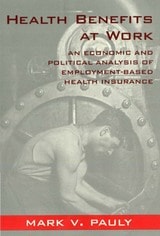
Health Benefits at Work
An Economic and Political Analysis of Employment-Based Health InsuranceMark V. Pauly
University of Michigan Press, 1999
The majority of Americans receive their health insurance for themselves and their families through their job. The employee pays a portion of the premium but the employer chooses the type and amount of coverage offered as well as administers the plan. This book addresses the question: Who really pays for employer-arranged health insurance? Are premiums paid from company profits or do employees bear the cost through lower wages? Pauly suggests that this confusion has complicated the debate on public policy and needs to be alleviated. This work first shows how views taken by business and political leaders during the Clinton health reform proposal debate were affected by this confusion and did not follow the economic view. It then provides a novel, intuitive, but comprehensive outline of the economic theory that bears on this question. Empirical evidence consistent with the economic view is summarized, and the implications of the view for some important issues in health policy and in practical health benefits management are discussed in detail. Health Benefits at Work explores the political economy of health policy when the stakeholders have an uncertain and possibly incorrect understanding of their actual interests. For the benefits specialist, it provides an accessible treatment of the complex and often counterintuitive economics of health benefits. This will appeal to the health policy community as well as economists and anyone concerned with issues surrounding health insurance in employment settings. "This book is refreshing . . . clean and intuitive; the logic devastating." --Michael A. Morrissey
[more]
Labor Markets and Firm Benefit Policies in Japan and the United States
Edited by Seiritsu Ogura, Toshiaki Tachibanaki, and David A. Wise
University of Chicago Press, 2003
This volume, the fourth to result from a remarkably productive collaboration between the National Bureau of Economic Research and the Japan Center for Economic Research, presents a selection of thirteen high-caliber papers addressing issues in the employment practices, labor markets, and health, benefit, and pension policies of the United States and Japan.
After an opening chapter assessing the recent ascendance of the U.S. economy, papers diverge to tackle a range of specific issues. Focusing less on international comparison than on the assembly of high-quality research, contributors hone in on a variety of individual topics. Chapters delve into issues of youth employment, participatory employment, information sharing, fringe benefits, and drug coverage in Japan, as well as the dynamics of medical savings accounts, private insurance coverage, and benefit options in the U.S.
Like previous volumes stemming from NBER/JCER collaboration, this book represents a valuable mass of empirical data on some of the most notable employment and benefits issues in each nation, information that will both anchor and provoke scholarly analysis of these topics well into the future.
[more]
The Measurement of Labor Cost
Edited by Jack E. Triplett
University of Chicago Press, 1983
Measuring costs of labor as a portion of total production costs has never before been treated so thoroughly or so thoughtfully. Moreover, contrary to most recent labor research, this book focuses on the demand side—the employer's point of view—and the behavior studied is employer behavior.
An introductory essay by the editor provides a useful guide to current thought in the analysis of labor cost. Other papers give new insights into problems encountered in accounting for the nonwage elements of labor compensation, the effect of pensions and other benefits, and the wage-measurement questions raised by incomes policies. In addition, there is a wealth of valuable new data on labor costs in the United States.
Labor economists, statisticians, econometric modelers, and advisers to government and industry will welcome this up-to-date and comprehensive treatment of the costs of production.
[more]