Results by title
3 books match the query 'Emptiness'
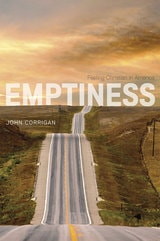
Emptiness
Feeling Christian in AmericaJohn Corrigan
University of Chicago Press, 2015
For many Christians in America, becoming filled with Christ first requires being empty of themselves—a quality often overlooked in religious histories. In Emptiness, John Corrigan highlights for the first time the various ways that American Christianity has systematically promoted the cultivation of this feeling.
Corrigan examines different kinds of emptiness essential to American Christianity, such as the emptiness of deep longing, the emptying of the body through fasting or weeping, the emptiness of the wilderness, and the emptiness of historical time itself. He argues, furthermore, that emptiness is closely connected to the ways Christian groups differentiate themselves: many groups foster a sense of belonging not through affirmation, but rather avowal of what they and their doctrines are not. Through emptiness, American Christians are able to assert their identities as members of a religious community.
Drawing much-needed attention to a crucial aspect of American Christianity, Emptiness expands our understanding of historical and contemporary Christian practices.
[more]
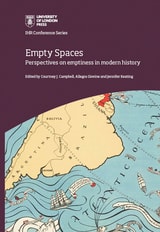
Empty Spaces
perspectives on emptiness in modern historyEdited by Courtney J. Campbell, Allegra Giovine, and Jennifer Keating
University of London Press, 2019
How is emptiness made and what historical purpose does it serve? What cultural, material and natural work goes into maintaining ‘nothingness’? Why have a variety of historical actors, from colonial powers to artists and urban dwellers, sought to construct, control and maintain (physically and discursively) empty space, and by which processes is emptiness discovered, visualised and reimagined? This volume draws together contributions from authors working on landscapes and rurality, along with national and imperial narratives, from Brazil to Russia and Ireland. It considers the visual, including the art of Edward Hopper and the work of the British Empire Marketing Board, while concluding with a section that examines constructions of emptiness in relation to capitalism, development and the (re)appropriation of urban space. In doing so, it foregrounds the importance of emptiness as a productive prism through which to interrogate a variety of imperial, national, cultural and urban history.
[more]
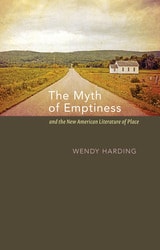
The Myth of Emptiness and the New American Literature of Place
Wendy Harding
University of Iowa Press, 2014
From the moment the first English-speaking explorers and settlers arrived on the North American continent, many have described its various locations and environments as empty. Indeed, much of American national history and culture is bound up with the idea that parts of the landscape are empty and thus open for colonization, settlement, economic improvement, claim staking, taming, civilizing, cultivating, and the exploitation of resources. In turn, most Euro-American nonfiction written about the landscape has treated it either as an object to be acted upon by the author or an empty space, unspoiled by human contamination, to which the solitary individual goes to be refreshed and rejuvenated.
In The Myth of Emptiness and the New American Literature of Place, Wendy Harding identifies an important recent development in the literature of place that corrects the misperceptions resulting from these tropes. Works by Rick Bass, Charles Bowden, Ellen Meloy, Jonathan Raban, Rebecca Solnit, and Robert Sullivan move away from the tradition of nature writing, with its emphasis on the solitary individual communing with nature in uninhabited places, to recognize the interactions of human and other-than-human presences in the land. In different ways, all six writers reveal a more historically complex relationship between Americans and their environments. In this new literature of place, writers revisit abandoned, threatened, or damaged sites that were once represented as devoid of human presence and dig deeper to reveal that they are in fact full of the signs of human activity. These writers are interested in the role of social, political, and cultural relationships and the traces they leave on the landscape.
Throughout her exploration, Harding adopts a transdisciplinary perspective that draws on the theories of geographers, historians, sociologists, and philosophers to understand the reasons for the enduring perception of emptiness in the American landscape and how this new literature of place works with and against these ideas. She reminds us that by understanding and integrating human impacts into accounts of the landscape, we are better equipped to fully reckon with the natural and cultural crisis that engulfs all landscapes today.
[more]