Results by title

3 books match the query 'End World'

cover of Prepared: The Environmental Politics of the End of the World

Prepared

The Environmental Politics of the End of the World

Allison Ford

University of Chicago Press, 0

Shares deep insights into the world of “prepping” and reveals how prepping functions as an environmental practice expressed through right-wing ideology. 

Sensationalized in TV shows like Doomsday Preppers, ordinary people who prepare for the end of the world are a subject of fascination. While beginners might keep a few days’ worth of food and water on hand in case of a weather emergency, others truly push themselves to acquire the materials, skills, and knowledge they would need to survive complete societal collapse. Though we might think of them as on the fringe, some estimate that there are as many as 20 million preppers worldwide.

Sociologist Allison Ford’s Prepared: The Environmental Politics of the End of the World shares a behind-the-scenes look at preppers. Ford’s ethnography finds that prepping is a response to environmental risk that originates in right-wing political ideology. Instead of turning to collective action to find a solution, however, preppers approach emergency preparedness as an individual responsibility. Preparedness reasserts and confirms preppers’ self-identification as people who protect their families and maintain self-control, without depending upon others. She argues that preppers adopt the strategies that they do because they are culturally attached to their worldviews, specifically their commitments to liberalism and its unspoken gendered, racial, and class hierarchies, which are being challenged by the failures of modernity that preppers observe. Ultimately, Prepared gives critical insight into how people who do not necessarily identify as environmentalists respond to and deal with environmental risk. 
[more]
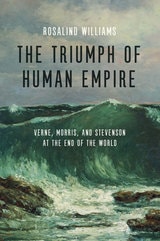
cover of The Triumph of Human Empire: Verne, Morris, and Stevenson at the End of the World

The Triumph of Human Empire

Verne, Morris, and Stevenson at the End of the World

Rosalind Williams

University of Chicago Press, 2013
In the early 1600s, in a haunting tale titled New Atlantis, Sir Francis Bacon imagined the discovery of an uncharted island. This island was home to the descendants of the lost realm of Atlantis, who had organized themselves to seek “the knowledge of Causes, and secret motions of things; and the enlarging of the bounds of Human Empire, to the effecting of all things possible.” Bacon’s make-believe island was not an empire in the usual sense, marked by territorial control; instead, it was the center of a vast general expansion of human knowledge and power.  
           
Rosalind Williams uses Bacon’s island as a jumping-off point to explore the overarching historical event of our time: the rise and triumph of human empire, the apotheosis of the modern ambition to increase knowledge and power in order to achieve world domination. Confronting an intensely humanized world was a singular event of consciousness, which Williams explores through the lives and works of three writers of the late nineteenth century: Jules Verne, William Morris, and Robert Louis Stevenson. As the century drew to a close, these writers were unhappy with the direction in which their world seemed to be headed and worried that organized humanity would use knowledge and power for unworthy ends. In response, Williams shows, each engaged in a lifelong quest to make a home in the midst of human empire, to transcend it, and most of all to understand it. They accomplished this first by taking to the water: in life and in art, the transition from land to water offered them release from the condition of human domination. At the same time, each writer transformed his world by exploring the literary boundary between realism and romance. Williams shows how Verne, Morris, and Stevenson experimented with romance and fantasy and how these traditions allowed them to express their growing awareness of the need for a new relationship between humans and Earth.
           
The Triumph of Human Empire shows that for these writers and their readers romance was an exceptionally powerful way of grappling with the political, technical, and environmental situations of modernity. As environmental consciousness rises in our time, along with evidence that our seeming control over nature is pathological and unpredictable, Williams’s history is one that speaks very much to the present.
[more]
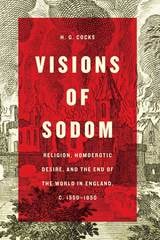
cover of Visions of Sodom: Religion, Homoerotic Desire, and the End of the World in England, c. 1550-1850

Visions of Sodom

Religion, Homoerotic Desire, and the End of the World in England, c. 1550-1850

H. G. Cocks

University of Chicago Press, 2017

The book of Genesis records the fiery fate of Sodom and Gomorrah—a storm of fire and brimstone was sent from heaven and, for the wickedness of the people, God destroyed the cities “and all the plains, and all the inhabitants of the cities, and that which grew upon the ground.” According to many Protestant theologians and commentators, one of the Sodomites’ many crimes was homoerotic excess.

In Visions of Sodom, H. G. Cocks examines the many different ways in which the story of Sodom’s destruction provided a template for understanding homoerotic desire and behaviour in Britain between the Reformation and the nineteenth century. Sodom was not only a marker of sexual sins, but also the epitome of false—usually Catholic—religion, an exemplar of the iniquitous city, a foreshadowing of the world’s fiery end, an epitome of divine and earthly punishment, and an actual place that could be searched for and discovered. Visions of Sodom investigates each of these ways of reading Sodom’s annihilation in the three hundred years after the Reformation. The centrality of scripture to Protestant faith meant that Sodom’s demise provided a powerful origin myth of homoerotic desire and sexual excess, one that persisted across centuries, and retains an apocalyptic echo in the religious fundamentalism of our own time.
[more]