Results by title
5 books match the query 'End of the world'
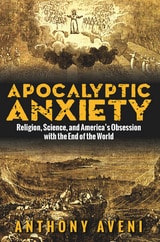
Apocalyptic Anxiety
Religion, Science, and America's Obsession with the End of the WorldAnthony Aveni
University Press of Colorado, 2016
The book begins with the Millerites, the nineteenth-century religious sect of Pastor William Miller, who used biblical calculations to predict October 22, 1844 as the date for the Second Advent of Christ. Aveni also examines several other religious and philosophical movements that have centered on apocalyptic themes—Christian millennialism, the New Age movement and the Age of Aquarius, and various other nineteenth- and early twentieth-century religious sects, concluding with a focus on the Maya mystery of 2012 and the contemporary prophets who connected the end of the world as we know it with the overturning of the Maya calendar.
Apocalyptic Anxiety places these seemingly never-ending stories of the world’s end in the context of American history. This fascinating exploration of the deep historical and cultural roots of America’s voracious appetite for apocalypse will appeal to students of American history and the histories of religion and science, as well as lay readers interested in American culture and doomsday prophecies.
Children of Ezekiel
Aliens, UFOs, the Crisis of Race, and the Advent of End TimeMichael Lieb
Duke University Press, 1998
Beginning with the merkabah chariot literature of Hebrew and Gnostic mysticism, Lieb shows how religiously inspired people concerned with annihilating their heretical enemies seized on Ezekiel’s vision as revealing the technologically superior instrument of God’s righteous anger. He describes how many who seek to know the unknowable that is the power of God conceive it in technological terms—and how that power is associated with political aims and a heralding of the end of time. For Milton, Ezekiel’s chariot becomes the vehicle in which the Son of God does battle with the rebellious angels. In the modern age, it may take the form of a locomotive, tank, airplane, missile, or UFO. Technology itself is seen as a divine gift and an embodiment of God in the temporal world. As Lieb demonstrates, the impetus to produce modern technology arises not merely from the desire for profit or military might but also from religious-spiritual motives.
Including discussions of conservative evangelical Christian movements, Reagan’s ballistic shooting gallery in the sky, and the Nation of Islam’s vision of the “mother plane” as the vehicle of retribution in the war against racial oppression, Children of Ezekiel will enthrall readers who have been captivated, either through religious belief or intellectual interests, by a common thread uniting millennial religious beliefs, racial conflict, and political and militaristic aspirations.
Politics and Apocalypse
Robert Hamerton-Kelly
Michigan State University Press, 2007
Apocalypse. To most, the word signifies destruction, death, the end of the world, but the literal definition is "revelation" or "unveiling," the basis from which renowned theologian René Girard builds his own view of Biblical apocalypse. Properly understood, Girard explains, Biblical apocalypse has nothing to do with a wrathful or vengeful God punishing his unworthy children, and everything to do with a foretelling of what future humans are making for themselves now that they have devised the instruments of global self-destruction. In this volume, some of the major thinkers about the interpretation of politics and religion— including Eric Voegelin, Leo Strauss, and Carl Schmitt— are scrutinized by some of today's most qualified scholars, all of whom are thoroughly versed in Girard’s groundbreaking work.
Including an important new essay by Girard, this volume enters into a philosophical debate that challenges the bona fides of philosophy itself by examining three supremely important philosopher of the twentieth century. It asks how we might think about politics now that the attacks of 9/11 have shifted our intellectual foundations and what the outbreak of rabid religion might signify for international politics.
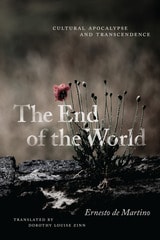
The End of the World
Cultural Apocalypse and TranscendenceErnesto de Martino
University of Chicago Press, 2023
A philosopher, historian of religions, and anthropologist, Ernesto de Martino (1908–1965) produced a body of work that prefigured many ideas and concerns that would later come to animate anthropology. In his writing, we can see the roots of ethnopsychiatry and medical anthropology, discussions of reflexivity and the role of the ethnographer, considerations of social inequality and hegemony from a Gramscian perspective, and an anticipation of the discipline’s “existential turn.” We also find an attentiveness to hope and possibility, despite the gloomy title of his posthumously published book La fine del mondo, or The End of the World. Examining apocalypse as an individual as well as a cultural phenomenon, treating subjects both classic and contemporary and both European and non-Western, ranging across ethnography, history, literature, psychiatry, and philosophy, de Martino probes how we relate to our world and how we might be better subjects and thinkers within it. This new translation offers English-language readers their first chance to engage with de Martino’s masterwork, which continues to appear prescient in the face of the frictions of globalization and environmental devastation.
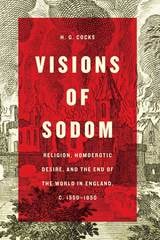
Visions of Sodom
Religion, Homoerotic Desire, and the End of the World in England, c. 1550-1850H. G. Cocks
University of Chicago Press, 2017
In Visions of Sodom, H. G. Cocks examines the many different ways in which the story of Sodom’s destruction provided a template for understanding homoerotic desire and behaviour in Britain between the Reformation and the nineteenth century. Sodom was not only a marker of sexual sins, but also the epitome of false—usually Catholic—religion, an exemplar of the iniquitous city, a foreshadowing of the world’s fiery end, an epitome of divine and earthly punishment, and an actual place that could be searched for and discovered. Visions of Sodom investigates each of these ways of reading Sodom’s annihilation in the three hundred years after the Reformation. The centrality of scripture to Protestant faith meant that Sodom’s demise provided a powerful origin myth of homoerotic desire and sexual excess, one that persisted across centuries, and retains an apocalyptic echo in the religious fundamentalism of our own time.