Results by title
3 books match the query 'Endangered'
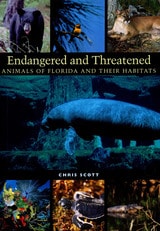
Endangered and Threatened Animals of Florida and Their Habitats
By Chris Scott
University of Texas Press, 2004
A biological crossroads where temperate gives way to tropical and east blends into west, Florida has over twenty-five primary habitat types, several of which are unique to the state. Within these richly varied natural communities lives an astonishing abundance of animals and plants, making Florida one of the United States' most biologically diverse regions. At the same time, sadly, Florida is also one of the country's most ecologically imperiled regions, second only to California in the number of its animals and plants that have been federally designated as endangered or threatened.
This fully illustrated book is a comprehensive, yet convenient and easy-to-understand guide to Florida's endangered and threatened animals and the habitats that support them. Chris Scott covers all 71 species, subspecies, or populations of mammals, birds, reptiles, fish, crustaceans, insects, corals, and mollusks. His species accounts describe each animal's listed status, identifying characteristics, historical and current distribution, biology, current threats, and conservation efforts. To make the crucial link between animals and their habitats, Scott also includes extensive discussions of Florida's natural regions; human impacts on the environment, including habitat destruction, pollution, and the introduction of invasive, nonnative species; and ongoing efforts to conserve and restore native plant and animal communities. With this wealth of information available in no other single volume, everyone who cares about the natural environment can help preserve one of America's biological treasurehouses.

Endangered and Threatened Wildlife of New Jersey
Edited by Bruce E. Beans and Larry Niles
Rutgers University Press, 2003
Every corner of New Jersey harbors natural wildlife of such value that it attracts birders and other naturalists from around the world. From the barrier beaches and coastal marshes at the ocean’s edge, through the flood plain forests and pine barrens, across the fertile rolling hills of the piedmont, to the highlands, ridges, and valleys of northwestern New Jersey, the state is a cornucopia of wildlife. With over 500 species calling the state home, New Jersey ranks as one of the most diverse wildlife habitats in the country. The state’s importance doesn’t end at the borders¾ New Jersey provides critical food and shelter to hundreds of species that use the state as a stop along their migratory route. Yet, in the nation’s most densely populated state, the loss of habitat continues at a relentless pace. The race is on to save natural areas and the species dependent upon them for survival.
Endangered and Threatened Wildlife of New Jersey is a richly illustrated color guide to the state’s fifty-four most imperiled species, from bobcats to bobolinks, shortnosed sturgeons to loggerhead turtles, frosted elfins to triangle floaters, blue whales to American burying beetles. Here, the authors detail each animal’s natural history, reasons for its decline, what’s been done so far¾and what must be done¾to keep New Jersey’s wildlife flourishing.
Written primarily by the people who know these species best, the biologists of the New Jersey’s Endangered and Nongame Species program, the book is divided into seven sections¾ mammals, birds, reptiles, amphibians, fish, insects, and bivalves. A chapter on individual species details animal identification, distribution, habitat, diet, life cycle, status and conservation, and limiting factors and threats, as well as recommendations for preservation. The authors also explore the particular characteristics of the species within New Jersey, including the species’ distribution, population status, and breeding and migration behaviors. Sixty-three detailed maps and more than one hundred spectacular color photos provide readers with a rare glimpse of these seldom-seen species.
Wildlife serves as a harbinger for our own environment: If the air, water, and earth aren’t healthy for animals, they surely can’t be healthy for humans. Endangered and Threatened Wildlife of New Jersey¾ an extraordinary resource and educational tool for anyone interested in preserving the state’s natural heritage¾provides a valuable wake-up call for us all.

The Edible and the Endangered
Animals, Empire, ExtinctionJohn Levi Barnard
Duke University Press, 2027