122 books match the query 'English poetry' and 7 start with a
cover of A History of Free Verse

A History of Free Verse

Chris Beyers

University of Arkansas Press, 2001
This book examines the most salient and misunderstood aspect of twentieth-century poetry, free verse. Although the form is generally approached as if it were one indissoluble lump, it is actually a group of differing poetic genres proceeding from much different assumptions. Separate chapters on T.S. Eliot, Wallace Stevens, H.D., and William Carlos Williams elucidate many of these assumptions and procedures, while other chapters address more general theoretical questions and trace the continuity of Modern poetics in contemporary poetry. Taking a historical and aesthetic approach, this study demonstrates that many of the forms considered to have been invented in the Modern period actually extend underappreciated traditions. Not only does this book examine the classical influence on Modern poetry, it also features discussions of the poetics of John Milton, Abraham Cowley, Matthew Arnold, and a host of lesser-known poets. Throughout it is an investigation of the prosodic issues that free verse foregrounds, particularly those focusing on the reader's part in interpreting poetic rhythm.
[more]
cover of A Poetry Criticism Reader

A Poetry Criticism Reader

Jerry Harp

University of Iowa Press, 2006
A timely and informative collection, A Poetry Criticism Reader brings together eleven essays and reviews that constitute some of the best and most illuminating poetry criticism from the past decade.In his introduction to the book, editor-poet Jerry Harp gives an overview of poetry criticism and its pluralistic traditions after the high modernist years of T. S. Eliot. In the essays that follow, esteemed critics and poets explore varied aspects of poetics, make aesthetic statements, relate to postmodernism with its array of meanings, and examine particular poets and poems. Works by Donald Justice, James Tate, Paul Muldoon, Jorie Graham, Seamus Heaney, and Czeslaw Milosz are among those studied. None of the pieces was written in direct response to any of the others; nonetheless, they complement each other, forming a kind of dialogue. Because editors Jerry Harp and Jan Weissmiller selected writers who give us a broad range of perspectives on our postmodern moment as they reach into history for context, the collection offers students---the next generation of poets and critics---and their teachers exemplary models of fine critical writing and thought.
[more]
cover of A Social Edition of the Devonshire Manuscript (BL MS Add 17,492)

A Social Edition of the Devonshire Manuscript (BL MS Add 17,492)

Edited by Raymond Siemens, Karin Armstrong, and Constance Crompton

Iter Press, 2015
Described by Colin Burrow as 'the richest surviving record of early Tudor poetry and of the literary activities of 16th-century women,' the Devonshire Manuscript (BL MS Add. 17492) is a verse miscellany belonging to the 1530s and early 1540s, including some 194 items including complete poems, verse fragments and excerpts from longer works, anagrams, and other ephemeral jottings attributed to Thomas Wyatt, Henry Howard Earl of Surrey, Lady Margaret Douglas, Richard Hattfield, Mary Fitzroy (née Howard), Thomas Howard, Edmund Knyvett, Anthony Lee, and Henry Stewart, as well transcriptions of the work of others or original works by prominent court figures such as Mary Shelton, Lady Margaret Douglas, Mary (Howard) Fitzroy, Lord Thomas Howard, and, possibly, Anne Boleyn.  This edition publishes the contents of the manuscript in their entirety, documenting well the manuscript's place as the earliest sustained example in English of men and women writing together in a community.
[more]
cover of All the Rage

All the Rage

William Logan

University of Michigan Press, 1998

William Logan has been called the most dangerous poetry critic since Randall Jarrell. All the Rage collects his early critical works, including reviews and verse chronicles, a long essay on Auden's imagery, an unpublished essay on "The Prejudice of Aesthetics," as well as a recent interview. A critic of uncompromising passions, his readings of modern poetry are irritating, intimate, severe, and luminous. Banned by some publications, his criticism has violently opposed the etiquette of praise that has silenced strong opinion among poetry circles.
Logan was among the first critics to review a generation of poets now in creative maturity, and his comments on the early works of Jorie Graham, Gjertrud Schnackenberg, and the late Amy Clampitt show the enthusiasm of fresh discovery. But he is no respecter of old reputation, as his reviews of John Ashbery and Robert Penn Warren demonstrate. In total, his criticism considers virtues with their defects and always speaks its author's mind. Some contemporary poetry has had few better friends, and some few greater enemies, than William Logan.
William Logan is the author of Sad-Faced Men, Difficulty, Sullen Weedy Lakes, and Vain Empires. He is Alumni/ae Professor of English, University of Florida.
[more]
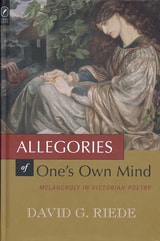
cover of Allegories of One’s Own Mind: MELANCHOLY IN VICTORIAN POETRY

Allegories of One’s Own Mind

MELANCHOLY IN VICTORIAN POETRY

David G. Riede

The Ohio State University Press, 2005

[more]
cover of Another English: Anglophone Poems from Around the World

Another English

Anglophone Poems from Around the World

Edited by Catherine Barnett and Tiphanie Yanique

Tupelo Press, 2014

In this unprecedented anthology, acclaimed poets from around the world select poems from their countries of origin to share with a wider audience. Readers will find eloquence, urgency, and idiosyncrasy, poems all in English but springing from drastically varied voices, geographies, and histories. Using an artist’s rather than a scholar’s approach, these poems — chosen out of love and admiration by practicing poets — show the vitality of English deployed by revered and emerging poets in Ghana (selected by Kwame Dawes), India (by Sudeep Sen), South Africa (by Rustum Kozain), the Caribbean (by Ishion Hutchinson and five other Caribbean poets), Canada (by Todd Swift), and the Antipodes: New Zealand (by Hinemoana Baker) and Australia (by Les Murray). Mindful of the contentious history of colonization and its staining of any notion of a unified Anglophone poetics, editors Catherine Barnett and Tiphanie Yanique have created an “anthology of anthologies”: a choral oratorio, a many-accented gathering of voices that invites further discovery and promotes an intra-cultural conversation. Featured poets include: Ama Ata Aidoo, Tatamkulu Afrika, Kofi Anyidoho, Tusiata Avia, Kofi Awoonor, Marion Bethel, Christian Bök, Jenny Bornholdt, Dionne Brand, Kamau Brathwaite, Diana Brebner, Abena Busia, Michelle Cahill, Christian Campbell, Vahni Capildeo, Priya Sarukkai Chabria, Amit Chaudhuri, George Elliot Clarke, Jennifer Compton, Jeremy Cronin, Mahadai Das, Ingrid de Kok, Peter Goldsworthy, Lorna Goodison, Bernadette Hall, Lesbia Harford, Shake Keane, A. M. Klein, Shara McCallum, Bill Manhire, Kei Miller, Arthur Nortje, Kwadwo Opoku-Agyeman, Richard Outram, P. K. Page, Marlene Nourbese Philip, Olive Senior, Mongane Wally Serote, Kenneth Slessor, Kelwyn Sole, Billy Marshall Stoneking, Arundhathi Subramaniam, Habib Tiwoni, Hone Tuwhare, Priscila Uppal, Chris van Wyk, David Wevill, Judith Wright, and many more.

[more]
cover of Anthropocene Poetics: Deep Time, Sacrifice Zones, and Extinction

Anthropocene Poetics

Deep Time, Sacrifice Zones, and Extinction

David Farrier

University of Minnesota Press, 2019

How poetry can help us think about and live in the Anthropocene by reframing our intimate relationship with geological time
 

The Anthropocene describes how humanity has radically intruded into deep time, the vast timescales that shape the Earth system and all life-forms that it supports. The challenge it poses—how to live in our present moment alongside deep pasts and futures—brings into sharp focus the importance of grasping the nature of our intimate relationship with geological time. In Anthropocene Poetics, David Farrier shows how contemporary poetry by Elizabeth Bishop, Seamus Heaney, Evelyn Reilly, and Christian Bök, among others, provides us with frameworks for thinking about this uncanny sense of time.

Looking at a diverse array of lyric and avant-garde poetry from three interrelated perspectives—the Anthropocene and the “material turn” in environmental philosophy; the Plantationocene and the role of global capitalism in environmental crisis; and the emergence of multispecies ethics and extinction studies—Farrier rethinks the environmental humanities from a literary critical perspective. Anthropocene Poetics puts a concern with deep time at the center, defining a new poetics for thinking through humanity’s role as geological agents, the devastation caused by resource extraction, and the looming extinction crisis. 

[more]