Results by title
4 books match the query 'Entanglement'
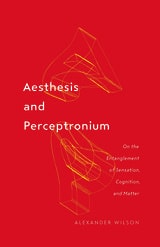
Aesthesis and Perceptronium
On the Entanglement of Sensation, Cognition, and MatterAlexander Wilson
University of Minnesota Press, 2019
A new speculative ontology of aesthetics
In Aesthesis and Perceptronium, Alexander Wilson presents a theory of materialist and posthumanist aesthetics founded on an original speculative ontology that addresses the interconnections of experience, cognition, organism, and matter. Entering the active fields of contemporary thought known as the new materialisms and realisms, Wilson argues for a rigorous redefining of the criteria that allow us to discriminate between those materials and objects where aesthesis (perception, cognition) takes place and those where it doesn’t.
Aesthesis and Perceptronium negotiates between indiscriminately pluralist views that attribute mentation to all things and eliminative views that deny the existence of mentation even in humans. By recasting aesthetic questions within the framework of “epistemaesthetics,” which considers cognition and aesthetics as belonging to a single category that can neither be fully disentangled nor fully reduced to either of its terms, Wilson forges a theory of nonhuman experience that avoids this untenable dilemma.
Through a novel consideration of the evolutionary origins of cognition and its extension in technological developments, the investigation culminates in a rigorous reevaluation of the status of matter, information, computation, causality, and time in terms of their logical and causal engagement with the activities of human and nonhuman agents.

Cocoon Cultures
The Entanglement of Silk and Biology in JapanLisa Onaga
Duke University Press, 2027
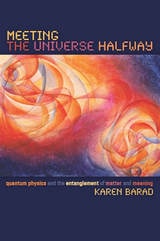
Meeting the Universe Halfway
Quantum Physics and the Entanglement of Matter and MeaningKaren Barad
Duke University Press, 2006
In an agential realist account, the world is made of entanglements of “social” and “natural” agencies, where the distinction between the two emerges out of specific intra-actions. Intra-activity is an inexhaustible dynamism that configures and reconfigures relations of space-time-matter. In explaining intra-activity, Barad reveals questions about how nature and culture interact and change over time to be fundamentally misguided. And she reframes understanding of the nature of scientific and political practices and their “interrelationship.” Thus she pays particular attention to the responsible practice of science, and she emphasizes changes in the understanding of political practices, critically reworking Judith Butler’s influential theory of performativity. Finally, Barad uses agential realism to produce a new interpretation of quantum physics, demonstrating that agential realism is more than a means of reflecting on science; it can be used to actually do science.
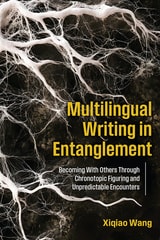
Multilingual Writing in Entanglement
Becoming With Others Through Chronotopic Figuring and Unpredictable EncountersXiqiao Wang
Utah State University Press, 2025
This longitudinal qualitative study follows Morgan and Leo through their undergraduate careers, collecting rich ethnographic data across private, academic, and digital spaces. The resulting theoretical framework conceptualizes multilingual writing as simultaneously strategic, agentive, creative, diffused, contingent, and messy—a phenomenon shaped by dynamic interplay between ephemeral encounters and established practices. Employing chronotopic figuring as a methodological tool, Wang illuminates aspects of multilingual writing often elided in research: fleeting encounters that energize composition, reciprocal relationships that distribute writing labor, unexpected detours that redirect the writing process, and the layering of writing and identity practices across multiple historical trajectories. This approach moves beyond examining writing in isolated moments to trace how meaning emerges across languages, modes, and spacetimes.
Multilingual Writing in Entanglement offers crucial insights into how international students strategically and improvisationally reconfigure their semiotic and rhetorical repertoires to write multilingual lives into meaning. This work is influential for scholars and educators in composition, literacy studies, multilingual education, ESL, and linguistics.