Results by title
11 books match the query 'Enterprise'

Bonds of Enterprise
John Murray Forbes and Western Development in America's Railway AgeJohn Lauritz Larson
University of Iowa Press, 2001
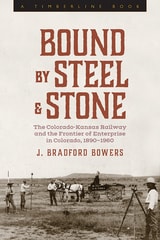
Bound by Steel and Stone
The Colorado-Kansas Railway and the Frontier of Enterprise in Colorado, 1890-1960J. Bradford Bowers
University Press of Colorado, 2022
Offering the Colorado-Kansas Railway as an example of how shortline railroads helped to integrate the rural landscape with the larger urban and economic world, Bowers reveals the constant adaptations driven by changing economic forces and conditions. He puts the railway in context of the wider environmental and political landscapes, the growing quarrying and mining business, the expansion of agriculture and irrigation, Progressive-era political reforms, and land development. In the new frontier of enterprise in the early twentieth-century American West, the railroad highlights the successes and failures of the men inspired to pursue these new opportunities as well as the story of one woman who held these fragile industries together well into the second half of the twentieth century.
Bound by Steel and Stone is an insightful addition to the history of industrialization and economic development in Colorado and the American West.

Capitalism's New Clothes
Enterprise, Ethics and Enjoyment in Times of CrisisColin Cremin
Pluto Press, 2011
Using materialist, psychoanalytic and linguistic approaches, Cremin shows how capitalism, anxiety and desire enter into a mutually supporting relationship. He identifies three ways in which we are tied in to capitalism – through a social imperative for enterprise and competition; through enjoyment and consumption; and through the depoliticisation of ethical debate by government and business.
Capitalism's New Clothes is ideal for students of sociology and for anyone worried about the ethics of capitalism or embarrassed by the enjoyments the system has afforded them.
Coordination and Information
Historical Perspectives on the Organization of EnterpriseEdited by Naomi R. Lamoreaux and Daniel M. G. Raff
University of Chicago Press, 1995
In an ideal world, the market would be the optimal provider of coordination, but in the real world of incomplete information, some activities are better coordinated in other ways. Divided into three parts, this book addresses coordination within firms, at the borders of firms, and outside firms, providing a picture of the overall incidence and logic of economic coordination. The case studies—drawn from the late nineteenth and early twentieth century, when the modern business enterprise was evolving, address such issues as the relationship between coordination mechanisms and production techniques, the logic of coordination in industrial districts, and the consequences of regulation for coordination.
Continuing the work on information and organization presented in the influential Inside the Business Enterprise, this book provides material for business historians and economists who want to study the development of the dissemination of information and the coordination of economic activity within and between firms.

From Charity to Enterprise
The Development of American Social Work in a Market EconomyStanley Wenocur and Michael Reisch
University of Illinois Press, 1989
Now in paperback for the first time, From Charity to Enterprise sets the professionalization of social work into a dynamic social context. The explicit political and economic framework of Wenocur and Reisch's model enables the authors to examine how various subgroups within social work lost or gained control of the professional enterprise at various points.

Madness and Enterprise
Psychiatry, Economic Reason, and the Emergence of Pathological ValueNima Bassiri
University of Chicago Press, 2024
Madness and Enterprise reveals the economic norms embedded within psychiatric thinking about mental illness in the North Atlantic world. Over the course of the nineteenth century, various forms of madness were subjected to a style of psychiatric reasoning that was preoccupied with money. Psychiatrists across Western Europe and the United States attributed financial and even moral value to an array of pathological conditions, such that some mental disorders were seen as financial assets and others as economic liabilities. By turning to economic conduct and asking whether potential patients appeared capable of managing their financial affairs or even generating wealth, psychiatrists could often bypass diagnostic uncertainties about a person’s mental state.
Through an exploration of the intertwined histories of psychiatry and economic thought, Nima Bassiri shows how this relationship transformed the very idea of value in the modern North Atlantic, as the most common forms of social valuation—moral value, medical value, and economic value—were rendered equivalent and interchangeable. If what was good and what was healthy were increasingly conflated with what was remunerative (and vice versa), then a conceptual space opened through which madness itself could be converted into an economic form and subsequently redeemed—and even revered.

Madness and Enterprise
Psychiatry, Economic Reason, and the Emergence of Pathological ValueNima Bassiri
University of Chicago Press, 2024
This is an auto-narrated audiobook version of this book.
Uncovers a powerful relationship between pathology and money: beginning in the nineteenth century, the severity of mental illness was measured against a patient’s economic productivity.
Madness and Enterprise reveals the economic norms embedded within psychiatric thinking about mental illness in the North Atlantic world. Over the course of the nineteenth century, various forms of madness were subjected to a style of psychiatric reasoning that was preoccupied with money. Psychiatrists across Western Europe and the United States attributed financial and even moral value to an array of pathological conditions, such that some mental disorders were seen as financial assets and others as economic liabilities. By turning to economic conduct and asking whether potential patients appeared capable of managing their financial affairs or even generating wealth, psychiatrists could often bypass diagnostic uncertainties about a person’s mental state.
Through an exploration of the intertwined histories of psychiatry and economic thought, Nima Bassiri shows how this relationship transformed the very idea of value in the modern North Atlantic, as the most common forms of social valuation—moral value, medical value, and economic value—were rendered equivalent and interchangeable. If what was good and what was healthy were increasingly conflated with what was remunerative (and vice versa), then a conceptual space opened through which madness itself could be converted into an economic form and subsequently redeemed—and even revered.

Non-Natural Social Science
Reflecting on the Enterprise of "More Heat than Light", Volume 25Neil De Marchi
Duke University Press, 0
In addition to questioning the veracity of the connection between physics and economics, the contributors consider the far-reaching implications of Mirowski’s thesis for the history of economics. Mirowski shows that economic texts must be viewed in their relation to texts outside the field of economics and offers an alternative reading of economic texts as social and cultural inscriptions. As historians of economics respond to Mirowski’s challenge, the style and direction of their work will be changed. Utlimately, a careful assessment of More Heat Than Light may introduce historians of economics to recognize that the “discipline” of economics may not be the most appropriate category from which to proceed.
Contributors. Jack Birner, Marcel Boumans, A. W. Coats, Avi J. Cohen, I. Bernard Cohen, Neil de Marchi, Steve Fuller, Clifford G. Gaddy, Wade Hands, Albert Jolink, Arjo Klamer, Robert Leonard, Philip Mirowski, Theodore M. Porter, Margaret Schabas, E. Roy Weintraub
Of Time and the Enterprise
North American Family Farm Management in a Context of Resource MarginalityJohn Bennett
University of Minnesota Press, 1982

Speculating Daguerre
Art and Enterprise in the Work of L. J. M. DaguerreStephen C. Pinson
University of Chicago Press, 2012
Louis Jacques Mandé Daguerre (1787–1851) was a true nineteenth-century visionary—a painter, printmaker, set designer, entrepreneur, inventor, and pioneer of photography. Though he was widely celebrated beyond his own lifetime for his invention of the daguerreotype, it was his origins as a theatrical designer and purveyor of visual entertainment that paved the way for Daguerre’s emergence as one of the world’s most iconic imagemakers.
In Speculating Daguerre, Stephen C. Pinson reinterprets the story of the man and his time, painting a vivid picture of Daguerre as an innovative artist and savvy impresario whose eventual fame as a photographer eclipsed everything that had come before. Drawing upon previously unpublished correspondence and unplumbed archival sources, Pinson mixes biography with an incisive study of Daguerre’s wide-ranging involvement in visual culture. From his work as a commercial lithographer to his coinvention of the Paris Diorama—a theater in the round in which Daguerre employed natural light and special effects to simulate time and movement in large-scale paintings—here we are given access to Daguerre the artist, whose tireless experimentation, entrepreneurial spirit, and exceptional talent for popular spectacle helped to usher in a new visual age.
Filled with more than one hundred illustrations and including the first complete catalogue of Daguerre’s paintings, works on paper, and daguerreotypes to appear in print, the publication of Speculating Daguerre will be a much-heralded event for anyone with even a passing interest in one of the most fascinating characters in the history of photography.
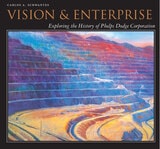
Vision and Enterprise
Exploring the History of Phelps Dodge CorporationCarlos A. Schwantes
University of Arizona Press, 2000
Phelps Dodge Corporation has shaped the landscape of America from the industrial revolution to the information technology revolution. A name synonymous with copper, Phelps Dodge has grown from a cotton and metal trading firm founded in 1834 to its present position as the world's largest publicly traded copper company.
Carlos Schwantes has written a sweeping corporate history of Phelps Dodge. Using landscape as an organizing concept to underscore the company's impact and accomplishments, he offers a close look at this corporate giant within the context of American technological and social history. In tracing the progress of Phelps Dodge through its 165-year history, Schwantes takes readers from the streets of Bisbee, Arizona, to the boardrooms of New York and Phoenix in order to examine the impact the company has had on the many landscapes in which it figures so prominently. Considering factors ranging from the environment to labor, he examines how Phelps Dodge has influenced, and has been influenced by, such forces as the global economy, technological innovation, urban growth, and social change.
Exhaustively researched and profusely illustrated with over 200 photographs, Vision and Enterprise makes a unique contribution to the history of the United States and the evolution of industry by considering the changing face of labor, the environment, and technology from one dynamic company's point of view.