Results by title
12 books match the query 'Entertainers'
A Mother's Tale
Phillip Lopate
The Ohio State University Press, 2017
In 1984, Phillip Lopate sat down with his mother, Frances, to listen to her life story. A strong, resilient, indomitable woman who lived through the major events of the twentieth century, she was orphaned in childhood, ran away and married young, and then reinvented herself as a mother, war factory worker, candy store owner, community organizer, clerk, actress, and singer. But paired with exciting anecdotes are the criticisms of the husband who couldn’t satisfy her, the details of numerous affairs and sexual encounters, and, though she succeeded at many of her roles, accounts of how she always felt mistreated, taken advantage of. After the interviews, at a loss for what to do with the tapes, Lopate put them away. But thirty years later, after his mother had passed away, Lopate found himself drawn back to the recordings of this conversation. Thus begins a three-way conversation between a mother, his younger self, and the person he is today.
Trying to break open the family myths, rationalizations, and self-deceptions, A Mother’s Tale is about family members who love each other but who can’t seem to overcome their mutual mistrust. Though Phillip is sympathizing to a point, he cannot join her in her operatic displays of self-pity and how she blames his father for everything that went wrong. His detached, ironic character has been formed partly in response to her melodramatic one. The climax is an argument in which he tries to persuade her—using logic, of all things—that he really does love her, but is only partially successful, of course.
A Mother’s Tale is about something primal and universal: the relationship between a mother and her child, the parent disappointed with the payback, the child, now fully grown, judgmental. The humor is in the details.

Dreams and Ideas
The Artistry of Costume Designer Winn MortonMyra Walker
University of North Texas Press, 2026
Marlene Dietrich
Life and LegendSteven Bach
University of Minnesota Press, 2011
My Life in Vaudeville
The Autobiography of Ed LowryEd Lowry, Edited by Paul M. Levitt
Southern Illinois University Press, 2011
Normal0falsefalsefalseEN-USX-NONEX-NONE
An entertaining record of a life and a time
Ed Lowry joined the vaudeville circuit in 1910 at the age of fourteen. He never achieved stardom equal to the likes of Fred Allen, Jack Benny, George Burns, Buster Keaton, or Eddie Cantor, and he never considered himself an “artiste.” Instead, he saw himself as a hoofer and comic simply trying to make a living on the vaude scene. My Life in Vaudeville recounts Lowry’s long career in entertainment from the viewpoint of a foot soldier with a big dream.
Lowry’s story begins in the heyday of vaudeville in the early twentieth century and follows its gradual decline. Unlike many of his associates, he recognized that movies and other forms of entertainment were the future, and thus branched out into other venues. He took gigs in radio in Philadelphia, Newark, New York, and Los Angeles; explored revues, cabarets, burlesque, and film; and organized USO road shows. With wit and perception, he reveals his stage roots as an entertainer playing to his audience, and editor Paul M. Levitt’s introduction beautifully sets the stage for Lowry’s gags-to-riches tale, providing much-needed historical perspective.
My Life in Vaudeville is an unpretentious record of a time when thousands of young people went into show business to escape the boredom of daily life, and Lowry’s story is a view of vaudeville not often encountered. Lowry does much more than recall the daily life of a working actor, musician, and comedian. His story brings vaudeville to life and places it within the larger narratives of popular culture and popular entertainment of the twentieth century.
Performance Art
StoriesDavid Kranes
University of Nevada Press, 2021
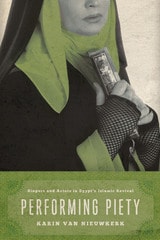
Performing Piety
Singers and Actors in Egypt's Islamic RevivalBy Karin van Nieuwkerk
University of Texas Press, 2013
In the 1980s, Egypt witnessed a growing revival of religiosity among large sectors of the population, including artists. Many pious stars retired from art, “repented” from “sinful” activities, and dedicated themselves to worship, preaching, and charity. Their public conversions were influential in spreading piety to the Egyptian upper class during the 1990s, which in turn enabled the development of pious markets for leisure and art, thus facilitating the return of artists as veiled actresses or religiously committed performers.
Revisiting the story she began in “A Trade like Any Other”: Female Singers and Dancers in Egypt, Karin van Nieuwkerk draws on extensive fieldwork among performers to offer a unique history of the religious revival in Egypt through the lens of the performing arts. She highlights the narratives of celebrities who retired in the 1980s and early 1990s, including their spiritual journeys and their influence on the “pietization” of their fans, among whom are the wealthy, relatively secular, strata of Egyptian society. Van Nieuwkerk then turns to the emergence of a polemic public sphere in which secularists and Islamists debated Islam, art, and gender in the 1990s. Finally, she analyzes the Islamist project of “art with a mission” and the development of Islamic aesthetics, questioning whether the outcome has been to Islamize popular art or rather to popularize Islam. The result is an intimate thirty-year history of two spheres that have tremendous importance for Egypt—art production and piety.
Shipping Out
Race, Performance, and Labor at SeaAnita Gonzalez
University of Michigan Press, 2025
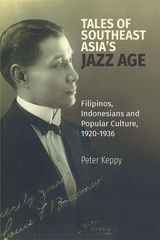
Tales of Southeast Asia’s Jazz Age
Filipinos, Indonesians and Popular Culture, 1920-1936Peter Keppy
National University of Singapore Press, 2019
This artistic era was marked by experimentation and adaption, and this was reflected in both Borromeo’s and Riboet’s styles. They were pioneering cultural brokers who dealt in hybrids. They were adept at combining high art and banal entertainment, tradition and modernity, and the foreign and the local.
Leaning on cultural studies and the work on cosmopolitanism and modernity by Henry Jenkins and Joel Kahn, Peter Keppy examines pop culture at this time as a contradictory social phenomenon. He challenges notions of Southeast Asia’s popular culture as lowbrow entertainment created by elites and commerce to manipulate the masses, arguing instead that audiences seized on this popular culture to channel emancipatory activities, to articulate social critique, and to propagate an inclusive nationalism without being radically anticolonial.
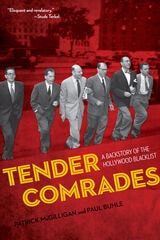
Tender Comrades
A Backstory of the Hollywood BlacklistPatrick McGilligan
University of Minnesota Press, 2012
More than sixty years ago, McCarthyism silenced Hollywood. In the pages of Tender Comrades, those who were suppressed, whose lives and careers were ruined, finally have their say. A unique collection of profiles in cinematic courage, this extraordinary oral history brings to light the voices of thirty-six blacklist survivors (including two members of the Hollywood Ten), seminal directors of film noir and other genres, starring actresses and memorable supporting players, top screenwriters, and many less known to the public, who are rescued from obscurity by the stories they offer here that, beyond politics, open a rich window into moviemaking during the Golden Age of Hollywood.
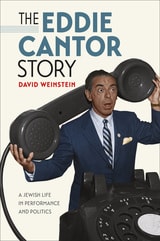
The Eddie Cantor Story
A Jewish Life in Performance and PoliticsDavid Weinstein
Brandeis University Press, 2017
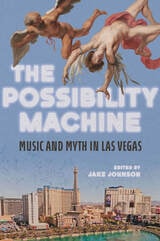
The Possibility Machine
Music and Myth in Las VegasEdited by Jake Johnson
University of Illinois Press, 2023
At once a Technicolor wonderland and the embodiment of American mythology, Las Vegas exists at the Ground Zero of a reverence for risk-taking and the transformative power of a winning hand. Jake Johnson edits a collection of short essays and flash ideas that probes how music-making and soundscapes shape the City of Second Chances. Treating topics ranging from Cher to Cirque de Soleil, the contributors delve into how music and musicians factored in the early development of Vegas’s image; the role of local communities of musicians and Strip mainstays in sustaining tensions between belief and disbelief; the ways aging showroom stars provide a sense of timelessness that inoculates visitors against the outside world; the link connecting fantasies of sexual prowess and democracy with the musical values of Liberace and others; considerations of how musicians and establishments gambled with identity and opened the door for audience members to explore Sin City–only versions of themselves; and the echoes and energy generated by the idea of Las Vegas as it travels across the country.
Contributors: Celine Ayala, Kirstin Bews, Laura Dallman, Joanna Dee Das, James Deaville, Robert Fink, Pheaross Graham, Jessica A. Holmes, Maddie House-Tuck, Jake Johnson, Kelly Kessler, Michael Kinney, Carlo Lanfossi, Jason Leddington, Janis McKay, Sam Murray, Louis Niebur, Lynda Paul, Arianne Johnson Quinn, Michael M. Reinhard, Laura Risk, Cassaundra Rodriguez, Arreanna Rostosky, and Brian F. Wright
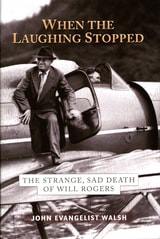
When the Laughing Stopped
The Strange, Sad Death of Will RogersJohn Evangelist Walsh
University of Alaska Press, 2008
The plane carrying Rogers and aviator Wiley Post crashed in a lagoon just outside Barrow, Alaska on August 15, 1935. Walsh retells the tragic tale from various angles, primarily alternating between Rogers and Post’s journey and the actions of the two men’s families on that fateful day. In particular, Walsh reveals moving details about the families and their struggle with grief, such as the fact that Post’s daughter was in a stage play about plane crashes at the time of the crash, or how Will Rogers’s daughter Mary never fully recovered from her father’s death and subsequently abandoned her promising acting career.
When the Laughing Stopped is a gripping and poignant retelling of the death of a beloved American legend, and it shines a humanizing light upon a pivotal moment in American history and culture.