Results by title
25 books match the query 'Entertainment'
American Cinema of the 2010s
Themes and VariationsDennis Bingham
Rutgers University Press, 2022
The newest installment in the Screen Decades series, American Cinema in the 2010s takes a close look at the memorable movies, visionary filmmakers, and behind-the-scenes drama that made this decade such an exciting time to be a moviegoer. Each chapter offers an in-depth examination of a specific year, covering a wide variety of films, from blockbuster superhero movies like Black Panther and animated films like Frozen to smaller-budget biopics like I, Tonya and horror films like Hereditary. This volume introduces readers to a decade in which established auteurs like Quentin Tarantino were joined by an exceptionally diverse set of new talents, taking American cinema in new directions.
Baby You're a Rich Man
Suing the Beatles for Fun and ProfitStan Soocher
University Press of New England, 2015
Beyond Squid Game
Korean Media and the Netflix ParadigmBenjamin M. Han
University of Texas Press, 2026
Examining Netflix’s global influence through its complex global-local dynamics in Korean media.
Korea is a global entertainment powerhouse, thanks in no small part to Netflix. Analyzing the artistry and industry behind Netflix-produced Korean hits like Squid Game, The Glory, and Narco-Saints, Benjamin Han argues that Korea is ground zero for an emerging “Netflix Paradigm.” The US-based streaming platform generates massive profits by erasing boundaries of foreign and domestic production, even as it underscores the resilience of the national media within global popular culture.
Beyond Squid Game breaks down the intricate and often ambivalent relationship between Netflix and the Korean media business, drawing on interviews with creative workers navigating the streaming giant’s ever-increasing economic and cultural power. Challenging narratives that present Netflix as a revolutionary disruptor, Han shows how the company has replicated abroad the precarious labor conditions and tensions over intellectual property from which US studios have long benefited. At the same time, Beyond Squid Game underscores the complex dynamics of a globalized media industry in which cultural imperialism thrives on localization and perceived authenticity.
Bootlegging the Airwaves
Alternative Histories of Radio and Television DistributionEleanor Patterson
University of Illinois Press, 2024
Long before internet archives and the anytime, anywhere convenience of streaming, people collected, traded, and shared radio and television content via informal networks that crisscrossed transnational boundaries.
Eleanor Patterson’s fascinating cultural history explores the distribution of radio and TV tapes from the 1960s through the 1980s. Looking at bootlegging against the backdrop of mass media’s formative years, Patterson delves into some of the major subcultures of the era. Old-time radio aficionados felt the impact of inexpensive audio recording equipment and the controversies surrounding programs like Amos ‘n’ Andy. Bootlegging communities devoted to buddy cop TV shows like Starsky and Hutch allowed women to articulate female pleasure and sexuality while Star Trek videos in Australia inspired a grassroots subculture built around community viewings of episodes. Tape trading also had a profound influence on creating an intellectual pro wrestling fandom that aided wrestling’s growth into an international sports entertainment industry.
Broadcasting Hollywood
The Struggle over Feature Films on Early TVJennifer Porst
Rutgers University Press, 2021
Destined for Greatness
Passions, Dreams, and Aspirations in a College Music TownRamirez, Michael
Rutgers University Press, 2018
In Destined for Greatness, sociologist Michael Ramirez examines the lives of forty-eight independent rock musicians who seek out such non-normative choices in a college town renowned for its music scene. He explores the rich life course trajectories of women and men to explore the extent to which pathways are structured to allow some, but not all, individuals to fashion careers in music worlds. Ramirez suggests a more nuanced understanding of factors that enable the pursuit of musical livelihoods well into adulthood.
Empires of Entertainment
Media Industries and the Politics of Deregulation, 1980-1996Holt, Jennifer
Rutgers University Press, 2011
Empires of Entertainment integrates legal, regulatory, industrial, and political histories to chronicle the dramatic transformation within the media between 1980 and 1996. As film, broadcast, and cable grew from fundamentally separate industries to interconnected, synergistic components of global media conglomerates, the concepts of vertical and horizontal integration were redesigned. The parameters and boundaries of market concentration, consolidation, and government scrutiny began to shift as America's politics changed under the Reagan administration. Through the use of case studies that highlight key moments in this transformation, Jennifer Holt explores the politics of deregulation, the reinterpretation of antitrust law, and lasting modifications in the media landscape.
Holt skillfully expands the conventional models and boundaries of media history. A fundamental part of her argument is that these media industries have been intertwined for decades and, as such, cannot be considered separately. Instead, film, cable and broadcast must be understood in relation to one another, as critical components of a common history. Empires of Entertainment is a unique account of deregulation and its impact on political economy, industrial strategies, and media culture at the end of the twentieth century.
Expanding the Strike Zone
Baseball in the Age of Free AgencyDaniel A. Gilbert
University of Massachusetts Press, 2013
Readers encounter both legendary and unheralded figures in this sweeping history, which situates Major League Baseball as part of a larger culture industry. The book examines a labor history defined at once by the growing power of big league stars—from Juan Marichal and Curt Flood to Fernando Valenzuela and Ichiro Suzuki—and the collective struggles of players working to make a living throughout the baseball world. It also explores the territorial politics that have defined baseball's development as a form of transnational popular culture, from the impact of Dominican baseball academies to the organized campaign against stadium development by members of Seattle's Asian American community.
Based on a rich body of research along with new readings of popular journalism, fiction, and film, Expanding the Strike Zone highlights the ways in which baseball's players, owners, writers, and fans have shaped and reshaped the sport as a central element of popular culture from the postwar boom to the Great Recession.
Financing Sport
Fourth EditionDennis R. Howard
FiT Publishing, 2018
The most authoritative and comprehensive textbook on sport finance has been updated and revised to include in its examination the distinct changes in the economic climate of the sport industry in recent decades, as well as the impacts and challenges the contemporary economic climate presents for the sport industry.
Divided into five sections – finance trends and challenges, economic rationale for public investment, primary sources of funding, revenue from enterprise sources, and fundraising – Financing Sport, 4th Edition also contains a thorough updated examination of venue and sport property revenues, including ticket and merchandise sales, the rise of luxurious and extravagant fan experiences, as well as commercial media rights that stretch across traditional broadcast, satellite, and innovative new web-based outlets for consuming sport content. Also newly updated and expanded are fundraising areas that discuss traditional and emerging trends in sport sponsorship and donation.
Thorough in both its depth and scope, Financing Sport, 4th Edition is an engaging, edifying textbook for sport-related graduate and undergraduate students, teachers, and industry professionals.
Gangsters to Governors
The New Bosses of Gambling in AmericaClary, David
Rutgers University Press, 2017
Winner of the 2018 Bronze Current Events Book Award from the Independent Publisher Book Awards
Generations ago, gambling in America was an illicit activity, dominated by gangsters like Benny Binion and Bugsy Siegel. Today, forty-eight out of fifty states permit some form of legal gambling, and America’s governors sit at the head of the gaming table. But have states become addicted to the revenue gambling can bring? And does the potential of increased revenue lead them to place risky bets on new casinos, lotteries, and online games?
In Gangsters to Governors, journalist David Clary investigates the pros and cons of the shift toward state-run gambling. Unearthing the sordid history of America’s gaming underground, he demonstrates the problems with prohibiting gambling while revealing how today’s governors, all competing for a piece of the action, promise their citizens payouts that are rarely delivered.
Clary introduces us to a rogue’s gallery of colorful characters, from John “Old Smoke” Morrissey, the Irish-born gangster who built Saratoga into a gambling haven in the nineteenth century, to Sheldon Adelson, the billionaire casino magnate who has furiously lobbied against online betting. By exploring the controversial histories of legal and illegal gambling in America, he offers a fresh perspective on current controversies, including bans on sports and online betting. Entertaining and thought-provoking, Gangsters to Governors considers the past, present, and future of our gambling nation.
Author's website (http://www.davidclaryauthor.com)
Hollywood Diplomacy
Film Regulation, Foreign Relations, and East Asian RepresentationsHye Seung Chung
Rutgers University Press, 2020
Hollywood Unions
Kate Fortmueller
Rutgers University Press, 2025

Hollywood and Broadcasting
From Radio to CableMichelle Hilmes
University of Illinois Press, 1990
an excellent introduction to a most important subject. This is an invaluable
work for both scholars and students that places film, radio, and television
within the context of the national culture experience."
--- American Historical Review
"Hilmes is one of the few historians
of broadcasting to move beyond a political economy of the media. . . . Her work
should serve as a model for future histories of broadcasting."
--- Journal of Communication
"All media historians will
find this work a critical addition to their bookshelves."
--- American Journalism
"A major addition to media
history literature."
--- Journalism History
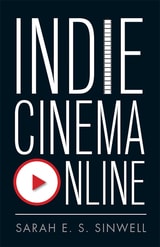
Indie Cinema Online
Sarah E.S. Sinwell
Rutgers University Press, 2020

Latin American Melodrama
Passion, Pathos, and EntertainmentEdited and with an Introduction by Darlene J. Sadlier
University of Illinois Press, 2008
Like their Hollywood counterparts, Latin American film and TV melodramas have always been popular and highly profitable. The first of its kind, this anthology engages in a serious study of the aesthetics and cultural implications of Latin American melodramas. Written by some of the major figures in Latin American film scholarship, the studies range across seventy years of movies and television within a transnational context, focusing specifically on the period known as the "Golden Age" of melodrama, the impact of classic melodrama on later forms, and more contemporary forms of melodrama. An introductory essay examines current critical and theoretical debates on melodrama and places the essays within the context of Latin American film and media scholarship.
Contributors are Luisela Alvaray, Mariana Baltar, Catherine L. Benamou, Marvin D’Lugo, Paula Félix-Didier, Andrés Levinson, Gilberto Perez, Darlene J. Sadlier, Cid Vasconcelos, and Ismail Xavier.
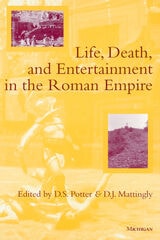
Life, Death, and Entertainment in the Roman Empire
D. S. Potter and D. J. Mattingly, Editors
University of Michigan Press, 1999
D. J. Mattingly is Professor of Roman Archaeology, University of Leicester.
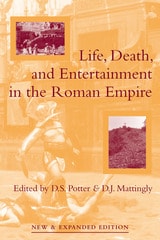
Life, Death, and Entertainment in the Roman Empire
D. S. Potter and D. J. Mattingly, Editors
University of Michigan Press, 2010
"[T]his handsomely-produced volume performs admirably as a series of introductions to sources, approaches, and the state of scholarship on major topics in Roman social history . . . Collections of essays come and go, but this one will stay in wide use. Each essay can stand alone but, tied together by the theme of dominance, the whole is greater than the sum of its parts."
---Donald Kyle, Bryn Mawr Classical Review
"This collection of essays is intended to serve as a coursebook for introductory lecture series on Roman civilization; the essays are concentrated on fundamental aspects of Roman society, and no prior knowledge of antiquity on the reader's part is assumed. . . . The book as a whole is entirely successful in its projected aim: an immense range of detailed information about antiquity is presented in readable and largely sophisticated discussion. . . . Increasingly we need to be able to suggest to our students reading that is introductory but also in-depth and challenging, and this book is one possible reading that we can offer."
---Ellen O'Gorman, Classical Review
Life, Death, and Entertainment gives those with a general interest in Roman antiquity a starting point, informed by the latest developments in scholarship, for understanding the extraordinary range of Roman society. Family structure, slavery, gender identity, food supply, religion, and entertainment---all crucial parts of the Roman world---are discussed here, in a single volume that offers an approachable guide for readers of all backgrounds. The collection unites a series of general introductions on each of these topics, bringing readers in touch with a broad range of evidence, as well as with a wide variety of approaches to basic questions about the Roman world.
The newly expanded edition includes historian Keith Hopkins' pathbreaking article on Roman slaves. Volume editor David Potter has contributed two new translations of documents from emperors Hadrian and Marcus Aurelius. Hadrian's letters document a reorganization of the festival cycle in the Empire and reassert the importance of the Olympic Games; the letter to Marcus provides the most important surviving evidence for how gladiatorial games were actually organized.
Contributors to the volume include Greg S. Aldrete, Hazel Dodge, Bruce W. Frier, Maud W. Gleason, Ann E. Hanson, Keith Hopkins, David J. Mattingly, and David S. Potter.
D.S. Potter is Professor of Classics and Arthur F. Thurnau Professor, University of Michigan.
D.J. Mattingly is Professor of Roman Archaeology, University of Leicester, and a Fellow of the British Academy.
Cover illustrations: top left, Karanis Excavation, courtesy Kelsey Museum; bottom right, Monte Testacchio, courtesy David J. Mattingly; center, Pollice Verso by Jean-Léon Gérôme, courtesy Phoenix Art Museum, Museum Purchase.
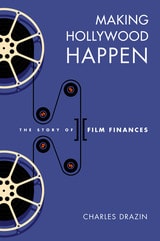
Making Hollywood Happen
Seventy Years of Film FinancesCharles Drazin
University of Wisconsin Press, 2022
Enter Film Finances. The company was founded in London in 1950 to insure against the risk that a film would exceed its original budget or not be completed on time. Its pioneering development of the “completion guarantee”—the financial instrument that provides the essential security for investors to support independent filmmaking—ultimately led to the creation of many thousands of films, including some of the most celebrated ever made: Moulin Rouge (1953), Dr. No (1962), The Outsiders (1982), Pulp Fiction (1994), Slumdog Millionaire (2008), La La Land (2016), and more.
Film Finances’s role in filmmaking was little known outside the industry until 2012, when it opened its historical archive to scholars. Drawing on these previously private documents as well as interviews with its executives, Making Hollywood Happen tells the company’s story through seven decades of postwar cinema history and chronicles the growth of the international independent film industry. Focusing on a business that has operated at the meeting point between money and art for more than seventy years, this lavishly illustrated book goes to the heart of how the movie business works.
Playing the Percentages
How Film Distribution Made the Hollywood Studio SystemDerek Long
University of Texas Press, 2024
A history of film distribution in the United States from the 1910s to the 1930s, concentrating on booking, circuiting, and packaging marketing practices.
Told not as a “golden age” narrative of films, stars, or individual studios but as an economic history of the industry’s film distribution practices, Playing the Percentages is the story of how Hollywood’s vertically integrated studio system came to be. Studying the history of distribution during the growth of Hollywood, Derek Long makes a case for the domination of the studio system as the result of struggles over distribution practices.
Through a combination of archival research, critical surveys of the film industry trade press, and economic analysis, Long uncovers a complex and ever-shifting system of wrangling between distributors and exhibitors. Challenging the overemphasis within scholarship on “block booking” as a monolithic distribution mode, and attending to distribution practices beyond simple circulation, Long highlights the crucial changes in film distribution brought about by live theater, the rise of features, and the transition to sound. Playing the Percentages is a comprehensive history of film distribution in the United States during the silent era that illustrates the importance of power struggles between distributors and exhibitors over booking, pricing, and playing time.

Playing with History
American Identities and Children’s Consumer CultureMolly Rosner
Rutgers University Press, 2021

Presumption
An Entertainment: A Sequel to Pride and PrejudiceJulia Barrett
University of Chicago Press, 1995
"An elegant emulation and continuation of Pride and Prejudice. . . . Jointly composed by two admirers of Jane Austen, the book often achieves crisp replication of her style. . . . Presumption shows how sequel-writing can, like parody, be a sharp exercise in literary appreciation."—Peter Kemp, Times Literary Supplement
Julia Barrett is a pseudonym for Julia Braun Kessler and Gabrielle Donnelly.
Staging a Comeback
Broadway, Hollywood, and the Disney RenaissancePeter C. Kunze
Rutgers University Press, 2023
The Digital NBA
How the World's Savviest League Brings the Court to Our CouchSteven Secular
University of Illinois Press, 2023
A timely look at a dynamic media landscape, The Digital NBA shows how the games we love became content first and sport a distant second.

The Other End of the Needle
Continuity and Change among Tattoo WorkersDavid C. Lane
Rutgers University Press, 2021
Yet, Lane notes, prior research has focused almost exclusively on the tattoos—the outcome of an intricate social process—and have ignored the significance of tattoo workers themselves. "Tattooists," as Lane dubs them, make decisions, but they work within a social world that constrains and shapes the outcome of their labor—the tattoo. The goal of this book is to help readers understand the world of tattoo work as an intricate and nuanced form of work. Lane ultimately asks new questions about the social processes occurring prior to the tattoo’s existence.
The Possibility Machine
Music and Myth in Las VegasEdited by Jake Johnson
University of Illinois Press, 2023
At once a Technicolor wonderland and the embodiment of American mythology, Las Vegas exists at the Ground Zero of a reverence for risk-taking and the transformative power of a winning hand. Jake Johnson edits a collection of short essays and flash ideas that probes how music-making and soundscapes shape the City of Second Chances. Treating topics ranging from Cher to Cirque de Soleil, the contributors delve into how music and musicians factored in the early development of Vegas’s image; the role of local communities of musicians and Strip mainstays in sustaining tensions between belief and disbelief; the ways aging showroom stars provide a sense of timelessness that inoculates visitors against the outside world; the link connecting fantasies of sexual prowess and democracy with the musical values of Liberace and others; considerations of how musicians and establishments gambled with identity and opened the door for audience members to explore Sin City–only versions of themselves; and the echoes and energy generated by the idea of Las Vegas as it travels across the country.
Contributors: Celine Ayala, Kirstin Bews, Laura Dallman, Joanna Dee Das, James Deaville, Robert Fink, Pheaross Graham, Jessica A. Holmes, Maddie House-Tuck, Jake Johnson, Kelly Kessler, Michael Kinney, Carlo Lanfossi, Jason Leddington, Janis McKay, Sam Murray, Louis Niebur, Lynda Paul, Arianne Johnson Quinn, Michael M. Reinhard, Laura Risk, Cassaundra Rodriguez, Arreanna Rostosky, and Brian F. Wright