Results by title
51 books match the query 'Entrepreneurship' and 4 start with a

African Entrepreneurship
Muslim Fula Merchants in Sierra LeoneAlusine Jalloh
Ohio University Press, 1999
Departing from the prevailing scholarship, Jalloh characterizes the Fula businesses as independent, rather than appendages of Western expatriate commerce. In addition to establishing successful businesses, Fula merchants established Islamic educational institutions for propogating the Muslim faith and promoting Islamic scholarship.
This study also examines the evolution of Fula chieftaincy from the colonial era to the postcolonial period and documents the importance of mercantile wealth and networks in the election of Fula chiefs in Freetown. African Entrepreneurship makes an important contribution to the understudied role of African business in Sierra Leone.
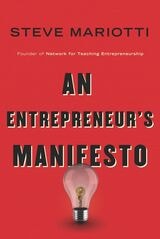
An Entrepreneur’s Manifesto
Steve Mariotti
Templeton Press, 2015
In an increasingly competitive world market, how does the United States rank? Many Americans are worried about the economic state of their nation, especially now that countries like China are becoming ever more economically powerful. What does America need to both stabilize and energize its economy?
Entrepreneurship, Steve Mariotti claims, is vital. An Entrepreneur’s Manifesto is Mariotti’s rallying cry for the world to recognize the potential that business creation holds for the individual and the economy. Mariotti explores how entrepreneurship affects schools and prisons, developed cities and isolated villages, brick-and-mortar stores, and internet-based businesses. He takes a hard look at the research on entrepreneurial education, entrepreneurship, government policy, and the social and cultural attributes most likely to foster successful business creation, incorporating his discussions with some of the best minds on the question of entrepreneurship. Mariotti also examines how the rise of the Internet and Web-based innovations like crowdfunding have both changed—and not changed—the fundamentals of promoting those who take the ultimate gamble of going into business for themselves.
As the author of several leading textbooks on the subject and founder of the Network for Teaching Entrepreneurship (NFTE), a global nonprofit organization that has educated more than 500,000 students and trained more than 5,000 teachers in 50 countries, Mariotti is both an experienced and reliable leader in what he calls the entrepreneurial revolution. Mariotti frequently writes for the Huffington Post and has been recruited by the State Department to discuss his ideas on youth entrepreneurship in Cambodia and other developing countries seeking to escape the shackles of centrally planned economic policies.
Neither a dry recitation of academic theory nor a scattered collection of feel-good stories, An Entrepreneur’s Manifesto builds on Mariotti’s unique perspective to offer a critique that is both inspiring and practical. Riveting stories complement enlightening real-world perspectives, making the work relatable and inspiring.
“There is no more revolutionary act,” Mariotti says, “than starting a business.”

Art Management
Entrepreneurial StyleGiep Hagoort
Eburon Academic Publishers, 2003

Artivate 11.3
Adrienne Callander
University of Arkansas Press, 2024
In this special edition of Artivate built around the expanded field of arts entrepreneurship, guest editors Adrienne Callander and Johanna K. Taylor collect scholars’ research on ideas they see as both central and pivotal in driving the field forward. In a futurecasting glossary, past, present, and future Artivate editors gather their thinking around such ideas, exploring where and how arts entrepreneurship currently happens beyond expected models. The three articles contained in this issue explore arts entrepreneurship’s overlaps from policy to activism to philanthropy through new adaptable organizational modeling. Starting with an in-depth analysis of hybrid practice as a mode of institutional entrepreneurship, the conversation turns to a view on artist activism as a form of arts entrepreneurship, followed by a case study of the Maniobra program of cultural employment supporting artists. To culminate in this issue’s galleries, an artist showcase profiles participating artists in the Maniobra program.