Results by title

4 books match the query 'Environmental Crisis'
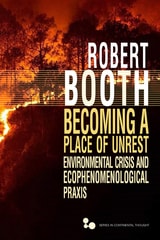
cover of Becoming a Place of Unrest: Environmental Crisis and Ecophenomenological Praxis

Becoming a Place of Unrest

Environmental Crisis and Ecophenomenological Praxis

Robert Booth

Ohio University Press, 2021

The key to mitigating the environmental crisis isn’t just based on science; it depends upon a profound philosophical revision of how we think about and behave in relation to the world. Our ongoing failure to interrupt the environmental crisis in a meaningful way stems, in part, from how we perceive the environment—what Robert Booth calls the "more-than-human world.” Anthropocentric presumptions of this world, inherited from natural science, have led us to better scientific knowledge about environmental problems and more science-based—yet inadequate—practical “solutions.” That’s not enough, Booth argues. Rather, he asserts that we must critically and self-reflexively revise how we perceive and consider ourselves within the more-than-human world as a matter of praxis in order to arrest our destructive impact on it. Across six chapters, Booth brings ecophenomenology—environmentally focused phenomenology—into productive dialogue with a rich array of other philosophical approaches, such as ecofeminism, new materialism, speculative realism, and object-oriented ontology. The book thus outlines and justifies why and how a specifically ecophenomenological praxis may lead to the disruption of the environmental crisis at its root. Booth’s observations and arguments make the leap from theory to practice insofar as they may influence how we fundamentally grasp the environmental crisis and what promising avenues of practical activism might look like. In Booth’s view, this is not about achieving a global scientific consensus regarding the material causes of the environmental crisis or the responsible use of “natural resources.” Instead, Booth calls for us to habitually resist our impetus to uncritically reduce more-than-human entities to “natural resources” in the first place. As Booth recognizes, Becoming a Place of Unrest cannot and does not tell us how we should act. Instead, it outlines and provides the basic means by which to instill positive and responsible conceptual and behavioral relationships with the rest of the world. Based on this, there is hope that we may begin to develop more concrete, actionable policies that bring about profound and lasting change.
[more]
cover of Love in the Time of Zika: Environmental Crisis and the Future of Reproduction

Love in the Time of Zika

Environmental Crisis and the Future of Reproduction

Paige Marie Patchin

Duke University Press, 2026
Love in the Time of Zika examines the transformation of reproductive politics spurred by the Zika public health emergency in 2016. The Zika virus, a mosquito-borne disease with a direct link to fetal and children’s disabilities, provoked the surveillance of and intervention into women’s and girls’ bodies and lives. Paige Marie Patchin tracks this period of intense reproductive experimentation, from fast contraceptive implant insertion drives in Puerto Rico to the genetic modification of mosquitoes in Brazil, to explore the future of reproduction as environmental crises mount, public infrastructures wilt, and walls rise. Patchin questions what kind of a world we are building if the response to dangerous, global environmental problems like Zika is to pit fetuses against one another in a future of limited resources. Set between the twin specters of eugenics and fascism, Love in the Time of Zika argues for the relevance of reproduction to wider questions about what it means to be people living amongst other people, and people living amongst other beings.
[more]
cover of Managing the Environmental Crisis: Incorporating Competing Values in Natural Resource Administration

Managing the Environmental Crisis

Incorporating Competing Values in Natural Resource Administration

William R. Mangun and Daniel H. Henning

Duke University Press, 1999

Second edition
With a new foreword by Lynton Keith Caldwell

In Managing the Environmental Crisis William R. Mangun and Daniel H. Henning provide a balanced and comprehensive guide to the management of complex environmental and natural resource policy issues. Taking into account new developments, trends, and issues that have arisen in recent years, the authors begin with the recognition, often overlooked, that it is not the environment that needs to be managed but human action relating to the environment.
The authors review issues associated with a range of environmental policy concerns, including energy considerations, renewable and non renewable resource management, pollution control, wilderness management, and urban and regional policy. The history of these issues, recent actions pertaining to their management, difficulties associated with their continued presence, and the consequences of a failure to address these concerns are explored. Though focused on specific political issues, Mangun and Henning direct their attention to two large-scale trends—globalization and the political polarization of the environmental movement. At the level of the decision-making process, the incorporation of values—specifically addressed from multicultural and cross-disciplinary perspectives—is also discussed. International in scope, the book provides descriptions of the roles of both governmental and nongovernmental organizations in the formulations and implementation of national and global environmental policy.
This thoroughly revised second edition discusses various successes in the arenas of environmental cooperation and management strategy while pointing to the new challenges that have emerged in the last decade.
[more]
cover of Running Dry: Essays on Energy, Water, and Environmental Crisis

Running Dry

Essays on Energy, Water, and Environmental Crisis

Jones, Toby Craig

Rutgers University Press, 2015

The world’s water is under siege. A combination of corporate greed, the elite pursuit of political power, and our unrelenting reliance on carbon-based energy is accerlating a broad range of environmental and political crises. Potentially catastrophic climate change, driven primarily by the consumption of oil and gas, threatens the environment in a variety of ways, including producing unprecedented patterns of heavy weather and superstorms in some places and droughts in others. Alongside intensifying environmental dangers posed by our reliance on carbon energy, the conditions of modern life, from happiness to the possibility of democratic politics, are also being undermined. 
 
In Running Dry, historian Toby Craig Jones explores how modern society’s unquenchable thirst for carbon-based energy is endangering the environment broadly, as well as the historical roots of this threat. This accessible book examines the history of the "energy-water nexus," the ways in which oil and gas extraction poison and dry up water resources, the role of corporate "science" in deflecting attention away from the emerging crises, and the ways in which the rush to capture more energy is also challenging America's democratic order. 
[more]