Results by title
9 books match the query 'Environmental responsibility'

Do It Yourself
A Handbook For Changing Our WorldEdited by Trapese Trapese
Pluto Press, 2007
Ethical consumerism is now big business. But leading a sustainable and truly radical life encompasses a whole variety of things that challenge the mainstream. This book shows how we can make real changes to the way we live. In simple steps, it describes how you can create sustainable and equitable ways of living that can help transform not just your own life, but the culture around you.
The book weaves together analysis, stories and experiences. It combines in-depth analytical chapters followed by easy to follow 'How to Guides' with practical ideas for change. Taken together, these small steps can move us towards taking back control of our lives from governments and corporations.
Environmental Policy Analysis and Practice
Greenberg, Michael R
Rutgers University Press, 2008
In Environmental Policy Analysis and Practice, Michael R. Greenberg cuts through the complicated layers of bureaucracy, science, and the public interest to show how all policy considerations can be broken down according to six specific factors: 1) the reaction of elected government officials, 2) the reactions of the public and special interests, 3) knowledge developed by scientists and engineers, 4) economics, 5) ethical imperatives, and 6) time pressure to make a decision.
The book is organized into two parts, with the first part defining and illustrating each one of these criteria. Greenberg draws on examples such as nuclear power, pesticides, brownfield redevelopment, gasoline additives, and environmental cancer, but focuses on how these subjects can be analyzed rather than exclusively on the issues themselves. Part two goes on to describe a set of over twenty tools that are used widely in policy analysis, including risk assessment, environmental impact analysis, public opinion surveys, cost-benefit analysis, and others. These tools are described and then illustrated with examples from part one.
Weaving together an impressive combination of practical advice and engaging first person accounts from government officials, administrators, and leaders in the fields of public health and medicine, this clearly written volume is poised to become a leading text in environmental policy.
How to Control Fire on a Burning Continent
Timothy Neale
Duke University Press, 2026
Each year, Australia faces increasingly unprecedented wildfires, marked both by their scale and by the intense public disagreements about their political, cultural, and ecological causes. How to Control Fire on a Burning Continent is a critical and ethnographic exploration of wildfire management in Australia and the technoscientific systems of control that shape its current and future possibilities. Timothy Neale observes how two seemingly opposing forces—an entrenched sense of crisis and widespread normalization—combine to form an apparatus of institutional fire management that increasingly centers technical control and militarization. While sympathetic to the double binds many fire management professionals find themselves in, Neale ties contemporary wildfire problems to ongoing colonization and Indigenous dispossession, exploring Indigenous-led land management and cultural burning as a practical assertion of sovereignty. Through dialogue and collaboration with professional fire managers and Indigenous environmental stewards, Neale calls for a collective movement beyond control thinking by fostering new alliances and modes of coping with, rather than commanding, our flammable world.
Refounding Environmental Ethics
Pragmatism, Principle, and PracticeBen Minteer
Temple University Press, 2011
Providing a bold and original rethinking of environmental ethics, Ben Minteer's Refounding Environmental Ethics will help ethicists and their allies resolve critical debates in environmental policy and conservation practice.
Minteer considers the implications of John Dewey's pragmatist philosophy for environmental ethics, politics, and practice. He provides a new and compelling intellectual foundation for the field—one that supports a more activist, collaborative and problem-solving philosophical enterprise.
Combining environmental ethics, democratic theory, philosophical pragmatism, and the environmental social sciences, Minteer makes the case for a more experimental, interdisciplinary, and democratic style of environmental ethics—one that stands as an alternative to the field's historically dominant “nature-centered” outlook.
Minteer also provides examples of his pragmatic approach in action, considering a wide range of application and issues, including invasive species, ecological research, biodiversity loss, protected area management, and conservation under global climate change.

Texas Land Ethics
By Pete A. Y. Gunter and Max Oelschlaeger
University of Texas Press, 1997
From the dense forests of the Big Thicket to the limitless vistas of the Davis Mountains, Texas is a land of astonishing diversity and natural beauty. Yet it is also a land where commuters endure endless traffic jams in the major cities and where pollution and environmental degradation threaten the most essential elements of our common living space—the land, air, and water.
In this thoughtful, practical book, Pete Gunter and Max Oelschlaeger offer a new vision for living on the land, a 'land ethic' that respects the stability, integrity, and beauty of the "land community." Avoiding harsh rhetoric that seeks only to place blame and foretell doom, they discuss how economic and environmental goals may be reconciled so that Texans can continue to enjoy a reasonable prosperity while living in a land free of pollutants and scars, where some wild lands still exist and animals range freely.
In presenting their land ethic, the authors draw on the ideas of Aldo Leopold, whose A Sand County Almanac persuasively urges human beings to respect the land—with all of its animal and plant inhabitants—that supports us. This is an ethic to take Texas into the twenty-first century, in which the wise choices we make now will create a stable and sustainable future.

The Climate Trial
Law and Justice on a Melting PlanetNoah Walker-Crawford
Duke University Press, 2026
The Environmental Endgame
Mainstream Economics, Ecological Disaster, and Human SurvivalNadeau, Robert L
Rutgers University Press, 2006
In this groundbreaking book, Robert L. Nadeau warns that we have moved menacingly close to a global environmental catastrophe and that to evade this fate we must stop drawing a distinction between issues that are "environmental" or "scientific" and those that reside in the sphere of "real life." Although scientists have attempted to bring ecological concerns to the forefront of global issues, problems are rarely communicated in ways that can be readily understood by those outside the scientific community.
Bringing together perspectives from a variety of disciplines, including economics, politics, biology, and the history of science, The Environmental Endgame articulates the concerns of scientists in a way that they become the real-life, tangible concerns of people around the world. Nadeau asserts that we have entered a new phase of human history that cannot be one of separation and division but must be one of cooperation and mutual goals.
Nadeau demonstrates that our current governmental and financial institutions, based on neoclassical economics, lack the mechanisms for implementing viable solutions to large-scale crises. Such steps cannot be taken without moving beyond the power politics of the nation-state system. The book concludes with a call to view the natural world as part of humanity, not separate from it. This unifying worldview would be a catalyst for implementing the international government organizations necessary to resolving the crisis.
The Environmental Endgame is an ambitious and timely book that will change the way we think about our economy, our government, and the environment. It should be read by everyone who cares about the pervasive neglect and abuse of planet Earth and wants to know what can be done about it.
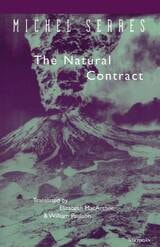
The Natural Contract
Michel Serres
University of Michigan Press, 1995
World history is often referred to as the story of human conflict. Those struggles that are seen as our history must now include the uncontrolled violence that humanity perpetrates upon the earth, and the uncontrollable menace to human life posed by the earth in reaction to this violence. Just as a social contract once brought order to human relations, Serres believes that we must now sign a "natural contract" with the earth to bring balance and reciprocity to our relations with the planet that gives us life. Our survival depends on the extent to which humans join together and act globally, on an earth now conceived as an entity.
Tracing the ancient beginnings of modernity, Serres examines the origins and possibilities of a natural contract through an extended meditation on the contractual foundations of law and science. By invoking a nonhuman, physical world, Serres asserts, science frees us from the oppressive confines of a purely social existence, but threatens to become a totalitarian order in its own right. The new legislator of the natural contract must bring science and law into balance.
Serres ends his meditation by retelling the story of the natural contract as a series of parables. He sees humanity as a spacecraft that with the help of science and technology has cast off from familiar moorings. In place of the ties that modernity and analytic reason have severed, we find a network of relations both stranger and stronger than any we once knew, binding us to one another and to the world. The philosopher's harrowing and joyous task, Serres tells us, is that of comprehending and experiencing the bonds of violence and love that unite us in our spacewalk to the spaceship Mother Earth.
"Wise, rich and poetic . . . not simply a philosophical study of the Environment, or an ecological questioning of Philosophy . . . Nature is acknowledged as an inside force which breaks [the philosopher's] discourse, and opens it up to a vigilant poetic meditation."--Substance: A Review of Theory and Literary Criticism
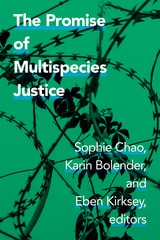
The Promise of Multispecies Justice
Sophie Chao, Karin Bolender, and Eben Kirksey, editors
Duke University Press, 2022
Contributors. Karin Bolender, Sophie Chao, M. L. Clark, Radhika Govindrajan, Zsuzsanna Dominika Ihar, Noriko Ishiyama, Eben Kirksey, Elizabeth Lara, Jia Hui Lee, Kristina Lyons, Michael Marder, Alyssa Paredes, Craig Santos Perez, Kim TallBear