Results by title
8 books match the query 'Environmental sociology'
Building Something Better
Environmental Crises and the Promise of Community ChangeStephanie A. Malin
Rutgers University Press, 2022
As the turmoil of interlinked crises unfolds across the world—from climate change to growing inequality to the rise of authoritarian governments—social scientists examine what is happening and why. Can communities devise alternatives to the systems that are doing so much harm to the planet and people?
Sociologists Stephanie A. Malin and Meghan Elizbeth Kallman offer a clear, accessible volume that demonstrates the ways that communities adapt in the face of crises and explains that sociology can help us understand how and why they do this challenging work. Tackling neoliberalism head-on, these communities are making big changes by crafting distributive and regenerative systems that depart from capitalist approaches. The vivid case studies presented range from activist water protectors to hemp farmers to renewable energy cooperatives led by Indigenous peoples and nations. Alongside these studies, Malin and Kallman present incisive critiques of colonialism, extractive capitalism, and neoliberalism, while demonstrating how sociology’s own disciplinary traditions have been complicit with those ideologies—and must expand beyond them.
Showing that it is possible to challenge social inequality and environmental degradation by refusing to continue business-as-usual, Building Something Better offers both a call to action and a dose of hope in a time of crises.
[more]
Disability, the Environment, and Colonialism
Edited by Tatiana Konrad
Temple University Press, 2024
Drawing on contemporary and historic literary and media examples of Western colonialism and Anglophone writings, Disability, the Environment, and Colonialism traces how the perverse nature of colonialism continues to dominate the globe today.
The editor and contributors provide a careful analysis of the intersection of disability, the environment, and colonialism to understand issues such as eco-ableism, environmental degradation, homogenized approaches to environmentalism, and climate change. They also look at the body as a site of colonial oppression and environmental exploitation.
Contributors: Holly Caldwell, Matthew J. C. Cella, John Gulledge, Memona Hossain, Nancy J. Hirschmann, Iain Hutchison, Andrew B. Jenks, Suha Kudsieh, Gordon M. Sayre, Jessica A. Schwartz, Anna Stenning, Aubrey Tang, Alice Wexler, and the editor.
[more]
Empty Spaces
perspectives on emptiness in modern historyEdited by Courtney J. Campbell, Allegra Giovine, and Jennifer Keating
University of London Press, 2019
How is emptiness made and what historical purpose does it serve? What cultural, material and natural work goes into maintaining ‘nothingness’? Why have a variety of historical actors, from colonial powers to artists and urban dwellers, sought to construct, control and maintain (physically and discursively) empty space, and by which processes is emptiness discovered, visualised and reimagined? This volume draws together contributions from authors working on landscapes and rurality, along with national and imperial narratives, from Brazil to Russia and Ireland. It considers the visual, including the art of Edward Hopper and the work of the British Empire Marketing Board, while concluding with a section that examines constructions of emptiness in relation to capitalism, development and the (re)appropriation of urban space. In doing so, it foregrounds the importance of emptiness as a productive prism through which to interrogate a variety of imperial, national, cultural and urban history.
[more]
From Environmental Loss to Resistance
Infrastructure and the Struggle for Justice in North AmericaMichael Loadenthal
University of Massachusetts Press, 2020
North Americans have reached a socioenvironmental tipping point where social transformation has become necessary to secure a stable and desirable future. As hurricanes destroy coastal areas that once hosted schools and homes, petroleum refineries choke nearby communities and their parks, and pipeline construction threatens water rights for indigenous peoples, communities are left to determine how to best manage and mitigate environmental loss.
In this new collection, a range of contributors—among them researchers, practitioners, organizers, and activists—explore the ways in which people counter or cope with feelings of despair, leverage action for positive change, and formulate pathways to achieve environmental justice goals. These essays pay particular attention to issues of race, class, economic liberalization, and geography; place contemporary environmental struggles in a critical context that emphasizes justice, connection, and reconciliation; and raise important questions about the challenges and responses that concern those pursuing environmental justice.
Contributors include the volume editors, Carol J. Adams, Randall Amster, Jan Inglis, Eileen Delehanty Pearkes, Zoë Roller, and Michael Truscello.
[more]
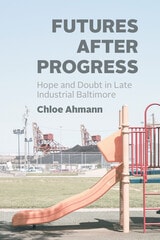
Futures after Progress
Hope and Doubt in Late Industrial BaltimoreChloe Ahmann
University of Chicago Press, 2024
A powerful ethnographic study of South Baltimore, a place haunted by toxic pasts in its pursuit of better futures.
Factory fires, chemical explosions, and aerial pollutants have inexorably shaped South Baltimore into one of the most polluted places in the country. In Futures after Progress, anthropologist Chloe Ahmann explores the rise and fall of industrial lifeways on this edge of the city and the uncertainties that linger in their wake. Writing from the community of Curtis Bay, where two hundred years of technocratic hubris have carried lethal costs, Ahmann also follows local efforts to realize a good future after industry and the rifts competing visions opened between neighbors.
Examining tensions between White and Black residents, environmental activists and industrial enthusiasts, local elders and younger generations, Ahmann shows how this community has become a battleground for competing political futures whose stakes reverberate beyond its six square miles in a present after progress has lost steam. And yet—as one young resident explains—“that’s not how the story ends.” Rigorous and moving, Futures after Progress probes the deep roots of our ecological predicament, offering insight into what lies ahead for a country beset by dreams deferred and a planet on the precipice of change.
[more]
Residues
Thinking Through Chemical EnvironmentsSoraya Boudia
Rutgers University Press, 2022
Winner of the 2023 Merton Award from the Science, Knowledge, and Technology section of the American Sociological Association
Residues offers readers a new approach for conceptualizing the environmental impacts of chemicals production, consumption, disposal, and regulation. Environmental protection regimes tend to be highly segmented according to place, media, substance, and effect; academic scholarship often reflects this same segmented approach. Yet, in chemical substances we encounter phenomena that are at once voluminous and miniscule, singular and ubiquitous, regulated yet unruly. Inspired by recent studies of materiality and infrastructures, we introduce “residual materialism” as a framework for attending to the socio-material properties of chemicals and their world-making powers. Tracking residues through time, space, and understanding helps us see how the past has been built into our present chemical environments and future-oriented regulatory systems, why contaminants seem to always evade control, and why the Anthropocene is as inextricably harnessed to the synthesis of carbon into new molecules as it is driven by carbon’s combustion.
[more]
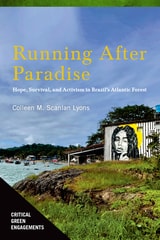
Running After Paradise
Hope, Survival, and Activism in Brazil's Atlantic ForestColleen M. Scanlan Lyons
University of Arizona Press, 2022
Brazil’s Atlantic Forest is a paradise to many. In Southern Bahia, surfers, billionaires, travelers, and hippies mingle with environmentalists, family farmers, quilombolas (descendants of formerly enslaved people), and nativos, or “locals.” Each of these groups has connections to the unique environment, culture, and character of this region as their home, their source of a livelihood, or perhaps their vacation escape. And while sometimes these connections converge—other times they clash.
The pressures on this tropical forest are palpable. So are people’s responses to these pressures. What was once the state’s economic mainstay, cacao production, is only now beginning to make a comeback after a disease decimated the crops of large and small farmers alike. Tourism, another economic hope, is susceptible to economic crises and pandemics. And the threat of a massive state-led infrastructure project involving mining, a railroad, and an international port has loomed over the region for well over a decade.
Southern Bahia is at a crossroads: develop a sustainable, forest-based economy or run the risk of losing the identity and soul of this place forevermore. Through the lives of environmentalists, farmers, quilombolas, and nativos—people who are in and of this place—this book brings alive the people who are grappling with this dilemma.
Anthropologist Colleen M. Scanlan Lyons brings the eye of a storyteller to present this complex struggle, weaving in her own challenges of balancing family and fieldwork alongside the stories of the people who live in this dynamic region. Intertwined tales, friendships, and hope emerge as people both struggle to sustain their lives in a biodiversity hotspot and strive to create their paradise.
[more]
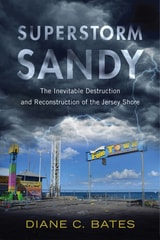
Superstorm Sandy
The Inevitable Destruction and Reconstruction of the Jersey ShoreBates, Diane C
Rutgers University Press, 2015
Sandy was the costliest hurricane in U.S. history after Katrina, but the waters had barely receded from the Jersey coast when massive efforts began to “Restore the Shore.” Why do people build in areas open to repeated natural disasters? And why do they return to these areas in the wake of major devastation? Drawing on a variety of insights from environmental sociology, Superstorm Sandy answers these questions as it looks at both the unique character of the Jersey Shore and the more universal ways that humans relate to their environment.
Diane C. Bates offers a wide-ranging look at the Jersey Shore both before and after Sandy, examining the many factors—such as cultural attachment, tourism revenues, and governmental regulation—that combined to create a highly vulnerable coastal region. She explains why the Shore is so important to New Jerseyans, acting as a key cultural touchstone in a state that lacks a central city or even a sports team to build a shared identity among the state’s residents. She analyzes post-Sandy narratives about the Jersey Shore that trumpeted the dominance of human ingenuity over nature (such as the state’s “Stronger than the Storm” advertising campaign) or proclaimed a therapeutic community (“Jersey Strong”)—narratives rooted in emotion and iconography, waylaying any thought of the near-certainty of future storms. The book also examines local business owners, politicians, real estate developers, and residents who have vested interests in the region, explaining why the Shore was developed intensively prior to Sandy, and why restoration became an imperative in the post-storm period.
Engagingly written and insightful, Superstorm Sandy highlights the elements that compounded the disaster on the Shore, providing a framework for understanding such catastrophes and preventing them in the future.
[more]