Results by title
6 books match the query 'Environmentalism in art'
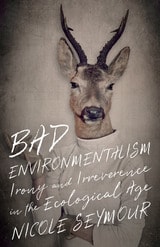
Bad Environmentalism
Irony and Irreverence in the Ecological AgeNicole Seymour
University of Minnesota Press, 2018
Traces a tradition of ironic and irreverent environmentalism, asking us to rethink the movement’s reputation for gloom and doom
Activists today strive to educate the public about climate change, but sociologists have found that the more we know about alarming issues, the less likely we are to act. Meanwhile, environmentalists have acquired a reputation as gloom-and-doom killjoys. Bad Environmentalism identifies contemporary texts that respond to these absurdities and ironies through absurdity and irony—as well as camp, frivolity, irreverence, perversity, and playfulness.
Nicole Seymour develops the concept of “bad environmentalism”: cultural thought that employs dissident affects and sensibilities to reflect critically on our current moment and on mainstream environmental activism. From the television show Wildboyz to the short film series Green Porno, Seymour shows that this tradition of thought is widespread—spanning animation, documentary, fiction film, performance art, poetry, prose fiction, social media, and stand-up comedy since at least 1975. Seymour argues that these texts reject self-righteousness and sentimentality, undercutting public negativity toward activism and questioning basic environmentalist assumptions: that love and reverence are required for ethical relationships with the nonhuman and that knowledge is key to addressing problems like climate change.
Funny and original, Bad Environmentalism champions the practice of alternative green politics. From drag performance to Indigenous comedy, Seymour expands our understanding of how environmental art and activism can be pleasurable, even in a time of undeniable crisis.
Captive Ecologies
The Environmental Afterlives of SlaveryJennifer C. James
Duke University Press, 2026
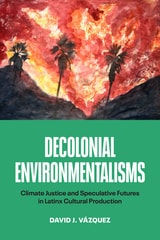
Decolonial Environmentalisms
Climate Justice and Speculative Futures in Latinx Cultural ProductionDavid J. Vázquez
University of Texas Press, 2025
A critical examination of the environmental movement and the Latinx voices that are shifting how to think about a future shaped by climate change.
In Decolonial Environmentalisms, David Vázquez argues that the mainstream environmental movement is implicated in racial capitalism, not least through its ignorance of environmental justice as it pertains to Latinx people. Through close readings of eco-minded novels, films, visual art, and short stories by Chicanx, Puerto Rican, Dominican, Cuban American, Peruvian, and Central American culture makers, Vázquez surfaces diverse Latinx visions for an equitable and sustainable humanity.
In the creations of Helena María Viramontes, Ester Hernández, Salvador Plascencia, the printmaking collective Dominican York Proyecto GRAFICA, and others, Vázquez locates a bracing critique of racist elisions and assumptions in hegemonic environmentalist thought. At the same time, he shows that the roles of Latinx people in the exploitation of the US West and the ruin of Indigenous communities are ripe for self-examination, in hopes of sparking reform. Indeed, Decolonial Environmentalisms is a work of guarded optimism, finding glimmers of possibility even in dystopic science fiction. The overlooked experiences of Latinx people, Vázquez suggests, can inspire environmental movements capable of transformative advocacy.

Loving Orphaned Space
The Art and Science of Belonging to EarthMrill Ingram
Temple University Press, 2022
How we relate to orphaned space matters. Voids, marginalia, empty spaces—from abandoned gas stations to polluted waterways—are created and maintained by politics, and often go unquestioned. In Loving Orphaned Space, Mrill Ingram provides a call to action to claim and to cherish these neglected spaces and make them a source of inspiration through art and/or remuneration.
Ingram advocates not only for “urban greening” and “green planning,” but also for “radical caring.” These efforts create awareness and understanding of ecological connectivity and environmental justice issues—from the expropriation of land from tribal nations, to how race and class issues contribute to creating orphaned space. Case studies feature artists, scientists, and community collaborations in Chicago, New York, and Fargo, ND, where grounded and practical work of a fundamentally feminist nature challenges us to build networks of connection and care.
The work of environmental artists who venture into and transform these disconnected sites of infrastructure allow us to rethink how to manage the enormous amount of existing overlooked and abused space. Loving Orphaned Space provides new ways humans can negotiate being better citizens of Earth.
Performing Environmentalisms
Expressive Culture and Ecological ChangeEdited by John Holmes McDowell, Katherine Borland, Rebecca Dirksen, and Sue Tuohy
University of Illinois Press, 2021
Interdisciplinary in approach and wide-ranging in scope, Performing Environmentalisms is an engaging look at the merger of cultural expression and environmental action on the front lines of today's global emergency.
Contributors: Aaron S. Allen, Eduardo S. Brondizio, Assefa Tefera Dibaba, Rebecca Dirksen, Mary Hufford, John Holmes McDowell, Mark Pedelty, Jennifer C. Post, Chie Sakakibara, Jeff Todd Titon, Rory Turner, Lois Wilcken
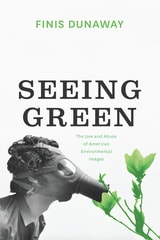
Seeing Green
The Use and Abuse of American Environmental ImagesFinis Dunaway
University of Chicago Press, 2015
Finis Dunaway closes that gap with Seeing Green. Considering a wide array of images—including pictures in popular magazines, television news, advertisements, cartoons, films, and political posters—he shows how popular environmentalism has been entwined with mass media spectacles of crisis. Beginning with radioactive fallout and pesticides during the 1960s and ending with global warming today, he focuses on key moments in which media images provoked environmental anxiety but also prescribed limited forms of action. Moreover, he shows how the media have blamed individual consumers for environmental degradation and thus deflected attention from corporate and government responsibility. Ultimately, Dunaway argues, iconic images have impeded efforts to realize—or even imagine—sustainable visions of the future.
Generously illustrated, this innovative book will appeal to anyone interested in the history of environmentalism or in the power of the media to shape our politics and public life.