Results by title
12 books match the query 'Environmentalism in literature'
A Place for Humility
Whitman, Dickinson, and the Natural WorldChristine Gerhardt
University of Iowa Press, 2014
Dickinson and Whitman developed their environmentally suggestive poetics at roughly the same historical moment, at a time when a major shift was occurring in American culture’s view and understanding of the natural world. Just as they were achieving poetic maturity, the dominant view of wilderness was beginning to shift from obstacle or exploitable resource to an endangered treasure in need of conservation and preservation.
A Place for Humility examines Dickinson’s and Whitman’s poetry in conjunction with this important change in American environmental perception, exploring the links between their poetic projects within the context of developing nineteenth-century environmental thought. Christine Gerhardt argues that each author's poetry participates in this shift in different but related ways, and that their involvement with their culture’s growing environmental sensibilities constitutes an important connection between their disparate poetic projects. There may be few direct links between Dickinson’s “letter to the World” and Whitman’s “language experiment,” but via a web of environmentally-oriented discourses, their poetry engages in a cultural conversation about the natural world and the possibilities and limitations of writing about it—a conversation in which their thematic and formal choices meet on a surprising number of levels.
Beasts at Bedtime
Revealing the Environmental Wisdom in Children’s LiteratureLiam Heneghan
University of Chicago Press, 2018
In Beasts at Bedtime, scientist (and father) Liam Heneghan examines the environmental underpinnings of children’s stories. From Beatrix Potter to Harry Potter, Heneghan unearths the universal insights into our inextricable relationship with nature that underlie so many classic children’s stories. Some of the largest environmental challenges in coming years—from climate instability, the extinction crisis, freshwater depletion, and deforestation—are likely to become even more severe as this generation of children grows up. Though today’s young readers will bear the brunt of these environmental calamities, they will also be able to contribute to environmental solutions if prepared properly. And all it takes is an attentive eye: Heneghan shows how the nature curriculum is already embedded in bedtime stories, from the earliest board books like The Rainbow Fish to contemporary young adult classics like The Hunger Games.
Beasts at Bedtime is an awakening to the vital environmental education children’s stories can provide—from the misadventures of The Runaway Bunny to more overt tales like The Lorax. Heneghan serves as our guide, drawing richly upon his own adolescent and parental experiences, as well as his travels in landscapes both experienced and imagined. Organized into thematic sections, the work winds its way through literary forests, colorful characters, and global environments.
This book enthralls as it engages. Heneghan as a guide is as charming as he is insightful, showing how kids (and adults) can start to experience the natural world in incredible ways from the comfort of their own rooms. Beasts at Bedtime will help parents, teachers, and guardians extend those cozy times curled up together with a good book into a lifetime of caring for our planet.
Captive Ecologies
The Environmental Afterlives of SlaveryJennifer C. James
Duke University Press, 2026
Ecoambiguity
Environmental Crises and East Asian LiteraturesKaren Laura Thornber
University of Michigan Press, 2012
Ecoambiguity is the first book in any language to analyze Chinese, Japanese, Korean, and Taiwanese literary treatments of damaged ecosystems. Thornber closely examines East Asian creative portrayals of inconsistent human attitudes, behaviors, and information concerning the environment and takes up texts by East Asians who have been translated and celebrated around the world, including Gao Xingjian, Ishimure Michiko, Jiang Rong, and Ko Un, as well as fiction and poetry by authors little known even in their homelands. Ecoambiguity addresses such environmental crises as deforesting, damming, pollution, overpopulation, species eradication, climate change, and nuclear apocalypse. This book opens new portals of inquiry in both East Asian literatures and ecocriticism (literature and environment studies), as well as in comparative and world literature.
Empire and Environment
Ecological Ruin in the TranspacificJeffrey Santa Ana, Heidi Amin-Hong, Rina Garcia Chua, Zhou Xiaojing, Editors
University of Michigan Press, 2022
Everyday Ecofascism
Crisis and Consumption in American LiteratureAlexander Menrisky
University of Minnesota Press, 2025
A timely look into how fascist ideas permeate contemporary culture well beyond the far right
As challenges posed by climate change have intensified in the twenty-first century, right-wing figures in the United States and abroad have increasingly framed anti-immigrant, anti-Indigenous, and white-supremacist sentiments in terms of environmental survival. Everyday Ecofascism explores the insidious nature of this tendency, revealing how permutations of these perspectives in fact resonate across the political spectrum. Drawing on comparative studies of fascism writ large, Alexander Menrisky demonstrates that ecofascism is best understood not as a uniquely right-wing ideology but as a political genre that reinforces white supremacy and other forms of domination.
Presenting a view of fascism as a complex power network that plays out on scales both large and small, Menrisky shows how extremist sentiments have crept into everyday language, stories, and ideas. Through a literary and cultural studies lens, he illuminates ecofascism’s narrative patterns and their easy permeation of environmentalist discourses, from back-to-the-land movements to the resurgence of psychedelic drugs, food localism, and pandemic politics. Opposite his analysis of ecofascism in action, Menrisky sheds important light on narrative resistances to dominant conceptions of race, nation, and territory by Native, queer, and women-of-color writers who have countered ethnonationalism for generations.
Bridging past and present, Menrisky powerfully nails down the emergent concept of ecofascism and forms a basis for understanding phenomena like Covid-19, ecological utopianism, and psychedelic environmentalism that detangles ecofascist tendencies from justice-oriented visions of place-based belonging.
Retail e-book files for this title are screen-reader friendly.
Fictional Environments
Mimesis, Deforestation, and Development in Latin AmericaVictoria Saramago
Northwestern University Press, 2021
Winner of the Brazilian Studies Association’s Roberto Reis Book Award for First Monograph • Honorable Mention for the Latin American Studies Association’s Antonio Candido Book Award • Shortlisted for the Association for the Study of Literature and Environment Book Award
Fictional Environments: Mimesis, Deforestation, and Development in Latin America investigates how fictional works have become sites for the production of knowledge, imagination, and intervention in Latin American environments. It investigates the dynamic relationship between fictional images and real places, as the lasting representations of forests, rural areas, and deserts in novels clash with collective perceptions of changes like deforestation and urbanization.
From the backlands of Brazil to a developing Rio de Janeiro, and from the rainforests of Venezuela and Peru to the Mexican countryside, rapid deforestation took place in Latin America in the second half of the twentieth century. How do fictional works and other cultural objects dramatize, resist, and intervene in these ecological transformations? Through analyses of work by João Guimarães Rosa, Alejo Carpentier, Juan Rulfo, Clarice Lispector, and Mario Vargas Llosa, Victoria Saramago shows how novels have inspired conservationist initiatives and offered counterpoints to developmentalist policies, and how environmental concerns have informed the agendas of novelists as essayists, politicians, and public intellectuals. This book seeks to understand the role of literary representation, or mimesis, in shaping, sustaining, and negotiating environmental imaginaries during the deep, ongoing transformations that have taken place from the 1950s to the present.
Finding Thoreau
The Meaning of Nature in the Making of an Environmental IconRichard W. Judd
University of Massachusetts Press, 2018
In his 1862 eulogy for Henry David Thoreau, Ralph Waldo Emerson reflected that his friend “dedicated his genius with such entire love to the fields, hills, and waters of his native town, that he made them known and interesting to all reading Americans, and to people over the sea.” Finding Thoreau traces the reception of Thoreau's work from the time of his death to his ascendancy as an environmental icon in the 1970s, revealing insights into American culture's conception of the environment.
Moving decade by decade through this period, Richard W. Judd unveils a cache of commentary from intellectuals, critics, and journalists to demonstrate the dynamism in the idea of nature, as Americans defined and redefined the organic world around them amidst shifting intellectual, creative, and political forces. This book tells the captivating story of one writer's rise from obscurity to fame through a cultural reappraisal of the work he left behind.
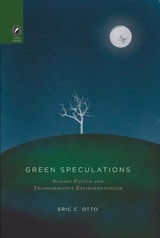
Green Speculations
Science Fiction and Transformative EnvironmentalismEric C. Otto
The Ohio State University Press, 2012
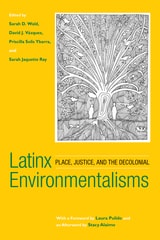
Latinx Environmentalisms
Place, Justice, and the DecolonialSarah D. Wald
Temple University Press, 2019
The whiteness of mainstream environmentalism often fails to account for the richness and variety of Latinx environmental thought. Building on insights of environmental justice scholarship as well as critical race and ethnic studies, the editors and contributors to Latinx Environmentalisms map the ways Latinx cultural texts integrate environmental concerns with questions of social and political justice.
Original interviews with creative writers, including Cherríe Moraga, Helena María Viramontes, and Héctor Tobar, as well as new essays by noted scholars of Latinx literature and culture, show how Latinx authors and cultural producers express environmental concerns in their work. These chapters, which focus on film, visual art, and literature—and engage in fields such as disability studies, animal studies, and queer studies—emphasize the role of racial capitalism in shaping human relationships to the more-than-human world and reveal a vibrant tradition of Latinx decolonial environmentalism.
Latinx Environmentalisms accounts for the ways Latinx cultures are environmental, but often do not assume the mantle of “environmentalism.”
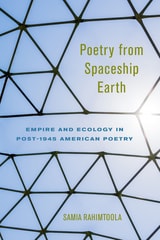
Poetry from Spaceship Earth
Empire and Ecology in Post-1945 American PoetrySamia Rahimtoola
University of Iowa Press, 2026
In the early decades of the postwar period, the planetary metaphor of “spaceship Earth” was everywhere in the West. It exerted its power on sites as various as Caribbean research stations, the shipping lanes of the U.S.-occupied Pacific, Palestinian refugee camps, and the internal colonies of segregated nations. At its heart was a new ideology and infrastructure of managing, administering, and rationalizing nature through which Western powers sought to maintain their grip on a decolonizing planet.
Poetry from Spaceship Earth retrieves a diverse array of postwar American poets—Robert Duncan, June Jordan, Joanne Kyger, Lorine Niedecker, and Charles Olson—who contested and cultivated alternatives to this emergent mode of environmentalism. By placing the major innovations of postwar poetry into conversation with environmental politics, Cold War science and technology studies, and postcolonial and Black studies, Samia Rahimtoola develops an original theoretical and historical account of the racial and colonial logics that underpin the supposedly neutral project of managing nature.
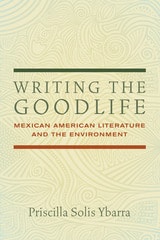
Writing the Goodlife
Mexican American Literature and the EnvironmentPriscilla Solis Ybarra
University of Arizona Press, 2016
Goodlife writing has existed for at least the past century, Ybarra contends, but Chicana/o literary history’s emphasis on justice and civil rights eclipsed this tradition and hidden it from the general public’s view. Likewise, in ecocriticism, the voices of people of color most often appear in deliberations about environmental justice. The quiet power of goodlife writing certainly challenges injustice, to be sure, but it also brings to light the decolonial environmentalism heretofore obscured in both Chicana/o literary history and environmental literary studies.
Ybarra’s book takes on two of today’s most discussed topics—the worsening environmental crisis and the rising Latino population in the United States—and puts them in literary-historical context from the U.S.-Mexico War up to today’s controversial policies regarding climate change, immigration, and ethnic studies. This book uncovers 150 years’ worth of Mexican American and Chicana/o knowledge and practices that inspire hope in the face of some of today’s biggest challenges.