Results by title
63 books match the query 'Environmentalists & Naturalists' and 11 start with a
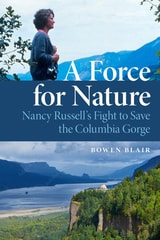
A Force for Nature
Nancy Russell's Fight to Save the Columbia GorgeBowen Blair
Oregon State University Press, 2022
The 85-mile-long Columbia Gorge forms part of the border between Oregon and Washington and is one of the nation’s most historic and scenic landscapes. Many of the region’s cultural divisions boil over here—urban versus rural, west of the mountains versus east—as well as clashes over private property rights, management of public lands, and tribal treaty rights.
In the early 1980s, as a new interstate bridge linked the City of Portland to rural counties in Washington, the Gorge’s renowned vistas were on the brink of destruction. Nancy Russell, forty-eight years old and with no experience in advocacy, fundraising, or politics, built a grassroots movement that overcame 70 years of failed efforts and bitter opposition from both Oregon and Washington governors, five of the six Gorge counties, 41,000 Gorge residents, and the Reagan administration. While building her campaign, Russell stopped subdivisions, factories, and government neglect through litigation brought by her organization, Friends of the Columbia Gorge, and last-second land purchases by the Trust for Public Land (TPL). Initially ignored, then demonized, Russell’s tires were slashed and her life threatened.
The Columbia River Gorge National Scenic Area Act barely passed—on the last day of the congressional session in 1986—and was signed by a reluctant President Reagan hours before the bill would die. Russell positioned the Friends to be a watchdog and orchestrated the purchase of thousands of acres of land for the public. Bowen Blair, an attorney, former executive director of Friends of the Columbia Gorge, and TPL senior vice president, brings an insider’s perspective to the tumultuous and inspiring story of this conservation battle.
A Force for Nature
Nancy Russell's Fight to Save the Columbia GorgeBowen Blair
Oregon State University Press, 2022
The 85-mile-long Columbia Gorge forms part of the border between Oregon and Washington and is one of the nation’s most historic and scenic landscapes. Many of the region’s cultural divisions boil over here—urban versus rural, west of the mountains versus east—as well as clashes over private property rights, management of public lands, and tribal treaty rights.
In the early 1980s, as a new interstate bridge linked the City of Portland to rural counties in Washington, the Gorge’s renowned vistas were on the brink of destruction. Nancy Russell, forty-eight years old and with no experience in advocacy, fundraising, or politics, built a grassroots movement that overcame 70 years of failed efforts and bitter opposition from both Oregon and Washington governors, five of the six Gorge counties, 41,000 Gorge residents, and the Reagan administration. While building her campaign, Russell stopped subdivisions, factories, and government neglect through litigation brought by her organization, Friends of the Columbia Gorge, and last-second land purchases by the Trust for Public Land (TPL). Initially ignored, then demonized, Russell’s tires were slashed and her life threatened.
The Columbia River Gorge National Scenic Area Act barely passed—on the last day of the congressional session in 1986—and was signed by a reluctant President Reagan hours before the bill would die. Russell positioned the Friends to be a watchdog and orchestrated the purchase of thousands of acres of land for the public. Bowen Blair, an attorney, former executive director of Friends of the Columbia Gorge, and TPL senior vice president, brings an insider’s perspective to the tumultuous and inspiring story of this conservation battle.
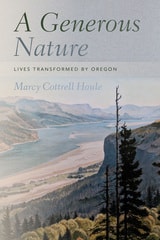
A Generous Nature
Lives Transformed by OregonMarcy Cottrell Houle
Oregon State University Press, 2019
A Generous Nature: Lives Transformed by Oregon offers profiles of twenty-one conservationists and activists who have made enduring contributions to the preservation of Oregon’s wild and natural places and high quality of life. These stories speak to their courage, foresight, and actions—at times against great odds— to enact legislation and motivate others to cherish and protect the places that make Oregon unique.
Taken from personal interviews conducted by the author over a decade, these stories will help readers understand the histories of Oregon’s exceptional places, innovative planning efforts, and laws. They provide insight into the principles and values that motivated individuals to preserve the beauty and natural resources of Oregon, craft legislation to further protect them, and educate others about their value. Houle features locations as diverse as the Columbia River Gorge Natural Scenic Area, the wild and scenic Sandy River, and Tryon Creek State Park, along with background on critical laws and organizations such as the Beach Bill, Diack Act, Senate Bill 100, SOLVE, and the High Desert Partnership.
These stories do more than educate. They will inspire readers and demonstrate that individually we can make a difference. A Generous Nature is a crucial reminder of our responsibility to stand for and defend the places, ideals, and laws that make Oregon a progressive model for the rest of the nation.
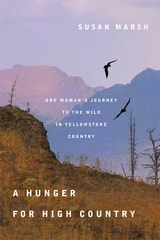
A Hunger for High Country
One Woman’s Journey to the Wild in Yellowstone CountrySusan Marsh
Oregon State University Press, 2014
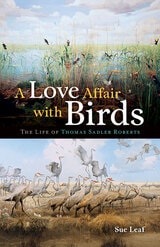
A Love Affair with Birds
The Life of Thomas Sadler RobertsSue Leaf
University of Minnesota Press, 2021
The father of Minnesota ornithology, whose life story opens a window on a lost world of nature and conservation in the state’s early days
Imagine a Minneapolis so small that, on calm days, the roar of St. Anthony Falls could be heard in town, a time when passenger pigeons roosted in neighborhood oak trees. Now picture a dapper professor conducting his ornithology class (the university’s first) by streetcar to Lake Harriet for a morning of bird-watching. The students were mostly young women—in sunhats, sailor tops, and long skirts, with binoculars strung around their necks. The professor was Thomas Sadler Roberts (1858–1946), a doctor for three decades, a bird lover virtually from birth, the father of Minnesota ornithology, and the man who, perhaps more than any other, promoted the study of the state’s natural history. A Love Affair with Birds is the first full biography of this key figure in Minnesota’s past.
Roberts came to Minnesota as a boy and began keeping detailed accounts of Minneapolis’s birds. These journals, which became the basis for his landmark work The Birds of Minnesota, also inform this book, affording a view of the state’s rich avian life in its early days—and of a young man whose passion for birds and practice of medicine in a young Minneapolis eventually dovetailed in his launching of the beloved Bell Museum of Natural History.
Bird enthusiast, doctor, author, curator, educator, conservationist: every chapter in Roberts’s life is also a chapter in the state’s history, and in his story acclaimed author Sue Leaf—an avid bird enthusiast and nature lover herself—captures a true Minnesota character and his time.
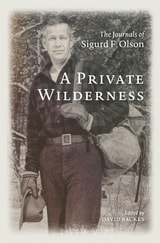
A Private Wilderness
The Journals of Sigurd F. OlsonSigurd F. Olson
University of Minnesota Press, 2024
The personal diaries of one of America’s best-loved naturalists, revealing his difficult and inspiring path to finding his voice and becoming a writer
Few writers are as renowned for their eloquence about the natural world, its power and fragility, as Sigurd F. Olson (1899–1982). Before he could give expression to The Singing Wilderness, however, he had to find his own voice. It is this struggle, the painstaking and often simply painful process of becoming the writer and conservationist now familiar to us, that Olson documented in the journal entries gathered here.
Written mostly during the years from 1930 to 1941, Olson’s journals describe the dreams and frustrations of an aspiring writer honing his skills, pursuing recognition, and facing doubt while following the academic career that allowed him to live and work even as it consumed so much of his time. But even as he speaks with immediacy and intensity about the conditions of his apprenticeship, Olson can be seen developing the singular way of observing and depicting the natural world that would bring him fame—and also, more significantly, alert others to the urgent need to understand and protect that world. Author of Olson’s definitive biography, editor David Backes brings a deep knowledge of the writer to these journals, providing critical context, commentary, and insights along the way.
When Olson wrote, in the spring of 1941, “What I am afraid of now is that the world will blow up just as I am getting it organized to suit me,” he could hardly have known how right he would prove to be. It is propitious that at our present moment, when the world seems once more balanced on the precipice, we have the words of Sigurd F. Olson to remind us of what matters—and of the hard work and the wonder that such a reckoning requires.

A Wild Path
Douglas Wood
University of Minnesota Press, 2024
A soul-satisfying journey through the wilderness that uncovers hope, healing, and the abiding grace of wild things
A Wild Path is author Douglas Wood’s highly anticipated followup to the critically acclaimed memoir Deep Woods, Wild Waters. He again leads readers along a meditative path through a wilderness of many dimensions—from the lakes and islands of his beloved Canoe Country to rugged ocean coasts to a mountain chasm, from camping on the Canadian Shield to listening to the soft strains of Beethoven in the pines, and from the pain of childhood wounds to appreciation for a life rich with nature. As on every good journey, there is plenty of laughter, warmth, and humor on the trail.
With the generosity and compassion of a good wilderness guide, Douglas Wood welcomes readers to accompany him as he navigates his life-path from struggling student and “worst reader in the class” to prolific writer and best-selling author. He offers courage and hope to those who feel different or left behind, and he shares how he found, through the counsel of rocks, trees, and waters, his own way toward joy and wonder and an unshakable sense of belonging.
Exploring the meanings of myriad outdoor experiences, Wood seeks to understand the importance and existence of beauty, the emotional poignancy of a wilderness sunset, and the realization of dreams, while also honoring his outdoor and literary mentors, including Sigurd Olson and Aldo Leopold. Traveling across continents, over oceans, and through the landscape of time, A Wild Path ranges from solitary shorelines of introspection to peaks of triumph, finding rest and tranquility in a simple cup of jasmine tea, sipped by a campfire under the stars.
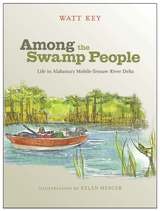
Among the Swamp People
Life in Alabama's Mobile-Tensaw River DeltaWatt Key
University of Alabama Press, 2015
Among the Swamp People is the story of author Watt Key’s discovery of the Mobile-Tensaw River Delta. “The swamp” consists of almost 260,000 acres of wetlands located just north of Mobile Bay. There he leases a habitable outcropping of land and constructs a primitive cabin from driftwood to serve as a private getaway. His story is one that chronicles the beauties of the delta’s unparalleled natural wonders, the difficulties of survival within it, and an extraordinary community of characters—by turns generous and violent, gracious and paranoid, hilarious and reckless—who live, thrive, and perish there.
There is no way into the delta except by small boat. To most it would appear a maze of rivers and creeks between stunted swamp trees and mud. Key observes that there are few places where one can step out of a boat without “sinking to the knees in muck the consistency of axle grease. It is the only place I know where gloom and beauty can coexist at such extremes. And it never occurred to me that a land seemingly so bleak could hide such beauty and adventure.”
It also chronicles Key’s maturation as a writer, from a twenty-five-year-old computer programmer with no formal training as a writer to a highly successful, award-winning writer of fiction for a young adult audience with three acclaimed novels published to date.
In learning to make a place for himself in the wild, as in learning to write, Key’s story is one of “hoping someone—even if just myself—would find value in my creations.”
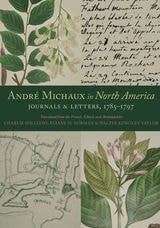
André Michaux in North America
Journals and Letters, 1785–1797Translated from the French, Edited, and Annotated by Charlie Williams, Eliane M. Norman, and Walter Kingsley Taylor
University of Alabama Press, 2020
Tracing the roots of American botany through the journals of an eighteenth-century explorer.
Known to today’s biologists primarily as the “Michx.” at the end of more than 700 plant names, André Michaux was an intrepid French naturalist. Under the directive of King Louis XVI, he was commissioned to search out and grow new, rare, and never-before-described plant species and ship them back to his homeland in order to improve French forestry, agriculture, and horticulture. He made major botanical discoveries and published them in his two landmark books, Histoire des chênes de l’Amérique (1801), a compendium of all oak species recognized from eastern North America, and Flora Boreali-Americana (1803), the first account of all plants known in eastern North America.
Straddling the fields of documentary editing, history of the early republic, history of science, botany, and American studies, André Michaux in North America: Journals and Letters, 1785–1797 is the first complete English edition of Michaux’s American journals. This copiously annotated translation includes important excerpts from his little-known correspondence as well as a substantial introduction situating Michaux and his work in the larger scientific context of the day.
To carry out his mission, Michaux traveled from the Bahamas to Hudson Bay and west to the Mississippi River on nine separate journeys, all indicated on a finely rendered, color-coded map in this volume. His writings detail the many hardships—debilitating disease, robberies, dangerous wild animals, even shipwreck—that Michaux endured on the North American frontier and on his return home. But they also convey the soaring joys of exploration in a new world where nature still reigned supreme, a paradise of plants never before known to Western science. The thrill of discovery drove Michaux ever onward, even ultimately to his untimely death in 1802 on the remote island of Madagascar.
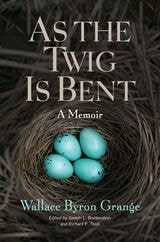
As the Twig Is Bent
A MemoirWallace Byron Grange, Edited by Joseph L. Breitenstein and Richard P. Thiel
University of Wisconsin Press, 2020
Written when Grange was in his sixties, As the Twig Is Bent conveys how a leading conservationist was formed through his early relationship to nature. In beautifully composed vignettes, he details encounters both profound and minute, from the white-footed mice attracted by cookie crumbs in his boyhood clubhouse to the sounds of great horned owls echoing through the wintry woods. As he develops his own understanding of the natural world, he comes to an awareness of the dramatic and devastating role of humankind on ecosystems. Grange’s poignant observations still resonate today amid global conversations about the fate of our natural resources and climate change.
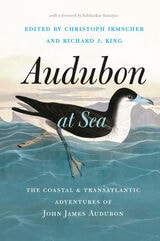
Audubon at Sea
The Coastal and Transatlantic Adventures of John James AudubonEdited by Christoph Irmscher and Richard J. King
University of Chicago Press, 2022
The American naturalist John James Audubon (1785–1851) is widely remembered for his iconic paintings of American birdlife. But as this anthology makes clear, Audubon was also a brilliant writer—and his keen gaze took in far more than creatures of the sky. Culled from his published and unpublished writings, Audubon at Sea explores Audubon’s diverse observations of the ocean, the coast, and their human and animal inhabitants. With Audubon expert Christoph Irmscher and scholar of the sea Richard J. King as our guides, we set sail from the humid expanses of the American South to the shores of England and the chilly landscapes of the Canadian North. We learn not only about the diversity of sea life Audubon documented—birds, sharks, fish, and whales—but also about life aboard ship, travel in early America, Audubon’s work habits, and the origins of beloved paintings. As we face an unfathomable loss of seabirds today, Audubon’s warnings about the fragility of birdlife in his time are prescient and newly relevant.
Charting the course of Audubon’s life and work, from his birth in Haiti to his death in New York City, Irmscher and King’s sweeping introduction and carefully drawn commentary confront the challenges Audubon’s legacy poses for us today, including his participation in American slavery and the thousands of birds he killed for his art. Rounded out by hundreds of historical and ornithological notes and beautiful illustrations, and with a foreword by distinguished photographer and conservationist Subhankar Banerjee, Audubon at Sea is the most comprehensively annotated collection of Audubon’s work ever published.