Results by title
5 books match the query 'Epistles'
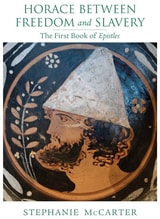
Horace between Freedom and Slavery
The First Book of <i>Epistles</i>Stephanie McCarter
University of Wisconsin Press, 2015
During the Roman transition from Republic to Empire in the first century B.C.E., the poet Horace found his own public success in the era of Emperor Augustus at odds with his desire for greater independence. In Horace between Freedom and Slavery, Stephanie McCarter offers new insights into Horace's complex presentation of freedom in the first book of his Epistles and connects it to his most enduring and celebrated moral exhortation, the golden mean.
She argues that, although Horace commences the Epistles with an uncompromising insistence on freedom, he ultimately adopts a middle course. She shows how Horace explores in the poems the application of moderate freedom first to philosophy, then to friendship, poetry, and place. Rather than rejecting philosophical masters, Horace draws freely on them without swearing permanent allegiance to any—a model for compromise that allows him to enjoy poetic
renown and friendships with the city's elite while maintaining a private sphere of freedom. This moderation and adaptability, McCarter contends, become the chief ethical lessons that Horace learns for himself and teaches to others. She reads Horace's reconfiguration of freedom as a political response to the transformations of the new imperial age.
[more]
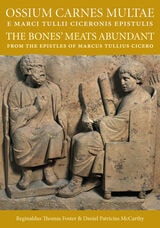
Ossium Carnes Multae e Marci Tullii Ciceronis Epistulis / The Bones’ Meats Abundant from the Epistles of Marcus Tullius Cicero
Reginaldus Thomas Foster
Catholic University of America Press, 2021
Beginners and experts alike will find a complete immersion into the workings and nature of the Latin language embodied in the incomparable, insuperable epistles of the great Marcus Tullius Cicero, something which other commentators pass over or scorn. This second volume puts “meat on the bones” of the Latin language presented in the first volume: Ossa Latinitatis Sola: The Mere Bones of Latin. The personal letters of Cicero provide ample meat to enflesh the skeletal structure of the language, thus the title: Ossium Carnes Multae: The Bones’ Meats Abundant from the epistles of Marcus Tullius Cicero.
Part 1 presents 51 complete letters from the Tyrell-Purser text. Facing each letter is an image of its oldest manuscript edition as early as the ninth century, which are preserved and guarded in the Medicea Laurentiana library in Florence, Italy, witnessing to the human hand preserving this monument of world heritage for over two millennia.
Part 2 follows with a most careful rendition into English of Tully’s living, telephone-like Latin discourse. A thorough treatment and explanation of noteworthy elements of his natural talk follows with numerous references to the Encounters in Volume I. All this has students, learners, teachers, experts of the Latin language in mind and is humbly designed to deepen the understanding and appreciation of specific expressions and peculiarities of Cicero’s language itself.
Part 3 provides 500 sentences consisting of from 1 to 5 words and suited for the beginnings or continuation of Latin conversations: 200 declarations, 100 questions, 100 exclamations, 100 injunctions drawn from his letters. The volume is amply indexed.
All this has been done to enhance the study and use of Latin, to popularize Cicero’s correspondence, to prepare the reader for Volume III which will deal again with the letters and their usefulness for Latin conversation.
[more]
Reading Women in the New Testament Letters
Korinna Zamfir
SBL Press, 2024
This volume explores the differing views expressed in the New Testament letters about the position of women in first- and second-generation Christian communities. Contributors place the letters in their broader Jewish and Greco-Roman cultural, religious, and social contexts to better understand how gender roles, family life, and women’s responsibilities for spreading the gospel changed over time. While some essays envision the lived realities of women as wives, mothers, and widows—both the free and the enslaved, others examine the rhetorical and theological function of female metaphors. Contributors include Bernadette Brooten, Christine Gerber, Annette Bourland Huizenga, Marianne Bjelland Kartzow, Beate Kowalski, Dominika Kurek-Chomycz, Peter Lampe, William R. G. Loader, Elisa Estévez López, Heidrun E. Mader, Marinella Perroni, Silke Petersen, Uta Poplutz, María José Schultz Montalbetti, Michael Sommer, Angela Standhartinger, Miklós Szabó, Korinna Zamfir, and Silvia Zanconato.
[more]
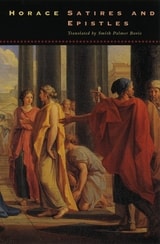
Satires and Epistles
Horace
University of Chicago Press, 1959
The writings of Horace have exerted strong and continuing influence on writers from his day to our own. Sophisticated and intellectual, witty and frank, he speaks to the cultivated and civilized world of today with the same astringent candor and sprightliness that appeared so fresh at the height of Rome's wealthy and glory.
The Satires and Epistles spans the poet's career as a satirist, critic, and master of lyric poetry, as man of the world, friend of the great, and relentless enemy of the mediocre. "Horace," writes translator Smith Palmer Bovie, "is the best antidote in the world for anxiety. His Satires and Epistles demonstrate the good-humored freedom of a man who has cheerfully assumed the responsibility for making his own life not so much a 'success' as the occasion for a true enjoyment of virtue and knowledge." Bovie's impeccable translation, along with Clancy's edition of the Odes and Epodes, offers the reader a complete and modern Horace.
The Satires and Epistles spans the poet's career as a satirist, critic, and master of lyric poetry, as man of the world, friend of the great, and relentless enemy of the mediocre. "Horace," writes translator Smith Palmer Bovie, "is the best antidote in the world for anxiety. His Satires and Epistles demonstrate the good-humored freedom of a man who has cheerfully assumed the responsibility for making his own life not so much a 'success' as the occasion for a true enjoyment of virtue and knowledge." Bovie's impeccable translation, along with Clancy's edition of the Odes and Epodes, offers the reader a complete and modern Horace.
[more]
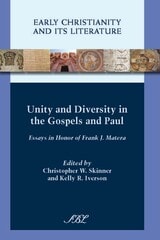
Unity and Diversity in the Gospels and Paul
Essays in Honor of Frank J. MateraChristopher W. Skinner
SBL Press, 2012
This volume addresses the perennial issue of unity and diversity in the New Testament canon. Celebrating the academic legacy of Fr. Frank J. Matera, colleagues and friends interact with elements of his many important works. Scholars and students alike will find fresh and stimulating discussions that navigate the turbulent waters between the Gospels and Paul, ranging from questions of Matthew's so-called anti-Pauline polemic to cruciform teaching in the New Testament. The volume includes contributions from leading scholars in the field, offering a rich array of insights on issues such as Christology, social ethics, soteriology, and more. The contributors are Paul J. Achtemeier, Sherri Brown, Raymond F. Collins, A. Andrew Das, John R. Donahue, S.J., Francis T. Gignac, S.J., Michael J. Gorman, Kelly R. Iverson, Luke Timothy Johnson, Jack Dean Kingsbury, William S. Kurz, S.J., John P. Meier, Francis J. Moloney, S.D.B., Christopher W. Skinner, and Matt Whitlock.
[more]