Results by title
4 books match the query 'Epistolary poetry, Latin'
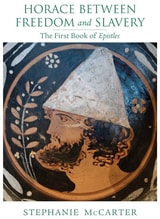
Horace between Freedom and Slavery
The First Book of <i>Epistles</i>Stephanie McCarter
University of Wisconsin Press, 2015
During the Roman transition from Republic to Empire in the first century B.C.E., the poet Horace found his own public success in the era of Emperor Augustus at odds with his desire for greater independence. In Horace between Freedom and Slavery, Stephanie McCarter offers new insights into Horace's complex presentation of freedom in the first book of his Epistles and connects it to his most enduring and celebrated moral exhortation, the golden mean.
She argues that, although Horace commences the Epistles with an uncompromising insistence on freedom, he ultimately adopts a middle course. She shows how Horace explores in the poems the application of moderate freedom first to philosophy, then to friendship, poetry, and place. Rather than rejecting philosophical masters, Horace draws freely on them without swearing permanent allegiance to any—a model for compromise that allows him to enjoy poetic
renown and friendships with the city's elite while maintaining a private sphere of freedom. This moderation and adaptability, McCarter contends, become the chief ethical lessons that Horace learns for himself and teaches to others. She reads Horace's reconfiguration of freedom as a political response to the transformations of the new imperial age.
[more]
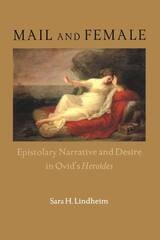
Mail and Female
Epistolary Narrative and Desire in Ovid's HeroidesSara H. Lindheim
University of Wisconsin Press, 2003
In the Heroides, the Roman poet Ovid wittily plucks fifteen abandoned heroines from ancient myth and literature and creates the fiction that each woman writes a letter to the hero who left her behind. But in giving voice to these heroines, is Ovid writing like a woman, or writing "Woman" like a man?
Using feminist and psychoanalytic approaches to examine the "female voice" in the Heroides, Sara H. Lindheim closely reads these fictive letters in which the women seemingly tell their own stories. She points out that in Ovid’s verse epistles all the women represent themselves in a strikingly similar and disjointed fashion. Lindheim turns to Lacanian theory of desire to explain these curious and hauntingly repetitive representations of the heroines in the "female voice." Lindheim’s approach illuminates what these poems reveal about both masculine and feminine constructions of the feminine
Using feminist and psychoanalytic approaches to examine the "female voice" in the Heroides, Sara H. Lindheim closely reads these fictive letters in which the women seemingly tell their own stories. She points out that in Ovid’s verse epistles all the women represent themselves in a strikingly similar and disjointed fashion. Lindheim turns to Lacanian theory of desire to explain these curious and hauntingly repetitive representations of the heroines in the "female voice." Lindheim’s approach illuminates what these poems reveal about both masculine and feminine constructions of the feminine
[more]
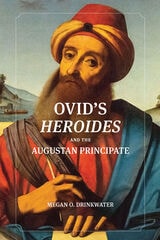
Ovid's "Heroides" and the Augustan Principate
Megan O. Drinkwater
University of Wisconsin Press, 2023
43 BCE, the year after the assassination of Julius Caesar. While the Roman republic had seen many conflicts, it was this civil war, headed by the vengeful triumvirate of Mark Anthony, Marcus Lepidus, and Octavian, that irrevocably transformed Rome with its upheaval. What followed was years of fighting and the eventual ascendancy of Octavian, who from 27 BCE onwards would be best known as Caesar Augustus, founder of the Roman Principate.
It was in this era of turmoil and transformation that Ovid, the Roman poet best known for Metamorphoses, was born. The Heroides, one of his earliest and most elusive works, is not written from the first-person perspective that so often characterizes the elegiac poetry of that time but from the personae of tragic heroines of classical mythology.
Megan O. Drinkwater illustrates how Ovid used innovations of literary form to articulate an expression of the crisis of civic identity in Rome at a time of extreme and permanent political change. The letters are not divorced from the context of their composition but instead elucidate that context for their readers and expose how Ovid engaged in politics throughout his entire career. Their importance is as much historical as literary. Drinkwater makes a compelling case for understanding the Heroides as a testament from one of Rome’s most eloquent writers to the impact that the dramatic shift from republic to empire had on its intellectual elites.
[more]
Renaissance Postscripts
Responding to Ovid's Heroides in Sixteenth-Century FrancePaul White
The Ohio State University Press, 2009
Ovid’s Heroides, a collection consisting mainly of poetic love letters sent by mythological heroines to their absent lovers, held a particular fascination for Renaissance readers. To understand their responses to these letters, we must ask exactly how and in what contexts those readers first encountered them: were they read in Latin or in the vernacular; as source texts for the learning of grammar and history or as love poetry; as epistolary and rhetorical models or as moral examples?
Renaissance Postscripts: Responding to Ovid’s Heroides in Sixteenth-Century France by Paul White offers an account of the wide variety of responses to the Heroides within the realm of humanist education, in the works of both Latin commentators and French translators, and as an example of a particular mode of imitation. The author examines how humanists shaped the discourse of Ovid’s heroines and heroes to pedagogical ends and analyses even the woodcuts that illustrated various editions. This study traces comparative readings of French translations through a period noted for important shifts in attitudes to the text and to poetic translation in general and offers an important history of the “reply epistle”—a mode of imitation attempted both in Latin and the vernacular. Renaissance Postscripts shows that while the Heroides was a versatile text that could serve a wide range of pedagogical and literary purposes, it was also a text that resisted the attempts of its interpreters to have the final word.
[more]