Results by title
14 books match the query 'Equality before the law'
Crafting Equality
America's Anglo-African WordCeleste Michelle Condit and John Louis Lucaites
University of Chicago Press, 1993
Drawing upon little studied speeches, newspapers, magazines, and other public discourse, Condit and Lucaites survey the shifting meaning of equality from 1760 to the present as a process of interaction and negotiation among different social groups in American politics and culture. They make a powerful case for the critical role of black Americans in actively shaping what equality has come to mean in our political conversation by chronicling the development of an African-American rhetorical community. The story they tell supports a vision of equality that embraces both heterogeneity and homogeneity as necessary for maintaining the balance between liberty and property.
A compelling revision of an important aspect of America's history, Crafting Equality will interest anyone wanting to better understand the role public discourse plays in affecting the major social and political issues of our times. It will also interest readers concerned with the relationship between politics and culture in America's increasingly multi-cultural society.
Dual Justice
America’s Divergent Approaches to Street and Corporate CrimeAnthony Grasso
University of Chicago Press, 2024
A far-reaching examination of how America came to treat street and corporate crime so differently.
While America incarcerates its most marginalized citizens at an unparalleled rate, the nation has never developed the capacity to consistently prosecute corporate wrongdoing. Dual Justice unearths the intertwined histories of these two phenomena and reveals that they constitute more than just modern hypocrisy.
By examining the carceral and regulatory states’ evolutions from 1870 through today, Anthony Grasso shows that America’s divergent approaches to street and corporate crime share common, self-reinforcing origins. During the Progressive Era, scholars and lawmakers championed naturalized theories of human difference to justify instituting punitive measures for poor offenders and regulatory controls for corporate lawbreakers. These ideas laid the foundation for dual justice systems: criminal justice institutions harshly governing street crime and regulatory institutions governing corporate misconduct.
Since then, criminal justice and regulatory institutions have developed in tandem to reinforce politically constructed understandings about who counts as a criminal. Grasso analyzes the intellectual history, policy debates, and state and federal institutional reforms that consolidated these ideas, along with their racial and class biases, into America’s legal system.
Judging Inequality
State Supreme Courts and the Inequality CrisisJames L. Gibson
Russell Sage Foundation, 2021
Drawing on an analysis of an original database of nearly 6,000 decisions made by over 900 judges on 50 state supreme courts over a quarter century, Judging Inequality documents two ways that state high courts have crafted policies relevant to inequality: through substantive policy decisions that fail to advance equality and by rulings favoring more privileged litigants (typically known as “upperdogs”). The authors discover that whether court-sanctioned policies lead to greater or lesser inequality depends on the ideologies of the justices serving on these high benches, the policy preferences of their constituents (the people of their state), and the institutional structures that determine who becomes a judge as well as who decides whether those individuals remain in office.
Gibson and Nelson decisively reject the conventional theory that state supreme courts tend to protect underdog litigants from the wrath of majorities. Instead, the authors demonstrate that the ideological compositions of state supreme courts most often mirror the dominant political coalition in their state at a given point in time. As a result, state supreme courts are unlikely to stand as an independent force against the rise of inequality in the United States, instead making decisions compatible with the preferences of political elites already in power. At least at the state high court level, the myth of judicial independence truly is a myth.
Judging Inequality offers a comprehensive examination of the powerful role that state supreme courts play in shaping public policies pertinent to inequality. This volume is a landmark contribution to scholarly work on the intersection of American jurisprudence and inequality, one that essentially rewrites the “conventional wisdom” on the role of courts in America’s democracy.
Just Words, Second Edition
Law, Language, and PowerJohn M. Conley and William M. O'Barr
University of Chicago Press, 2005
Conley and O'Barr show how the microdynamics of the legal process and the largest questions of justice can be fruitfully explored through the field of linguistics. Each chapter covers a language-based approach to a different area of the law, from the cross-examinations of victims and witnesses to the inequities of divorce mediation. Combining analysis of common legal events with a broad range of scholarship on language and law, Just Words seeks the reality of power in the everyday practice and application of the law. As the only study of its type, the book is the definitive treatment of the topic that will be welcomed by students and specialists alike.
Just Words
Law, Language, and Power, Third EditionJohn M. Conley, William M. O'Barr, and Robin Conley Riner
University of Chicago Press, 2019
John M. Conley, William M. O'Barr, and Robin Conley Riner show how the microdynamics of the legal process and the largest questions of justice can be fruitfully explored through the field of linguistics. Each chapter covers a language-based approach to a different area of the law, from the cross-examinations of victims and witnesses to the inequities of divorce mediation. Combining analysis of common legal events with a broad range of scholarship on language and law, Just Words seeks the reality of power in the everyday practice and application of the law. As the only study of its type, the book is the definitive treatment of the topic and will be welcomed by students and specialists alike. This third edition brings this essential text up to date with new chapters on nonverbal, or “multimodal,” communication in legal settings and law, language, and race.
Modern Isonomy
Democratic Participation and Human Rights Protection as a System of Equal RightsGerald Stourzh
University of Chicago Press, 2021
The ideal, Stourzh argues, is a state, and indeed a world, in which individual rights, including the right to participate in politics equally, are clearly defined and possessed by all. Stourzh begins with ancient Greek thought contrasting isonomy—which is associated with the rule of the many—with “gradated societies,” oligarchies, and monarchies. He then discusses the American experiment with the development of representative democracy as well as the French Revolution, which proclaimed that all people are born and remain free and with equal rights. But progress on the creation and protection of rights for all has been uneven. Stourzh discusses specifically the equalization of slaves, peasants, women, Jews, and indigenous people. He demonstrates how deeply intertwined the protection of equal rights is with the development of democracy and gives particular attention to the development of constitutional adjudication, notably the constitutional complaint of individuals. He also discusses the international protection human rights. Timely and thought-provoking, Modern Isonomy is an erudite exploration of political and human rights.

Progressive Constitutionalism
Reconstructing the Fourteenth AmemdmentRobin L. West
Duke University Press, 1994
West shows how the "equal protection" clause, far from insulating the private spheres of culture, market, and home life, as is commonly held, directly targets abuses of power within those spheres. She develops a number of arguments for the modern relevance of this understanding, from the failure of the state to provide equal protection against private domestic violence, permitting a "private sovereignty" of patriarchal power within the home, to the the state’s failure to provide equal protection against material deprivation, allowing "private sovereignty" between economically privileged and desperate people in private markets.
West’s argument extends to the "liberty" prong of the due process clause, seen here as a protection of the positive, not negative, liberty of citizens, covering rights in such typically controversial areas as welfare, education, and domestic safety. This interpretation recasts a number of contemporary constitutional issues, such as affirmative action and hate speech, and points to very different problems—notably private, unchecked criminal violence and extreme economic deprivation—as the central constitutional dilemmas of our day.
Progressive Constitutionalism urges a substantive, institutional, and jurisprudential reorientation of our understanding of the Fourteenth Amendment, one that would necessarily be pursued through Congressional rather than judicial channels. In doing so, with attention to history and both feminist and critical race scholarship, it should reinvigorate our politics and our constitutional conversations—and, perhaps, point us toward a more just society.
Scientific Evidence and Equal Protection of the Law
Ancheta, Angelo N
Rutgers University Press, 2006
Scientific and social scientific evidence has informed judicial decisions and the making of constitutional law for decades, but for much of U.S. history it has also served as a rhetorical device to justify inequality. It is only in recent years that scientific and statistical research has helped redress discrimination—but not without controversy.
Scientific Evidence and Equal Protection of the Law provides unique insights into the judicial process and scientific inquiry by examining major decisions of the U.S. Supreme Court, civil rights advocacy, and the nature of science itself. Angelo Ancheta discusses leading equal protection cases such as Brown v. Board of Education and recent litigation involving race-related affirmative action, gender inequality, and discrimination based on sexual orientation. He also examines less prominent, but equally compelling cases, including McCleskey v. Kemp, which involved statistical evidence that a state’s death penalty was disproportionately used when victims were white and defendants were black, and Castaneda v. Partida, which established key standards of evidence in addressing the exclusion of Latinos from grand jury service. For each case, Ancheta explores the tensions between scientific findings and constitutional values.
Self-Determination and Women’s Rights in Muslim Societies
Edited by Chitra Raghavan and James P. Levine
Brandeis University Press, 2012
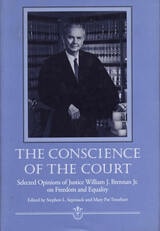
The Conscience of the Court
Selected Opinions of Justice William J. Brennan Jr. on Freedom and EqualityEdited by Stephen L. Sepinuck and Mary Pat Treuthart
Southern Illinois University Press, 1999
The Conscience of the Court celebrates the work of Justice William J. Brennan Jr., who served on the United States Supreme Court for thirty-four years (1956–1990).
Stephen L. Sepinuck and Mary Pat Treuthart introduce and present selected judicial opinions written by Justice Brennan on issues involving personal freedom, civil liberties, and equality. Brennan is ranked by many as the best writer ever to have served on the Supreme Court, and his written opinions depict real people, often in desperate, emotional situations. Remarkable for their clarity of analysis, for their eloquence, and for their forcefulness and persuasiveness, his opinions demonstrate that judicial thought need not be a proprietary enclave of lawyers or the intellectual elite.
The extended excerpts selected by Sepinuck and Treuthart highlight Brennan's approach to judicial decision making. Concerned always with how each decision would actually affect people's lives, Brennan possessed a rare quality of empathy. In Brennan, the editors note, "people and groups who lacked influence in society—Communists and flag burners, children and foreigners, criminal defendants and racial minorities"—found a champion they could count on "to listen to their causes and judge them unmoved by the passions of the politically powerful."
In their introduction to each opinion, the editors provide background facts, discuss how the excerpted opinion transformed the law or otherwise fit into the realm of constitutional jurisprudence, and delve into Justice Brennan's judicial philosophy, his method of constitutional interpretation, and the language he used.
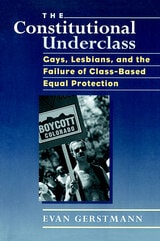
The Constitutional Underclass
Gays, Lesbians, and the Failure of Class-Based Equal ProtectionEvan Gerstmann
University of Chicago Press, 1999
The Court divides people into legal classes that receive varying levels of protection; gays and lesbians and other groups, such as the elderly and the poor, receive the least. Gerstmann reveals how these standards are used to favor certain groups over others, and also how Amendment 2 advocates used the Court's doctrine to convince voters that gays and lesbians were seeking "special rights" in Colorado.
Concluding with a call for wholesale reform of equal-protection jurisprudence, this book is essential reading for anyone interested in fair, coherent, and truly equal protection under the law.
The Making of Lawyers' Careers
Inequality and Opportunity in the American Legal ProfessionRobert L. Nelson, Ronit Dinovitzer, Bryant G. Garth, Joyce S. Sterling, David B. Wilkins, Meghan Dawe, and Ethan Michelson
University of Chicago Press, 2023
An unprecedented account of social stratification within the US legal profession.
How do race, class, gender, and law school status condition the career trajectories of lawyers? And how do professionals then navigate these parameters?
The Making of Lawyers’ Careers provides an unprecedented account of the last two decades of the legal profession in the US, offering a data-backed look at the structure of the profession and the inequalities that early-career lawyers face across race, gender, and class distinctions. Starting in 2000, the authors collected over 10,000 survey responses from more than 5,000 lawyers, following these lawyers through the first twenty years of their careers. They also interviewed more than two hundred lawyers and drew insights from their individual stories, contextualizing data with theory and close attention to the features of a market-driven legal profession.
Their findings show that lawyers’ careers both reflect and reproduce inequalities within society writ large. They also reveal how individuals exercise agency despite these constraints.
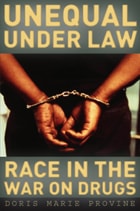
Unequal under Law
Race in the War on DrugsDoris Marie Provine
University of Chicago Press, 2007
Doris Marie Provine’s engaging analysis traces the history of race in anti-drug efforts from the temperance movement of the early 1900s to the crack scare of the late twentieth century, showing how campaigns to criminalize drug use have always conjured images of feared minorities. Explaining how alarm over a threatening black drug trade fueled support in the 1980s for a mandatory minimum sentencing scheme of unprecedented severity, Provine contends that while our drug laws may no longer be racist by design, they remain racist in design. Moreover, their racial origins have long been ignored by every branch of government. This dangerous denial threatens our constitutional guarantee of equal protection of law and mutes a much-needed national discussion about institutionalized racism—a discussion that Unequal under Law promises to initiate.
Wives Not Slaves
Patriarchy and Modernity in the Age of RevolutionsKirsten Sword
University of Chicago Press, 2021
Kirsten Sword’s richly researched history reconstructs the stories of wives who fled their husbands between the mid-seventeenth and early nineteenth centuries, comparing their plight with that of other runaway dependents. Wives not Slaves explores the links between local justice, the emerging press, and transatlantic political debates about marriage, slavery and imperial power. Sword traces the relationship between the distress of ordinary households, domestic unrest, and political unrest, shedding new light on the social changes imagined by eighteenth-century revolutionaries, and on the politics that determined which patriarchal forms and customs the new American nation would—and would not—abolish.