Results by title

8 books match the query 'Erasmus, Desiderius'
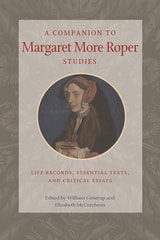
cover of A Companion to Margaret More Roper Studies: Life Records, Essential Texts, and Critical Essays

A Companion to Margaret More Roper Studies

Life Records, Essential Texts, and Critical Essays

Elizabeth McCutcheon

Catholic University of America Press, 2022

This volume is an important contribution to the field of Margaret More Roper studies, early modern women's writing, as well as Erasmian piety, Renaissance humanism, and historical and cultural studies more generally.

Margaret More Roper is the learned daughter of St. Thomas More, the Catholic martyr; their lives are closely linked to each other and to early sixteenth-century changes in politics and religion and the social upheaval and crises of conscience that they brought. Specifically, Roper's major works - her translation of Erasmus's commentary on the Lord's Prayer and the long dialogue letter between More and Roper on conscience - highlight two major preoccupations of the period: Erasmian humanism and More's last years, which led to his death and martyrdom.

Roper was one of the most learned women of her time and a prototype of the woman writer in England, and this edited volume is a tribute to her life, writings, and place among early women authors. It combines comprehensive and convenient joining of biographical, textual, historical, and critical components within a single volume for the modern reader. There is no comparable study in print, and it fills a significant gap in studies of early modern women writers.

[more]
cover of Erasmus and the Jews

Erasmus and the Jews

Shimon Markish

University of Chicago Press, 1986

Erasmus of Rotterdam was the greatest Christian humanist scholar of the Northern European Renaissance, a correspondent of Sir Thomas More and many other learned men of his time, known to his contemporaries and to posterity for subtlety of his thought and the depth of his learning. He was also, according to some modern writers, an anti-Semite. In this complete analysis of all of Erasmus' writings on Jews and Judaism, Shimon Markish asserts that the accusation cannot be sustained. For Markish, to ask whether Erasmus was a friend or enemy of the Jews is to ask a modern question of a sixteenth-century man, whose attitude can best be called "asemitism." Erasmus' chief preoccupation was with the future of "the true philosophy of Christ"; he had little interest in the Jewish community of his own time.

Erasmus and the Jews discusses Erasmus' critique of Mosaic law and his view of the conflict between "Judaism" as legalistic morality and Jesus' teaching; his judgment on the Pharisees of Jesus' time; his emphasis on the importance of the study of Hebrew; and his opinions of sixteenth-century Jews. This meticulous analysis reveals an Erasmus who defended his vision of true piety by rejecting "Judaizing" Christians more than Jews and who saw the Old Testament as integral to the Christian worldview. As a Christian, he regretted nonbelief and pitied unbelievers, without vicious hostility toward any single people. His theological opposition to a form of religious thought which he identified with Judaism was not translated into crude prejudice against actual Jews. In general, his calm consideration of the strange and the foreign and his willingness to restrict his judgments to the philosophical realm were, Markish argues, early and significant steps toward enlightened toleration.

Markish's discussion of Erasmus is supplemented with an Afterword by theologian and philosopher Arthur A. Cohen, who offers a variant interpretation of Erasmus' writings and attitudes. The juxtaposed arguments of the two scholars make this an especially illuminating work for any student of Erasmus and his influence. Erasmus and the Jews also gives a necessary clarity to our understanding of the meaning of anti-Semitism and the history of religious toleration. Markish's profound knowledge of Erasmus allows him to demonstrate the fundamental importance of putting arguments and terminology in the context of a thinker's work and his own time.
[more]
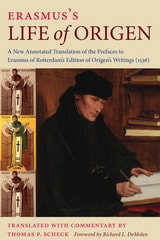
cover of Erasmus's Life of Origen

Erasmus's Life of Origen

Thomas P. Scheck

Catholic University of America Press, 2016
Erasmus of Rotterdam (1466-1536) hailed Origen of Alexandria (185-254) as a holy priest, a gifted homilist, a heroic Christian, and a celebrated exegete and theologian of the ancient Church. In this book Thomas Scheck presents one of the fruits of Erasmus's endeavors in the field of patristic studies (a particularly neglected field of scholarship within Erasmus studies) by providing the first English translation, annotated and thoroughly introduced, of Erasmus' final work, the Prefaces to his Edition of Origen's writings (1536). Originally published posthumously two months after Erasmus's death, the work surveys Origen of Alexandria's life, writings, preaching, and contribution to the Catholic Church. The staggering depth and breadth of Erasmus's learning are exhibited here, as well as the maturity of his theological reflections, which in many ways anticipate the irenicism of the Second Vatican Council with respect to Origen. Erasmus presents Origen as a marvelous doctor of the ancient Church who made a tremendous contribution to the Catholic exegetical tradition and who lived a saintly life.
[more]
cover of Praise of Folly

Praise of Folly

Desiderius Erasmus; Translated by John Wilson

University of Michigan Press, 1958
The Praise of Folly by Desiderius Erasmus is an enduring classic that satirically critiques the societal and religious norms of its time. Translated by John Wilson in 1668, this seminal work uses wit and humor to examine the folly prevalent in various human behaviors and institutions, making it a timeless piece that continues to resonate. With a foreword by Kenneth E. Boulding, this edition delves into the essence of folly through a monologue by the allegorical character, Folly herself. She extols the virtues of foolishness in a world riddled with pretentious wisdom and self-importance. Erasmus, with his sharp intellect and playful prose, not only entertains but also provokes deep reflection on the paradoxes of human nature and the pursuit of wisdom, making The Praise of Folly a profound yet accessible read for anyone interested in literature, philosophy, and social commentary.
[more]
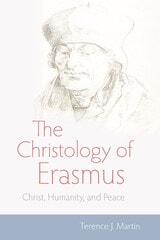
cover of The Christology of Erasmus: Christ, Humanity, and Peace

The Christology of Erasmus

Christ, Humanity, and Peace

Terence J. Martin

Catholic University of America Press, 2024
Nothing is more central to the religious thinking of Erasmus of Rotterdam than the reality of Christ—in his eyes, that supreme revelation of divine mercy embodied in the life of Jesus of Nazareth to which Christian scriptures variously testify, but also the divine presence undergirding that life-centering ethic of love and peace, what Erasmus calls the “philosophy of Christ.” The purpose of this book is to distill the Christological elements from his vast corpus in a manner that shows the range, coherence, and value of Erasmus’ thinking on Christological questions. While Erasmus works within the broad parameters of orthodox teaching, his critical skills with languages, accent on rhetoric in theology, keen sense of irony, appreciation for the limits of human knowledge, incipient sense of history, emphasis on the welfare of humanity, and passionate defense of peace, give his work a distinctive stamp and thereby make a singular contribution to the history of Christology. What Erasmus contributes to discussions of the divinity of Christ is a counsel of restraint in metaphysical speculation, an accent on the revelatory breadth of the eternal Word of God, and an invitation to think of Christ incarnate as the eloquent oration of God. But the central impulse of the Christology of Erasmus is the affirmation of the full incarnation of Christ in human existence, abstaining as much as possible from docetic insulation of the divine from the struggles of human experience, in order to highlight the redemptive capacity of Christ for the transformation of human life. With that, the ethical capstone of Erasmus’ reflections on Christ centers on the responsibility to imitate Christ’s love for others, and thus for advancing the cause of peace in personal and social life. This books adds the voice of this remarkable Catholic humanist to the history of theological discussions in the early modern era, while also restoring its rightful place in the broader history of Christology.
[more]
cover of The Kingdom Suffereth Violence: The Machiavelli / Erasmus / More Correspondence and Other Unpublished Documents

The Kingdom Suffereth Violence

The Machiavelli / Erasmus / More Correspondence and Other Unpublished Documents

Philippe Bénéton

St. Augustine's Press, 2012
[more]
cover of The Renaissance Rediscovery of Intimacy

The Renaissance Rediscovery of Intimacy

Kathy Eden

University of Chicago Press, 2012

In 1345, when Petrarch recovered a lost collection of letters from Cicero to his best friend Atticus, he discovered an intimate Cicero, a man very different from either the well-known orator of the Roman forum or the measured spokesman for the ancient schools of philosophy. It was Petrarch’s encounter with this previously unknown Cicero and his letters that Kathy Eden argues fundamentally changed the way Europeans from the fourteenth through the sixteenth centuries were expected to read and write.

The Renaissance Rediscovery of Intimacy explores the way ancient epistolary theory and practice were understood and imitated in the European Renaissance.Eden draws chiefly upon Aristotle, Cicero, and Seneca—but also upon Plato, Demetrius, Quintilian, and many others—to show how the classical genre of the “familiar” letter emerged centuries later in the intimate styles of Petrarch, Erasmus, and Montaigne. Along the way, she reveals how the complex concept of intimacy in the Renaissance—leveraging the legal, affective, and stylistic dimensions of its prehistory in antiquity—pervades the literary production and reception of the period and sets the course for much that is modern in the literature of subsequent centuries. Eden’s important study will interest students and scholars in a number of areas, including classical, Renaissance, and early modern studies; comparative literature; and the history of reading, rhetoric, and writing.
[more]
cover of Truth and Irony

Truth and Irony

Terence J. Martin

Catholic University of America Press, 2016

Tapping into selected works of Erasmus of Rotterdam, this book offers a series of philosophical meditations designed to retrieve and deploy a distinctively Erasmian manner of thinking - one that is capacious in its perception, agile in its judgments, and unsettling in its irony. In purpose, it takes a philosophical route, addressing perennial questions of self-knowledge - what we can know and how best to communicate what we take to be true, what we ought to do or how we should live, and what we might hope for or what would offer us fulfilment. In method, however, this work taps into the various strategies of irony at play in the works of Erasmus, looking for guidance in handling these age-old questions. What readers will find in Erasmus is a knack for playfully reversing appearances and realities, a penchant for pushing disturbing questions relentlessly to the limit, and a skill for juxtaposing oddly matched opposites. Again and again, Erasmus presses readers to rethink these fundamental questions with dexterity and nuance, ever ready to appreciate the surprising and unsettling upshot of ironic insight.
[more]