Results by title
5 books match the query 'Espada, Martín'
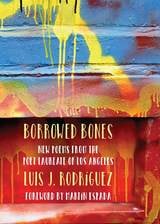
Borrowed Bones
New Poems from the Poet Laureate of Los AngelesLuis J. Rodriguez
Northwestern University Press, 2016
Foreword by Martín Espada
This chapbook collection offers new poems from the prolific career of a community leader, activist, and healer. Luis J. Rodríguez’s work asks profound questions of us as readers and fellow humans, such as, "If society cooperates, can we nurture the full / and healthy development of everyone?" In his introductory remarks, Martín Espada describes the poet as a man engaged in people and places: "Luis Rodríguez is a poet of many tongues, befitting a city of many tongues. He speaks English, Spanish, ‘Hip Hop,’ ‘the Blues,’ and ‘cool jazz.’ He speaks in ‘mad solos.’ He speaks in ‘People’s Sonnets.’ He speaks in the language of protest. He speaks in the language of praise."
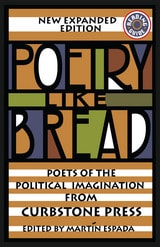
Poetry Like Bread, New Expanded Edition
Poets of the Political Imagination from Curbstone PressMartín Espada
Northwestern University Press, 2000
These poems were not written to be studied. They were meant to be read. Or better yet, heard. Whole or in part. Alone or among friends and strangers. Reading and hearing them, you must respond and react. Some may inspire you, knock the wind out of you—make you indignant, sad, joyous, ashamed. Whether you drop this book, seek out others, join a social action group, write letters to your elected representatives, or write poems of your own, your reaction to the poems will be as political as the poems themselves.
Some of the subjects of these poems may be unfamiliar to you, or very familiar to you. Many relate stories from war-torn Central and South America, where U. S. policy has had a huge impact on people's lives. The rest are the voices of the voiceless here in the U.S: Latinos and African Americans, Vietnam veterans and Vietnamese, prison inmates, blue collar workers, migrant workers, women, the homeless. It's the poet's job to open up and validate these worlds to us. Our job, once roused, is to learn. To learn and to act.
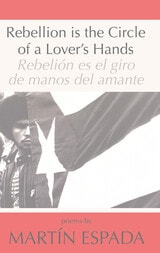
Rebellion Is the Circle of a Lover's Hands/Rebelió
Martín Espada
Northwestern University Press, 1995
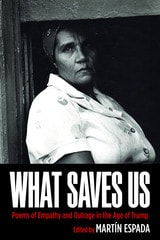
What Saves Us
Poems of Empathy and Outrage in the Age of TrumpEdited by Martín Espada
Northwestern University Press, 2019
This is an anthology of poems in the Age of Trump—and much more than Trump. These are poems that either embody or express a sense of empathy or outrage, both prior to and following his election, since it is empathy the president lacks and outrage he provokes.
There is an extraordinary diversity of voices here. The ninety-three poets featured include Elizabeth Alexander, Julia Alvarez, Richard Blanco, Carolyn Forché, Aracelis Girmay, Donald Hall, Juan Felipe Herrera, Yusef Komunyakaa, Naomi Shihab Nye, Marge Piercy, Robert Pinsky, Danez Smith, Patricia Smith, Brian Turner, Ocean Vuong, Bruce Weigl, and Eleanor Wilner. They speak of persecuted and scapegoated immigrants. They bear witness to violence: police brutality against African Americans, mass shootings in a school or synagogue, the rage inflicted on women everywhere. They testify to poverty: the waitress surviving on leftovers at the restaurant, the battles of a teacher in a shelter for homeless mothers, the emergency-room doctor listening to the heartbeats of his patients. There are voices of labor, in the factory and the fields. There are prophetic voices, imploring us to imagine the world we will leave behind in ruins lest we speak and act.
However, this is not merely a collection of grievances. The poets build bridges. One poet steps up to translate in Arabic at the airport; another walks through the city and sees her immigrant past in the immigrant present; another declaims a musical manifesto after the hurricane that devastated his island; another evokes a demonstration in the street, shouting in an ecstasy of defiance. The poets take back the language, resisting the demagogic corruption of words themselves. They assert our common humanity in the face of dehumanization.
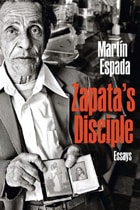
Zapata's Disciple
EssaysMartín Espada
Northwestern University Press, 2016
The ferocious acumen with which the award-winning poet Martín Espada attacks issues of social injustice in Zapata’s Disciple makes it no surprise that the book has been the subject of bans in both Arizona and Texas, targeted for its presence in the Mexican American Studies curriculum of Tucson’s schools and for its potential to incite a riot among Texas prison populations. This new edition of Zapata’s Disciple, which won the 1999 Independent Publisher Book Award for Essay / Creative Nonfiction, opens with an introduction in which the author chronicles this history of censorship and continues his lifelong fight for freedom of expression. A dozen of Espada’s poems, tender and wry as they are powerful, interweave with essays that address the denigration of the Spanish language by American cultural arbiters, castigate Nike for the exploitation of its workers, reflect upon National Public Radio’s censorship of Espada’s poem about Mumia Abu- Jamal, and more. Zapata’s Disciple is a potent assault on the continued marginalization of Latinos and other poor and working-class citizens in American society, and the collection breathes with a revolutionary zeal that is as relevant now as when it was first published.