Results by title

2 books match the query 'Espinosa, Gastón'
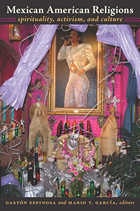
cover of Mexican American Religions: Spirituality, Activism, and Culture

Mexican American Religions

Spirituality, Activism, and Culture

Gastón Espinosa and Mario T. García, eds.

Duke University Press, 2008

This collection presents a rich, multidisciplinary inquiry into the role of religion in the Mexican American community. Breaking new ground by analyzing the influence of religion on Mexican American literature, art, activism, and popular culture, it makes the case for the establishment of Mexican American religious studies as a distinct, recognized field of scholarly inquiry. Scholars of religion, Latin American, and Chicano/a studies as well as of sociology, anthropology, and literary and performance studies, address several broad themes. Taking on questions of history and interpretation, they examine the origins of Mexican American religious studies and Mario Barrera’s theory of internal colonialism. In discussions of the utopian community founded by the preacher and activist Reies López Tijerina, César Chávez’s faith-based activism, and the Los Angeles-based Católicos Por La Raza movement of the late 1960s, other contributors focus on mystics and prophets. Still others illuminate popular Catholicism by looking at Our Lady of Guadalupe, home altars, and Los Pastores dramas (nativity plays) as vehicles for personal, social, and political empowerment.

Turning to literature, contributors consider Gloria Anzaldúa’s view of the borderlands as a mystic vision and the ways that Chicana writers invoke religious symbols and rhetoric to articulate a moral vision highlighting social injustice. They investigate the role of healing, looking at it in relation to both the Latino Pentecostal movement and the practice of the curanderismo tradition in East Los Angeles. Delving into to popular culture, they reflect on Luis Valdez’s video drama La Pastorela: “The Shepherds’ Play,” the spirituality of Chicana art, and the religious overtones of the reverence for the slain Tejana music star Selena. This volume signals the vibrancy and diversity of the practices, arts, traditions, and spiritualities that reflect and inform Mexican American religion.

Contributors: Rudy V. Busto, Davíd Carrasco, Socorro Castañeda-Liles, Gastón Espinosa, Richard R. Flores, Mario T. García, María Herrera-Sobek, Luís D. León, Ellen McCracken, Stephen R. Lloyd-Moffett, Laura E. Pérez, Roberto Lint Saragena, Anthony M. Stevens-Arroyo, Kay Turner

[more]
cover of William J. Seymour and the Origins of Global Pentecostalism: A Biography and Documentary History

William J. Seymour and the Origins of Global Pentecostalism

A Biography and Documentary History

Gastón Espinosa

Duke University Press, 2014

In 1906, William J. Seymour (1870–1922) preached Pentecostal revival at the Azusa Street mission in Los Angeles. From these and other humble origins the movement has blossomed to 631 million people around the world. Gastón Espinosa provides new insight into the life and ministry of Seymour, the Azusa Street revival, and Seymour's influence on global Pentecostal origins. After defining key terms and concepts, he surveys the changing interpretations of Seymour over the past 100 years, critically engages them in a biography, and then provides an unparalleled collection of primary sources, all in a single volume. He pays particular attention to race relations, Seymour's paradigmatic global influence from 1906 to 1912, and the break between Seymour and Charles Parham, another founder of Pentecostalism. Espinosa's fragmentation thesis argues that the Pentecostal propensity to invoke direct unmediated experiences with the Holy Spirit empowers ordinary people to break the bottle of denominationalism and to rapidly indigenize and spread their message.

The 104 primary sources include all of Seymour's extant writings in full and without alteration and some of Parham's theological, social, and racial writings, which help explain why the two parted company. To capture the revival's diversity and global influence, this book includes Black, Latino, Swedish, and Irish testimonies, along with those of missionaries and leaders who spread Seymour's vision of Pentecostalism globally.
[more]