Results by title
16 books match the query 'Essays & Writings'
Bill Veeck's Crosstown Classic
Bill Veeck and Ed Linn
University of Chicago Press, 1962
Bottom of the Ninth
Great Contemporary Baseball Short StoriesEdited and with an Introduction by John McNally. Foreword by Richard Russo
Southern Illinois University Press, 2003
Skillfully edited by John McNally, Bottom of the Ninth: Great Contemporary Baseball Short Stories collects nineteen contemporary baseball short stories from a successful mix of well-established writers, lesser-knowns, and a few up-and-comers. These stories are characterized by the same dramatic elements that draw people to the sport itself—the mythologizing of players, the obsessions and romance of the game, the bonds between players and fans, parents and children. From a key play, a missed catch, a chance lost, these are tales of characters facing high stakes and calls to action, metaphorically and literally, in the bottom of the ninth.
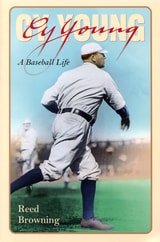
Cy Young
A Baseball LifeReed Browning
University of Massachusetts Press, 2000
He was the winner of 511 major league baseball games, nearly a hundred more than any other pitcher. He threw three no-hitters, including the first perfect game in the new American League. He was among the original twelve players inducted into baseball's Hall of Fame, and his name is now attached to the game's most prestigious pitching award. Yet for all his accomplishments, Cy Young remains to most baseball fans a legendary but little known figure.
In this book, Reed Browning re-creates the life of Denton True “Cyclone” Young and places his story in the context of a rapidly changing turn-of-the-century America. Born in rural Ohio, the son of a Civil War veteran, Young learned his trade at a time when only underhand pitching was permitted. When he began his professional career in 1890, pitchers wore no gloves and stood five feet closer to the batter than they do today. By the time he retired in 1911, the game of baseball had evolved into its modern form and claimed unquestioned status as America's “national pastime.”
As Browning shows, Young's extraordinary mastery of his craft owed much to his ability to adapt to the changing nature of the game. Endowed with an exceptional fastball, he gradually developed a wide array of deliveries and pitches—all of which he could throw with astonishing control. Yet his success can also be attributed, at least in part, to the rustic values of loyalty, hard work, and fair play that he embraced and embodied, and for which he became renowned among baseball fans of his day.
Dead Balls and Double Curves
An Anthology of Early Baseball FictionEdited and with an Introduction by Trey Strecker. Foreword by Arnold Hano
Southern Illinois University Press, 2004
Dead Balls and Double Curves: An Anthology of Early Baseball Fiction collects twenty-two classic stories from baseball’s youth, presented in chronological order to capture the development of this most American of sports. Many of these tales have never before been reprinted, adding historical value to the rich literary merits of this anthology.
Editor Trey Strecker’s collection begins with an informal village match in an excerpt from James Fenimore Cooper’s Home as Found (1838), published the year prior to Abner Doubleday’s alleged invention of the game outside Cooperstown, New York, and concludes with the arrival of the superstar slugger that signaled the end of the dead-ball era in Heywood Broun’s The Sun Field (1923). The sampling of fiction from the eighty-five-year interim loads the bases with the humor, realism, and athletic gallantry of the sport’s earliest years. Not all grandstanding and heroism, these stories also explore cultural and class conflicts, racial strife, town rivalries, labor disputes, gambling scandals, and the striking personalities that decorated a simple game’s evolution into a national pastime.
Dead Balls and Double Curves presents a lineup of first-division writers, including Mark Twain, Frank Norris, Christy Mathewson, Edna Ferber, and the game’s poet laureate, Ring Lardner, plus legendary characters such as Baseball Joe, South-Paw Skaggs, Tin Can Tommy, and the sole artiste of the mythic double curve, Frank Merriwell. Throughout the volume, each author’s abiding affection for the game and its characters shines through with diamond-like focus.

Hell of a Way to Make a Living
The Unvarnished Truth about What It's Like to Cover Major League BaseballPaul Hagen
Temple University Press, 2027
For 50 years, Paul Hagen lived the dream of being a beat writer covering the Dodgers, Rangers, and Phillies. But, as Hell of a Way to Make a Living demonstrates, the enviable job isn’t always as glamorous as it seems.
This insider’s account gives readers an all-access pass to the press box, clubhouse, and dugout to discover what the experience is really about. It’s both a clear-eyed dissection of the daily grind and a breezy, occasionally gossipy, account of being to paid to watch baseball games.
Hagen features entertaining and insightful anecdotes such as confirming to manager Terry Francona that the Phillies were going to fire him two weeks before it happened and building trust with players from the last man on the roster to future Hall of Famers like Mike Schmidt, Ferguson Jenkins, Billy Wagner, and Scott Rolen. He also addresses the changing media landscape, what’s on the record and off, the ethics of reporting on a team fairly, and how sports writing has changed over the decades.
Covering all the bases, Hell of a Way to Make a Living is an ode to the importance of conscientious beat writing and building trust with readers.
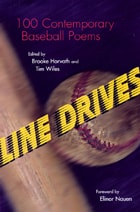
Line Drives
100 Contemporary Baseball PoemsEdited by Brooke Horvath and Tim Wiles. Foreword by Elinor Nauen
Southern Illinois University Press, 2002
“We wait for baseball all winter long,” Bill Littlefield wrote in Boston Magazine a decade ago, “or rather, we remember it and anticipate it at the same time. We re-create what we have known and we imagine what we are going to do next. Maybe that’s what poets do, too.”
Poetry and baseball are occasions for well-put passion and expressive pondering, and just as passionate attention transforms the prose of everyday life into poetry, it also transforms this game we write about, play, or watch. Editors Brooke Horvath and Tim Wiles unite their own passion for baseball and poetry in this collection, Line Drives: 100 Contemporary Baseball Poems, providing a forum for ninety-two poets. Line after line, like baseball itself game after game and season after season, these poems manage to make the old and the familiar new and surprising.
The poems in these pages invite interrogation, and the reader—like the true baseball fan—must be willing to play the game, for these poems are fun, fresh, angry, nostalgic, meditative, and meant to be read aloud. They are keen on taking us deeply into baseball as sport and intent on offering countless metaphors for exploring history, religion, love, family, and self-identity. Each poem delivers images of pure beauty as the poets speak of murder and ghost runners and old ball gloves, of baseball as a tie that binds families—and indeed the nation—together, of the game as a stage upon which no-nonsense grit and skill are routinely displayed, and of the delight experienced in being one amid a mindlessly happy crowd. This book is true to the game’s long season and to the lives of those the game engages.
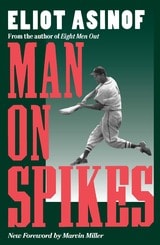
Man on Spikes
Eliot Asinof. Foreword by Marvin Miller
Southern Illinois University Press, 1998
Selected as one of baseball literature's Golden Dozen by Roger Kahn, Man on Spikes is an uncompromisingly realistic novel about a baseball player who struggles through sixteen years of personal crises and professional ordeals before finally appearing in a major league game. In a preface to this new edition, Eliot Asinof reveals the longsuffering ballplayer and friend upon which the novel is based.
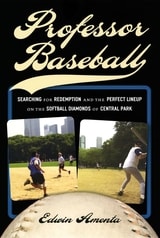
Professor Baseball
Searching for Redemption and the Perfect Lineup on the Softball Diamonds of Central ParkEdwin Amenta
University of Chicago Press, 2007
It happens every summer: packs of beer-bellied men with gloves and aluminum bats, putting their middle-aged bodies to the test on the softball diamond. For some, this yearly ritual is driven by a simple desire to enjoy a good ballgame; for others, it’s a way to forge friendships—and rivalries. But for one short, wild-haired, bespectacled professor, playing softball in New York’s Central Park means a whole lot more. It's one last chance to heal the nagging wounds of Little League trauma before the rust of decline and the relentless responsibilities of fatherhood set in.
Professor Baseball is the coming-of-middle-age story of New York University professor and Little League benchwarmer Edwin Amenta. As rookie manager of the Performing Arts Softball League’s doormat Sharkeys, he reverses softball’s usual brawn-over-brains formula. He coaxes his skeptical teammates to follow his sabermetric and sociological approach, based equally on Bill James and Max Weber, which in the heady days of early success he dubs “Eddy Ball.” But Amenta soon learns that his teammates’ attachments to favorite positions and time-honored (if ineffective) strategies are hard to break—especially when the team begins losing. And though he rejects the baseball-as-life metaphor, life keeps intruding on his softball season. Amenta here comes to grips with the humiliation of assisted reproduction, suffers mysterious ailments, and finds himself lingering at the sponsor’s bar, while his partner, a beautiful but baseball-challenged professor, second-guesses his book in the making. Can he turn his team—and his life—around?
Packed with colorful personalities, dramatic games, and the bustle of New York life, Professor Baseball will charm anyone who has ever root, root, rooted for the underdog.
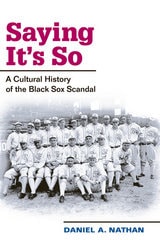
Saying It's So
A Cultural History of the Black Sox ScandalDaniel A. Nathan
University of Illinois Press, 2002
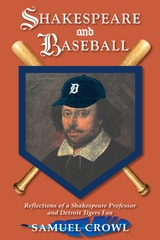
Shakespeare and Baseball
Reflections of a Shakespeare Professor and Detroit Tigers FanSamuel Crowl
Ohio University Press, 2024
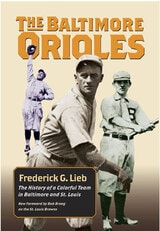
The Baltimore Orioles
The History of a Colorful Team in Baltimore and St. LouisFrederick G. Lieb Foreword by Bob Broeg
Southern Illinois University Press, 2005
With a legacy that spans two fiercely loyal baseball towns a half-nation apart, the Baltimore Orioles—originally the St. Louis Browns—rank among baseball’s most storied teams. One of the fifteen celebrated team histories commissioned by G. P. Putnam’s Sons in the 1940s and 1950s, The Baltimore Orioles: The History of a Colorful Team in Baltimore and St. Louis chronicles the club’s early history and is reissued on the fiftieth anniversary of their first season in Baltimore.
Hall of Fame sportswriter Frederick G. Lieb begins with the history of baseball in Baltimore from its pre-Civil War beginnings and its major-league debut as the Lord Baltimores in 1872 to the championship seasons of the National League Orioles in 1894, ’95, and ’96 when the roster included Willie Keeler, Joe Kelley, Kid Gleason, Roger Bresnahan, Joe McGinnity, and John McGraw. After the turn of the century, Baltimore was briefly home to the Orioles of the American League in 1901-02, then, after losing its franchise to New York, had to settle for the AAA International League Orioles until 1954. Under the leadership of Jack Dunn, the minor-league Orioles, while developing the talents of Babe Ruth, Lefty Grove, and other future major-league stars, won seven straight International League pennants from 1919 to 1926.
Here, too, is the colorful history of the precursors to the current Orioles, the lovable and luckless St. Louis Browns, augmented for this edition with a new foreword from St. Louis sportswriter Bob Broeg on the escapades of the Brownies. Though they lost more than a thousand games and captured only a single pennant in fifty-three seasons, the Browns remain a legendary part of national lore. Taking their lead in different eras from larger-than-life figures such as Branch Rickey, Rogers Hornsby, Urban Shocker, and the Barnum of Baseball, Bill Veeck, the Browns “boasted a one-armed outfielder, a hired hypnotist, the mighty midget [Eddie Gaedel] and—even the best ballplayer in the land—George Sisler,” as Broeg recalls in his foreword. In 1944, the Browns also played in the only all-St. Louis World Series, losing to the Cardinals.
Originally published in 1955 and featuring twenty-two photographs, The Baltimore Orioles history concludes with the new American League team’s first season in Baltimore, finishing seventh in the league but garnering the lasting adoration of their new hometown.
The Detroit Tigers Reader
Tom Stanton, Editor
University of Michigan Press, 2010
The story of the Tigers---like the story of Detroit itself---is one of resilience and endurance. For baseball fans it's also an intensely personal one: Detroit Tigers baseball has flowed through the veins of generations of families.
The essays, articles, and letters in The Detroit Tigers Reader capture those stories and the essence of the Tigers' spirit, tracing the history of the team from its first game on April 25, 1901, up through the arrival of "Pudge" Rodriguez in 2004. With contributions from some of the greatest sportswriters and athletes, as well as local journalists and fans, The Detroit Tigers Reader charts the highs and lows of one of the most extraordinary and celebrated teams in baseball history.
Includes contributions from
Mitch Albom
Dave Anderson
Joseph Durso
Joe Falls
Hank Greenberg
Ernie Harwell
Al Kaline
Mike Lupica
Grantland Rice
Damon Runyon
Babe Ruth
Neal Shine
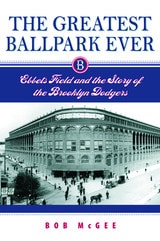
The Greatest Ballpark Ever
Ebbets Field and the Story of the Brooklyn DodgersMcGee, Bob
Rutgers University Press, 2005
In this lively story of sports, politics, and the talented, hilarious, and charming characters associated with the Brooklyn Dodgers, Bob McGee chronicles the ballpark's vibrant history from the drawing board to the wrecking ball, beginning with Charley Ebbets and the heralded opening in 1913, on through the eras that followed. McGee weaves a story about how Ebbets Field's architectural details, notable flaws, and striking facade brought Brooklyn and its team together in ways that allowed each to define the other.
Drawing on original interviews and letters, as well as published and archival sources, The Greatest Ballpark Ever explores the struggle of Charley Ebbets to build Ebbets Field, the days of Wilbert Robinson's early pennant winners, the eras of the Daffiness Boys, Larry MacPhail, and Branch Rickey, the tumultuous field leadership of Leo the Lip, the fiery triumph of Jackie Robinson, the golden days of the Boys of Summer, and Walter O'Malley's ignominious departure.
With humor and passion, The Greatest Ballpark Ever lets readers relive a day in the raucous ballpark with its quirky angles and its bent right-field wall, with the characters and events that have become part of the nation's folklore.
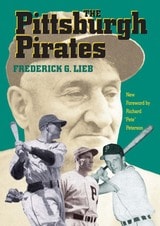
The Pittsburgh Pirates
Frederick G. Lieb. Foreword by Richard "Pete" Peterson
Southern Illinois University Press, 2003
An admirer of Pirate president Barney Dreyfuss, prolific baseball writer Frederick G. Lieb consorted with the club’s biggest stars, christened the legendary Dreyfuss “the first-division man,” and produced The Pittsburgh Pirates, one of the fifteen celebrated histories of major league teams commissioned by G. P. Putnam’s Sons in the 1940s and 1950s. Originally published in 1948, Lieb’s history ranges from the ball club’s earliest professional days in the late nineteenth century as the Pittsburgh Alleghenies to its spring training session in preparation for the 1948 season, a span that included six National League pennants and two World Series championships, as well as a loss to the Boston Red Sox, then the Pilgrims, at the inaugural World Series a century ago.
“This reprint of Fred Lieb’s The Pittsburgh Pirates is an invitation for baseball readers to enjoy Lieb’s wonderful stories of the great Pirate teams of the first half of the twentieth century,” writes Richard “Pete” Peterson in the new foreword to this edition. “Lieb’s book is rich with accounts of World Series triumphs and disappointments, of epic encounters on the playing field, like that between Wagner and Cobb, of mutinies in the clubhouse, of courageous comebacks, and of devastating defeats, including the infamous ‘homer in the gloaming.’”
In Lieb’s personable and anecdotal prose, honed over the course of his sustained sportswriting career, the book conveys “baseball drama of the highest order,” including the pre-Dreyfuss days of Captain Kerr, Ned Hanlon, and Connie Mack; Dreyfuss’s dynasty in the early twentieth century; the dramatic World Series triumphs of 1909 and 1925; the end of the Dreyfuss era and the sale of the club to a syndicate headed by John Galbreath and Bing Crosby; and the purchase of Hank Greenberg and the emergence of slugger Ralph Kiner. Aided by twenty-five black-and-white photographs, this rare history revisits the glories and stories of “fabulous old Pirates” such as Honus Wagner, Tommy Leach, Fred Clarke, Babe Adams, Max Carey, Kiki Cuyler, Pie Traynor, Paul and Lloyd Waner, and Arky Vaughan.
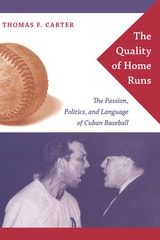
The Quality of Home Runs
The Passion, Politics, and Language of Cuban BaseballThomas F. Carter
Duke University Press, 2008
As an avid baseball fan, Carter draws on his experiences listening to and participating in discussions of baseball in Cuba (particularly in Havana) and among Cubans living abroad to describe how baseball provides the ground for negotiations of national, masculine, and class identities wherever Cubans gather. He considers the elaborate spectacle of Cuban baseball as well as the relationship between the socialist state and the enormously popular sport. Carter provides a detailed history of baseball in Cuba, analyzing players, policies, rivalries, and fans, and he describes how the sport has forged connections (or reinforced divisions) between Cuba and other nations. Drawing on insights from cultural studies, political theory, and anthropology, he maintains that sport and other forms of play should be taken seriously as crucibles of social and cultural experience.
The St. Louis Baseball Reader
Richard Peterson
University of Missouri Press, 2022