Results by title
10 books match the query 'Essentials'

Developing and Managing Electronic Collections
The EssentialsPeggy Johnson
American Library Association, 2013

Essentials of Electromagnetic Compatibility Engineering
Randy J. Jost
The Institution of Engineering and Technology, 2016
Essentials of English Grammar
Otto Jespersen
University of Alabama Press, 1964
A classic of English grammar, Essentials of English Grammar provides a common ground for the traditionalist and the structural or descriptive linguist. Jespersen’s work provides insight into the fundamental concepts that underlie the linguistic approach, but at the same time the foundation of the traditional approach is retained.

Essentials of MMPI-2 and MMPI-A Interpretation
James N. Butcher
University of Minnesota Press, 2000
The best resource for interpreting these widely used personality assessment tests.
The best resource for interpreting these widely used personality assessment tests.
Essentials of MMPI-2 and MMPI-A Interpretation presents innovative interpretive strategies for both the Minnesota Multiphasic Personality Inventory-2, or MMPI-2, and the adaptation for adolescents, the MMPI-A. James N. Butcher and Carolyn L. Williams detail the rationale for the revision and development of the instruments and their scales, and describe how to administer, score, profile, code, and interpret the tests.The revised edition includes the most recent MMPI research, including new information on ethnic background and cultural setting as they relate to assessment. Focusing primarily on studies of profile validity and external correlates, the revision also includes interpretive guidelines for several scales that will be introduced into the MMPI tests in 2000.Translation inquiries: University of Minnesota PressEssentials of Non-linear Control Theory
J.R. Leigh
The Institution of Engineering and Technology, 1983
Essentials of STEM Librarianship
Alexander J. Carroll and Joshua Borycz; Foreword by Carol Tenopir
American Library Association, 2025
Amid overall falling enrollment figures for higher education, the growing success of STEM programs bucks the trend. Ensuring that these programs flourish has become a priority for administrators at the provost level and above. But this emphasis on STEM poses challenges for academic libraries, many of which have instead historically focused on the humanities and social sciences. This primer helps to fill that knowledge gap, demystifying the scientific teaching and research processes for LIS students and current academic librarians alike. Regardless of their background or level of experience, readers of this guide will
- gain an overview of the contemporary STEM teaching and research enterprise by learning about the roles and needs of STEM community members such as program administrators, tenure track principal investigators (PIs), non-tenure track teaching faculty, research staff, graduate students, and undergraduate students;
- become familiarized with the “research group,” the organizational structure through which these different personas come together to advance the university research enterprise;
- get pointers on building teaching and learning programs that enhance student success and designing research support services that integrate into STEM researchers' actual workflows;
- receive proven outreach strategies for engaging STEM communities;
- learn approaches for incorporating AI (artificial intelligence) and LLMs (large language models) into information literacy programs for scientists and engineers; and
- discover how library leaders can support both nascent and established STEM librarians to advance STEM education and research at their local institutions.
Essentials of the Theory of Fiction
Michael J. Hoffman and Patrick D. Murphy, eds.
Duke University Press, 2005
Contributors. M. M. Bakhtin, John Barth, Roland Barthes, Wayne Booth, John Brenkman, Peter Brooks, Catherine Burgass, Seymour Chatman, J. Yellowlees Douglas, Rachel Blau DuPlessis, Wendy B. Faris, Barbara Foley, E. M. Forster, Joseph Frank, Joanne S. Frye, William H. Gass, Henry Louis Gates Jr., Gérard Genette, Ursula K. Heise, Michael J. Hoffman, Linda Hutcheon, Henry James, Susan S. Lanser, Helen Lock, Georg Lukács, Patrick D. Murphy, Ruth Ronen, Joseph Tabbi, Jon Thiem, Tzvetan Todorov, Virginia Woolf

Essentials of the Theory of Fiction, 2nd ed.
Michael J. Hoffman and Patrick D. Murphy, eds.
Duke University Press, 1996
Selections from: M. M. Bakhtin, John Barth, Roland Barthes, Wayne Booth, Peter Brooks, Seymour Chatman, Rachel Blau DuPlessis, Suzanne C. Ferguson, Barbara Foley, E. M. Forster, Joseph Frank, William Freedman, Norman Friedman, Joanne S. Frye, William H. Gass, Henry Louis Gates Jr., Gérard Genette, J. Arthur Honeywell, Linda Hutcheon, Henry James, Susan S. Lanser, Mitchell A. Leaska, George Levine, David Lodge, Georg Lukács, Gerald Prince, Patrocinio P. Schweickart, Tzvetan Todorov, Lionel Trilling, and Virginia Woolf
In Essentials, Unity
An Economic History of the Grange MovementJenny Bourne
Ohio University Press, 2017
The Patrons of Husbandry—or the Grange—is the longest-lived US agricultural society and, since its founding shortly after the Civil War, has had immeasurable influence on social change as enacted by ordinary Americans. The Grange sought to relieve the struggles of small farmers by encouraging collaboration. Pathbreaking for its inclusion of women, the Grange is also well known for its association with Gilded Age laws aimed at curbing the monopoly power of railroads.
In Essentials, Unity takes as its focus Grange founder Oliver Kelley and his home organization in Minnesota. Jenny Bourne draws upon numerous historical records to present a lively picture of a fraternal organization devoted to improving the lot of farmers but whose legacies extend far beyond agriculture. From struggles over minimum wage, birth control, and environmental regulation to the conflicts surrounding the Affordable Care Act, and from lunch-counter sit-ins to Occupy Wall Street, the Grange has shaped the very notion of collective action and how it is deployed even today. As this compact book so effectively illustrates, the history of the Patrons of Husbandry exposes the classic tension between the desires for achieving overall economic success and determining how the spoils are split.
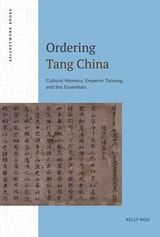
Ordering Tang China
Cultural Memory, Emperor Taizong, and the EssentialsKelly Ngo
Lever Press, 2024
By connecting the textual discourse with an analysis of its use and reception across the region, Ngo demonstrates that the Essentials was a key source of Confucian political thought and practice during the early Tang dynasty. In accounting for the place of the Essentials in political advice literature, Ngo illustrates how it drew from the ancient Confucian heritage and was still responsive to contemporaneous political concerns, suggesting that the Essentials played a part in the success of Zhenguan political practice.
Ordering Tang China also includes the first English-language translations of portions of the seventh-century anthology, with reference to partial translations published in nine languages. Utilizing the theory of cultural memory to study the Essentials not only opens a fresh approach to learning about the imperial consumption of literature, as well as the theory and practice of emperorship, but also offers a case study for how to study Chinese governance literature, including its “mirror for princes” genre.