Results by title
3 books match the query 'Estill, Laura'
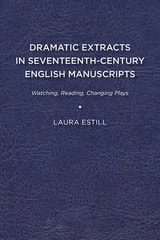
Dramatic Extracts in Seventeenth-Century English Manuscripts
Watching, Reading, Changing PlaysLaura Estill
University of Delaware Press, 2015
Throughout the seventeenth century, early modern play readers and playgoers copied dramatic extracts (selections from plays and masques) into their commonplace books, verse miscellanies, diaries, and songbooks. Dramatic Extracts in Seventeenth-Century English Manuscripts: Watching, Reading, Changing Plays is the first to examine these often overlooked texts, which reveal what early modern audiences and readers took, literally and figuratively, from plays. As this under-examined archival evidence shows, play readers and playgoers viewed plays as malleable and modular texts to be altered, appropriated, and, most importantly, used. These records provide information that is not available in other forms about the popularity and importance of early modern plays, the reasons plays appealed to their audiences, and the ideas in plays that most interested audiences.
Tracing the course of dramatic extracting from the earliest stages in the 1590s, through the prolific manuscript circulation at the universities, to the closure and reopening of the theatres, Estill gathers these microhistories to create a comprehensive overview of seventeenth-century dramatic extracts and the culture of extracting from plays. Dramatic Extracts in Seventeenth-Century English Manuscripts: Watching, Reading, Changing Plays explores new archival evidence (from John Milton’s signature to unpublished university plays) while also analyzing the popularity of perennial favorites such as Shakespeare’s The Tempest. The study of dramatic extracts is the study of particulars: particular readers, particular manuscripts, particular plays or masques, particular historic moments. As D. F. McKenzie puts it, “different readers [bring] the text to life in different ways.” By providing careful analyses of these rich source texts, this book shows how active play-viewing and play-reading (that is, extracting) ultimately led to changing the plays themselves, both through selecting and manipulating the extracts and positioning the plays in new contexts.
Published by University of Delaware Press. Distributed worldwide by Rutgers University Press.
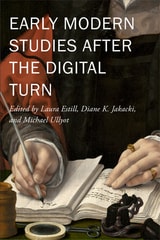
Early Modern Studies after the Digital Turn
Edited by Laura Estill, Diane K. Jakacki, Michael Ullyot
Iter Press, 2016
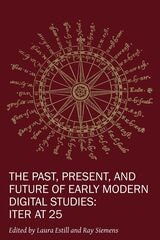
The Past, Present, and Future of Early Modern Digital Studies
Iter at 25Edited by Laura Estill and Ray Siemens
Iter Press, 2025
Early modern digital studies is a thriving field that draws in strands from publishing, textual studies, digital humanities, and more. Yet it is also rapidly changing. This volume shows that early modern digital studies must be reconsidered from different perspectives as new projects and tools emerge, change, or disappear, and as we make advances into better understanding the past. The chapters in this volume explore how and what we publish (digitally and otherwise), how we value, evaluate, and sustain those publications and digital projects, and how these projects enable us to ask new research questions about early modern literature and culture. This collection does not seek to be a definitive or final state-of-the-field, but rather, a celebration of existing scholarship and an invitation to further scholarship about our ever-evolving practices.