Results by title
2 books match the query 'Ethical Inquiry'
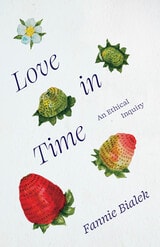
Love in Time
An Ethical InquiryFannie Bialek
University of Chicago Press, 2025
A meditative reconsideration of what it means to love as ever-changing beings in an ever-changing world.
We live in time, and so we love in time. Our beloveds change, and we change beside them. Sometimes we change apart, but it is this very changeableness, the braving of an unknown future together, that endears us to our lovers. Far from an ideal of constancy and commitment, then, love is an endeavor fraught with uncertainty.
In this book, Fannie Bialek sketches a view of love that does not ignore the vagaries of life but embraces them. In contrast to philosophical and religious attempts to secure love against finitude, Bialek’s love embraces its susceptibility to change and accepts the ethical challenges such change introduces. Attentive to our deepest vulnerabilities, Bialek develops a fresh ethics of love grounded by our humility before time.
[more]

Theory as Practice
Ethical Inquiry in the RenaissanceNancy S. Struever
University of Chicago Press, 1992
There is a tendency in modern scholarship to describe the Renaissance Humanists merely as readers—as interpreters happily absorbed within the bounds of their chosen classical texts. In Theory as Practice, Nancy Struever contests this accepted notion; by focusing on ethical inquiry, she presents the Humanists as engaged in subtle, innovative moral work.
Struever argues that the accomplishment of five major Renaissance figures—Petrarch, Nicolaus Cusanus, Lorenzo Valla, Machiavelli, and Montaigne—was to consider theory as practice and thus engage the ethics of inquiry. She notes three stages of investigation, the first represented by Petrarch, who "relocated" ethical inquiry from a theoretical realm to a familiar practice responsive to daily experience.
Struever argues that the accomplishment of five major Renaissance figures—Petrarch, Nicolaus Cusanus, Lorenzo Valla, Machiavelli, and Montaigne—was to consider theory as practice and thus engage the ethics of inquiry. She notes three stages of investigation, the first represented by Petrarch, who "relocated" ethical inquiry from a theoretical realm to a familiar practice responsive to daily experience.
Next, Struever describes how Cusanus and Valla assume Petrarch's relocation, yet confect ethics into discursive disciplines. Finally, while both Machiavelli and Montaigne produced strong revisions of discipline, they considered the problems of addressing the non-inquirer as well. Struever urges modern readers to employ both rhetorical and philosophical analysis to reveal these Humanists' aggressive tactics of presentation as well as their novel disciplinary reorientation. By doing so, she suggests, we discover how Renaissance ethical inquiry illuminates, and is illuminated by, the modern ethical theory of such philosophers as Peirce, Wittgenstein, Bernard Williams, and Quine.
[more]