Results by title
3 books match the query 'Ethical Theory'
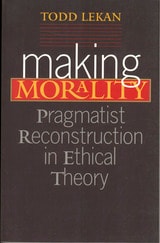
Making Morality
Pragmatist Reconstruction in Ethical TheoryTodd Lekan
Vanderbilt University Press, 2003
In this new contribution to moral theory, Todd Lekan argues for a pragmatist conception of morality as an evolving, educational, and fallible practice of everyday life. Drawing on the work of John Dewey, Lekan asserts that moral norms are neither timeless truths nor subjective whims, but habits transmitted through practices. Like the habits that make up medicine or engineering, moral habits are subject to rational evaluation and change according to new challenges and circumstances. This pragmatic interpretation of morality provides a way out of the conundrum of relativism and absolutism.
Building on classical American philosophy to address current philosophical concerns, Lekan's theory revises our basic understanding of moral life and the place of theorizing within that life. Making Morality will prove of great interest to ethical theorists, as it enjoins them to measure theoretical inquiries by how well they produce intellectual tools for problem-solving in dynamic, complex communities.
[more]
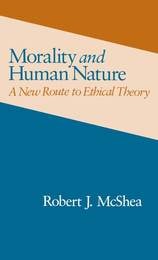
Morality and Human Nature
A New Route to Ethical TheoryRobert J. McShea
Temple University Press, 1990
Plato asked, "How shall a man live?" In this volume, Robert J. McShea offers an important, serious, and controversial answer to that perennial question. In this inquiry into the origins of human values, the author argues that values are based on emotions rather than on reason. The human ability to recall the past, to imagine future consequences of actions, and to be aware simultaneously of present, past, and probable future feelings form the basis of moral judgments. What is truly valuable to humans is a consequence of their species nature; thus, moral theory is the study of that nature. This is what McShea calls the human nature tradition, from "know thyself": to "the noblest study of man is man." Using ethology (studies of animal behavior), the author seeks to remind the reader of the significance of species being to the understanding of all creatures, and thus of ourselves. In viewing moral values as arising from human nature, McShea challenges a number of influential theories-notably, the belief that values are products of culture. Written out of a growing sense that our society finds itself in a moral and social limbo, Morality and Human Nature aurges that we start afresh and calls us to a continual reassessment of mores and social practices in the light of their adaptability to human feeling.
[more]
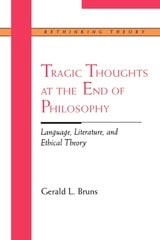
Tragic Thoughts at the End of Philosophy
Language, Literature, and Ethical TheoryGerald L. Bruns
Northwestern University Press, 1999
Recently, a number of Anglo-American philosophers of very different sorts--pragmatists, metaphysicians, philosophers of language, philosophers of law, moral philosophers—have taken a reflective rather than merely recreational interest in literature. Does this literary turn mean that philosophy is coming to an end or merely down to earth? In this collection of essays, one of the most insightful of contemporary literary theorists investigates the intersection of literature and philosophy, analyzing the emerging preferences for practice over theory, particulars over universals, events over structures, inhabitants over spectators, an ethics of responsibility over a morality of rules, and a desire for intimacy with the world instead of simply a disengaged knowledge of it.
[more]