Results by title
14 books match the query 'Ethnobiology'
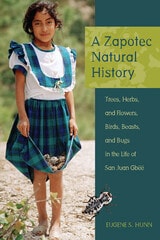
A Zapotec Natural History
Trees, Herbs, and Flowers, Birds, Beasts, and Bugs in the Life of San Juan GbëëEugene S. Hunn
University of Arizona Press, 2008
The contents of Part 2 are available online.
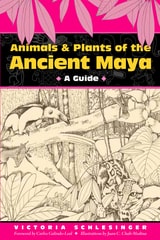
Animals and Plants of the Ancient Maya
A GuideBy Victoria Schlesinger
University of Texas Press, 2002
A growing interest in all things Maya brings an increasing number of visitors to prehistoric Maya ruins and contemporary Maya communities in Guatemala, Belize, El Salvador, western Honduras, the Yucatán Peninsula, and the southern areas of Chiapas and Tabasco, Mexico. For these visitors and indeed everyone with an interest in the Maya, this field guide highlights nearly 100 species of plants and animals that were significant to the ancient Maya and that continue to inhabit the Maya region today.
Drawing from the disciplines of biology, ecology, and anthropology, Victoria Schlesinger describes each plant or animal's habitat and natural history, identifying characteristics (also shown in a black-and-white drawing), and cultural significance to the ancient and contemporary Maya. An introductory section explains how to use the book and offers a concise overview of the history, lifeways, and cosmology of the ancient Maya. The concluding section describes the collapse of ancient Maya society and briefly traces the history of the Maya region from colonial times to the present.
Cultural Memory and Biodiversity
Virginia D. Nazarea
University of Arizona Press, 1998
Ethnobiology at the Millennium
Past Promise and Future ProspectsEdited by Richard I. Ford
University of Michigan Press, 2001
Ethnobiology for the Future
Linking Cultural and Ecological DiversityEdited by Gary Paul Nabhan; Foreword by Paul E. Minnis
University of Arizona Press, 2016
In this important new collection, Gary Paul Nabhan puts forth a call for the future not only of ethnobiology but for the entire planet. He articulates and broadens the portfolio of ethnobiological principles and amplifies the tool kit for anyone engaged in the ethnobiosphere, those vital spaces of intense interaction among cultures, habitats, and creatures.
The essays are grouped into a trio of themes. The first group presents the big questions facing humanity, the second profiles tools and methodologies that may help to answer those questions, and the third ponders how to best communicate these issues not merely to other scholars, but to society at large. The essays attest to the ways humans establish and circumscribe their identities not only through their thoughts and actions, but also with their physical, emotional, and spiritual attachments to place, flora, fauna, fungi, and feasts.
Nabhan and his colleagues from across disciplines and cultures encourage us to be courageous enough to include ethical, moral, and even spiritual dimensions in work regarding the fate of biocultural diversity. The essays serve as cairns on the critical path toward an ethnobiology that is provocative, problem-driven, and, above all, inspiring.
Ethnoecology
Situated Knowledge/Located LivesVirginia D. Nazarea
University of Arizona Press, 1999
1. Introduction. A View from a Point: Ethnoecology as Situated Knowledge, Virginia D. Nazarea
2. The Value of Subsistence for the Future of the World, Eugene S. Hunn
3. Practical and Religious Meanings of the Navajo Hogan, Lillie Lane
4. The Agronomy of Memory and the Memory of Agronomy: Ritual Conservation of Archaic Cultigens in Contemporary Farming Systems, Michael R. Dove
5. Ethnoecology Serving the Community: A Case Study from Zuni Pueblo, New Mexico, Richard I. Ford
6. Lenses and Latitudes in Landscapes and Lifescapes, Virginia D. Nazarea
7. Cultural Landscapes and Biodiversity: The Ethnoecology of an Upper R¡o Grande Watershed Commons, Devon G. Peña
8. Conserving Folk Crop Varieties: Different Agricultures, Different Goals, Daniela Soleri and Steven E. Smith
9. Plant Constituents and the Nutrition and Health of Indigenous Peoples, Timothy Johns
10. Sustainable Production and Harvest of Medicinal and Aromatic Herbs in the Sierras de C¢rdoba Region, Argentina, Marta Lagrotteria and James M. Affolter
11. Managing the Maya Commons: The Value of Local Knowledge, Scott Atran
12. Safeguarding Traditional Resource Rights of Indigenous Peoples, Darrell A. Posey
13. A Practical Primer on Intellectual Property Rights in a Contemporary Ethnoecological Context, David J. Stephenson, Jr.
14. Toward Compensation: Returning Benefits from Ethnobotanical Drug Discovery to Native Peoples, Katy Moran
15. Am I My Brother's Keeper?, Christine S. Kabuye
16. Epilogue. Quo Vadis? The Promise of Ethnoecology, Robert E. Rhoades and Jack Harlan
Fire Otherwise
Ethnobiology of Burning for a Changing WorldEdited by Cynthia T. Fowler and James R. Welch
University of Utah Press, 2018
Introduction to Sociocultural Anthropology
Adaptations, Structures, MeaningsDavid Haines
University Press of Colorado, 2017
An Introduction to Sociocultural Anthropology exposes students to the cultural detail and personal experiences that lie in the anthropological record and extends their anthropological understanding to contemporary issues.
The book is divided into three parts that focus on the main themes of the discipline: ecological adaptations, structural arrangements, and interpretive meanings. Each chapter provides an overview of a particular topic and then presents two case examples that illuminate the range of variation in traditional and contemporary societies. New case examples include herders’ climate change adaptations in the Arctic, matrilineal Muslims in Indonesia, Google’s AI winning the Asian game Go, mass migration in China, cross-cultural differences in the use of social media, and the North American response to the Syrian refugee crisis. Instructors will also have digital access to all the book’s illustrations for class review.
Covering the full range of sociocultural anthropology in a compact approach, this revised and updated edition of Cultural Anthropology: Adaptations, Structures, Meanings is a holistic, accessible, and socially relevant guide to the discipline for students at all levels.
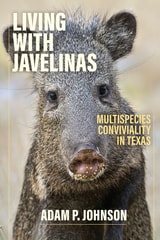
Living with Javelinas
Multispecies Conviviality in TexasAdam P. Johnson
University of Texas Press, 2026
An ethnography on how both humans and javelinas can thrive in shared space.
As human settlements expand into formerly wild lands, coexistence with wildlife is no longer optional––it’s a daily negotiation. In Living with Javelinas, Adam Johnson explores what it means to share space and adapt in a more-than-human world. Often mistaken for wild pigs, javelinas unsettle the boundaries between nuisance and neighbor. Johnson traces the other species that shape their lives––feral hogs, prickly pear, mountain cedar––and examines how folklore, perception, and memory influence human–javelina encounters. Drawing on ethnographic, ecological, and ethological research across Texas, he shows how coexistence becomes a practical, albeit often uneasy, conviviality.
In much of Texas, decades of hunting have made javelinas wary. Through extended time with rancher Roger Gray, who encounters and feeds javelinas daily, Johnson reveals how repeated contact can foster a mutually responsive relationship. Bringing anthropology into dialogue with ecology, Living with Javelinas argues that coexistence is not harmony but an ongoing adjustment. In a time of ecological strain, situated acts of accommodation point toward more ethical and sustainable ways of living together.
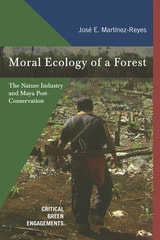
Moral Ecology of a Forest
The Nature Industry and Maya Post-ConservationJosé E. Martínez-Reyes
University of Arizona Press, 2016
Moral Ecology of a Forest provides an ethnographic account of conservation politics, particularly the conflict between Western conservation and Mayan ontological ecology. The difficult interactions of the Maya of central Quintana Roo, Mexico, for example, or the Mayan communities of the Sain Ka’an Biosphere, demonstrate the clashing interests with Western biodiversity conservation initiatives. The conflicts within the forest of Quintana Roo represent the outcome of nature in this global era, where the forces of land grabbing, conservation promotion and organizations, and capitalism vie for control of forests and land.
Forests pose living questions. In addition to the ever-thrilling biology of interdependent species, forests raise questions in the sphere of political economy, and thus raise cultural and moral questions. The economic aspects focus on the power dynamics and ideological perspectives over who controls, uses, exploits, or preserves those life forms and landscapes. The cultural and moral issues focus on the symbolic meanings, forms of knowledge, and obligations that people of different backgrounds, ethnicities, and classes have constructed in relation to their lands. The Maya Forest of Quintana Roo is a historically disputed place in which these three questions come together.

Plants and Animals in the Life of the Kuna
By Jorge Ventocilla, Heraclio Herrera, & Valerio Núñez
University of Texas Press, 1995
"The earth is the mother of all things"; thus begins this original and accessible book on how the Kuna of Panama relate to the natural world. An integrative project involving Kuna traditional leaders and trained scholars, and fully illustrated by a Kuna artist, this translation of Plantas y animales en la vida del pueblo Kuna focuses on Kuna plant and animal life, social life, and social change as a means of saving traditional ecological knowledge and "returning" it to the community.
The authors hope to preserve the Kuna environment not only by reviving traditional technologies but also by educating the Kuna as to what needs protection. While the Kuna have a tradition of living in harmony with the land, the intrusion of the market economy is eroding the very basis of their sustainable way of life.
As a response to this crisis, this book seeks to develop native self-awareness and provide a model for collaboration. It will appeal to Latin Americanists, anthropologists, and ethnobotanists, as well as to a general readership in environmental issues.
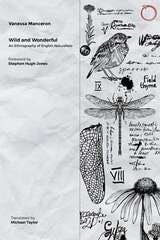
Wild and Wonderful
An Ethnography of English NaturalistsVanessa Manceron
HAU, 2025
In Wild and Wonderful, social anthropologist Vanessa Manceron investigates an understudied but indispensable scientific practice: getting to know and recognize the living worlds around us. Her research takes her to England, where a longstanding naturalist tradition brings together professionals, academics, and amateurs to study the world around them. Observing the natural world here is regarded not as a simple hobby, but as a necessary activity. This is participatory science, an itinerant brand of scholarship that immerses itself in a specific and delimited territory, meticulously documenting the species living there and how they develop and expand their domain or regress and disappear. Manceron leads us through woods and fields, showing us another way of looking, of paying attention to minute differences, sounds, and variations of color. Her book is both a contribution to the anthropology of science and an opportunity to take a fresh look at our relationship with nature, affording us a glimpse of another way of living and living with.
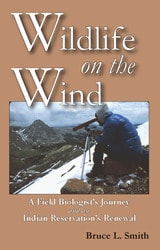
Wildlife on the Wind
A Field Biologist's Journey and an Indian Reservation's RenewalBruce L Smith
Utah State University Press, 2010
In the heart of Wyoming sprawls the ancient homeland of the Eastern Shoshone Indians, who were forced by the U.S. government to share a reservation in the Wind River basin and flanking mountain ranges with their historical enemy, the Northern Arapahos. Both tribes lost their sovereign, wide-ranging ways of life and economic dependence on decimated buffalo. Tribal members subsisted on increasingly depleted numbers of other big game—deer, elk, moose, pronghorn, and bighorn sheep. In 1978, the tribal councils petitioned the U.S. Fish and Wildlife Service to help them recover their wildlife heritage. Bruce Smith became the first wildlife biologist to work on the reservation. Wildlife on the Wind recounts how he helped Native Americans change the course of conservation for some of America's most charismatic wildlife.
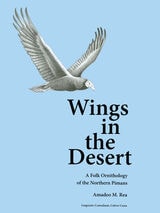
Wings in the Desert
A Folk Ornithology of the Northern PimansAmadeo M. Rea
University of Arizona Press, 2008