Results by title
7 books match the query 'Ethnoscience'
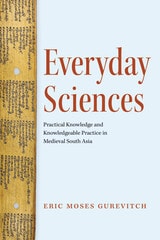
Everyday Sciences
Practical Knowledge and Knowledgeable Practice in Medieval South AsiaEric Moses Gurevitch
University of Chicago Press, 2027
How people across society in medieval South Asia—including coppersmiths, merchants, bureaucrats, philosophers, and physicians—pioneered new vernacular sciences.
Starting in the eleventh century, South Asian scholars and artisans began to investigate and shape the world in a novel manner. Intellectuals translated Sanskrit texts into regional languages such as Kannada, situating knowledge in particular places. At the same time, architects and artisans began to assert their intellectual and literary presence, often claiming the title of “scholar” as they negotiated a space between classical textual erudition, professional expertise, and personal experience. Working within the perilous world of court politics, a new class of scholar-administrators began collecting recipes and composing texts about weather prediction, horticulture, mathematics, astrology, sexual life, and medicine.
Everyday Sciences traces this emergence of vernacular sciences by engaging with untapped archives and an array of sources in multiple languages. By exploring how historical actors resolved disputes about the physiology of vision, the use of meat and alcohol in medicine, and the management of information in elephant stables, Eric Moses Gurevitch unveils the complex textual and social orders that structured medieval society in India. He argues that a focus on everyday sciences in the non-modern non-West allows historians to reassess how places outside—and even inside—Europe are brought into narratives of a global history of science. Gurevitch articulates a “big-enough” history of science in South Asia, one open to little voices and unexpected connections that might not make their way through the fray in other histories.
Everyday Sciences demonstrates how practical, everyday activities were engines of profound intellectual innovation—and it shows the promise of revisiting the past without colonial hang-ups, and with fresh eyes.
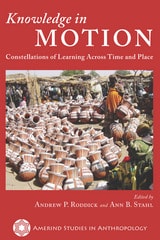
Knowledge in Motion
Constellations of Learning Across Time and PlaceEdited by Andrew P. Roddick and Ann B. Stahl
University of Arizona Press, 2019
In the last twenty-five years, scholars from a number of disciplines have explored “situated learning,” specifically investigating how learning relates to social reproduction and daily life. In Knowledge in Motion, contributors focus on learning through time and at a variety of scales, particularly as they relate to power and politics, with implications for emergent communities and constellations of practice.
This volume brings together archaeologists, historians, and cultural anthropologists to examine communities engaged in a range of learning practices around the globe, from Africa to the Americas. Contributors draw on the growing interdisciplinary scholarship on situated learning to explore those processes in relation to power and broader forces that shape knowledge during times of turbulent change.
Enriching the diversity of regions and disciplines, Knowledge in Motion focuses on how learning, knowledge transmission, and the emergent qualities of communities and constellations of practice are shaped by changing spheres of interaction or other unstable events and influences. The contributions forge productive theories and methodologies for exploring situated learning and its broad-ranging outcomes.
Postcolonial Developments
Agriculture in the Making of Modern IndiaAkhil Gupta
Duke University Press, 1998
Based on fieldwork done in the village of Alipur in rural north India from the early 1980s through the 1990s, Postcolonial Developments examines development itself as a post–World War II sociopolitical ideological formation, critiques related policies, and explores the various uses of the concept of the “indigenous” in several discursive contexts. Gupta begins with an analysis of the connections and conflicts between the world food economy, transnational capital, and technological innovations in wheat production. He then examines narratives of village politics in Alipur to show how certain discourses influenced governmental policies on the green revolution. Drawing links between village life, national trends, and global forces, Gupta concludes with a discussion of the implications of environmentalism as exemplified by the Rio Earth Summit and an examination of how global environmental treaties may detrimentally affect the lives of subaltern peoples.
With a series of subtle observations on rural politics, nationalism, gender, modernization, and difference, this innovative study capitalizes on many different disciplines: anthropology, sociology, comparative politics, cultural geography, ecology, political science, agricultural economics, and history.
Science and an African Logic
Helen Verran
University of Chicago Press, 2001
In this captivating book, Helen Verran addresses precisely that question by looking at how science, mathematics, and logic come to life in Yoruba primary schools. Drawing on her experience as a teacher in Nigeria, Verran describes how she went from the radical conclusion that logic and math are culturally relative, to determining what Westerners find so disconcerting about Yoruba logic, to a new understanding of all generalizing logic. She reveals that in contrast to the one-to-many model found in Western number systems, Yoruba thinking operates by figuring things as wholes and their parts. Quantity is not absolute but always relational. Certainty is derived not from abstract logic, but from cultural practices and associations.
A powerful story of how one woman's investigation in this everday situation led to extraordinary conclusions about the nature of numbers, generalization, and certainty, this book will be a signal contribution to philosophy, anthropology of science, and education.

Sounds of Tohi
Cherokee Health and Well-Being in Southern AppalachiaLisa J. Lefler and Thomas N. Belt
University of Alabama Press, 2022
Dialogue between a medical anthropologist and a Cherokee linguist about health, well-being, and environmental issues
Sounds of Tohi: Cherokee Health and Well-Being in Southern Appalachia is the result of almost two decades of work by medical anthropologist Lisa J. Lefler and Cherokee elder and traditionalist Thomas N. Belt. The narrative consists of a dialogue between them that displays traditional Indigenous knowledge as well as the importance of place for two people from cultures and histories that intersect in the mountains of Southern Appalachia. Together, Lefler and Belt decolonize thinking about health, well-being, and environmental issues through the language and experiences of people whose identity is inextricably linked to the mountains and landscape of western North Carolina.
Lefler and Belt discuss several critical cultural concepts that explain the science of relationships with this world, with the spirit world, and with people. They explore tohi, the Cherokee concept of health, which offers a more pervasive understanding of relationships in life as balanced and moving forward in a good way. They converse about the importance of matrilineality, particularly in light of community healing, the epistemologies of Cherokee cosmography, and decolonizing counseling approaches.
The discussions here offer a different way of approaching the issues that face Americans in this difficult time of division. Lefler and Belt share their urgency to take action against the wholesale exploitation of public lands and the shared environment, to work to perpetuate tribal languages, to preserve the science that can make a difference in how people treat one another, and to create more forums that are inclusive of Native and marginalized voices and that promote respect and appreciation of one another and the protection of sacred places. Throughout, they rely on the preservation of traditional knowledge, or Native science, via Native language to provide insight as to why people should recognize a connection to the land.
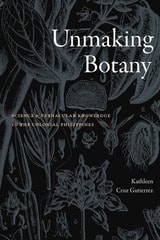
Unmaking Botany
Science and Vernacular Knowledge in the Colonial PhilippinesKathleen Cruz Gutierrez
Duke University Press, 2025
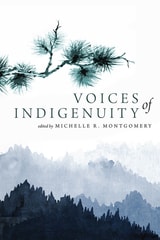
Voices of Indigenuity
Michelle Montgomery
University Press of Colorado, 2023
Advocating for and providing an expansion of place-based Indigenized education that infuses Indigenous epistemologies for student success in both K–12 and higher education curricula, these essays explore topics such as land fragmentation, remote sensing, and outreach through the lens of TEK, demonstrating methods of fusing learning with Indigenous knowledge (IK). Contributors emphasize the need to increase the perspectives of IK within institutionalized knowledge beyond being co-opted into non-Indigenous frameworks that may be fundamentally different from Indigenous ways of thinking.
Decolonizing current harmful pedagogical curricula and research training about the natural world through an Indigenous- guided approach is an essential first step to rebuilding a healthy relationship with our environment while acknowledging that all relationships come with an ethical responsibility. Voices of Indigenuity captures the complexities of exploring the contextu- alized meanings for why TEK should be integrated into Western environmental science processes and frameworks while rooted in Indigenous studies programs.