Results by title
8 books match the query 'Ethos'
Errant Modernism
The Ethos of Photography in Mexico and BrazilEsther Gabara
Duke University Press, 2008
Gabara argues that Brazilian and Mexican modernists deliberately made photography err: they made this privileged medium of modern representation simultaneously wander and work against its apparent perfection. They flouted the conventions of mainstream modernism so that their aesthetics registered an ethical dimension. Their photographic modernism strayed, dragging along the baggage of modernity lived in a postcolonial site. Through their “errant modernism,” avant-garde writers and photographers critiqued the colonial history of Latin America and its twentieth-century formations.
Ethos Of Pluralization
William Connolly
University of Minnesota Press, 1995
A skeptical examination of the inclusiveness of pluralism.
How plural, really, is pluralism today? In this book a prominent political theorist reworks the traditional pluralist imagination, rendering it more inclusive and responsive to new drives to pluralization. Traditional pluralism, William E. Connolly shows, gives too much priority to past political settlements, allotments of public space and power relations already made and fixed. It deflates the politics of pluralization. The Ethos of Pluralization explores the constitutive tension between pluralism and pluralization, pursuing an ethos of politics that enables new forces of pluralization to find receptive responses in public life.
Connolly explores how contemporary drives to pluralize stir the reactionary forces of political fundamentalism and how fundamentalism generates the cultural fragmentation it purports to resist. The reluctance of traditional pluralists to address the tension between pluralism and pluralization plays into the hands of fundamentalist forces. The Ethos of Pluralization eventually ranges beyond the borders of the territorial state to explore relations between the globalization of economic life and a more adventurous pluralization of political identities. Engaging images of pluralism and nationalism advanced by Tocqueville, Schumpeter, Ricoeur, Walzer, Herz, and Kurth, Connolly draws selectively upon Nietzsche, Foucault, Butler and Deleuze to delineate an ethos of politics that makes for new identities while protecting conditions that make pluralism and governance possible.
Image Makers
Advertising, Public Relations, and the Ethos of AdvocacyRobert Jackall and Janice M. Hirota
University of Chicago Press, 2000
Robert Jackall and Janice M. Hirota explore the fashioning of the apparatus of advocacy through the stories of two organizations, the Committee on Public Information, which sold the Great War to the American public, and the Advertising Council, which since the Second World War has been the main coordinator of public service advertising. They then turn to the career of William Bernbach, the adman's adman, who reinvented advertising and grappled creatively with the profound skepticism of a propaganda-weary midcentury public. Jackall and Hirota argue that the tools-in-trade and habits of mind of "image makers" have now migrated into every corner of modern society. Advocacy is now a vocation for many, and American society abounds as well with "technicians in moral outrage," including street-smart impresarios, feminist preachers, and bombastic talk-radio hosts.
The apparatus and ethos of advocacy give rise to endlessly shifting patterns of conflicting representations and claims, and in their midst Image Makers offers a clear and spirited understanding of advocacy in contemporary society and the quandaries it generates.
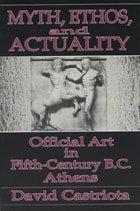
Myth, Ethos, and Actuality
Official Art in Fifth Century B.C. AthensDavid Castriota
University of Wisconsin Press, 1992
Using material remains, as well as the evidence of contemporary Greek history, rhetoric, and poetry, David Castriota interprets the Athenian monuments as vehicles of an official ideology intended to celebrate and justify the present in terms of the past.
Castriota focuses on the strategy of ethical antithesis that asserted Greek moral superiority over the “barbaric” Persians, whose invasion had been repelled a generation earlier. He examines how, in major public programs of painting and sculpture, the leading artists of the period recast the Persians in the guise of wild and impious mythic antagonists to associate them with the ethical flaws or weaknesses commonly ascribed to women, animals, and foreigners. The Athenians, in contrast, were compared to mythic protagonists representing the excellence and triumph of Hellenic culture.
Castriota’s study is innovative in emphasizing the ethical implication of mythic precedents, which required substantial alterations to render them more effective as archetypes for the defense of Greek culture against a foreign, morally inferior enemy. The book looks in new ways at how the patrons and planners sought to manipulate viewer response through the selective presentation or repackaging of mythic traditions.
Sexuality and the Politics of Ethos in the Writing Classroom
Zan Meyer Goncalves
Southern Illinois University Press, 2005
Applying the complexities of literacy development and personal ethos to the teaching of composition, Zan Meyer Goncalves challenges writing teachers to consider ethos as a series of identity performances shaped by the often-inequitable social contexts of their classrooms and communities. Using the rhetorical experiences of students who identify as lesbian, gay, bisexual, and/or transgender, she proposes a new way of thinking about ethos that addresses the challenges of social justice, identity, and transfer issues in the classroom.
Goncalves offers an innovative approach to teaching identity performance theory bound by social contexts. She applies this new approach to theories of specificity and intersectionality, illustrating how teachers can help students redefine the relationship between their social identities and their writing. She also addresses bringing social activism and identity politics into the classroom, helping writers make transfers across rhetorical contexts and linking students' interests to public conversations.
Theoretical and practical, Sexuality and the Politics of Ethos in the Writing Classroom provides teachers of first-year and advanced composition studies with useful, detailed assignments based in specific identity performance. Goncalves offers techniques to subvert oppressive language practices, while encouraging students to recognize themselves as writers, citizens, and active participants in their own educations and communities.
The Ethos of Drama
Rhetorical Theory and Dramatic WorthRobert L. King
Catholic University of America Press, 2010
The Ethos of Romance at the Turn of the Century
By William J. Scheick
University of Texas Press, 1994
The romance genre was a popular literary form among writers and readers in the nineteenth and early twentieth centuries, but since then it has often been dismissed as juvenile, unmodern, improper, or subversive. In this study, William J. Scheick seeks to recover the place of romance in fin-de-siècle England and America; to distinguish among its subgenres of eventuary, aesthetic, and ethical romance; and to reinstate ethical romance as a major mode of artistic expression.
Scheick argues that the narrative maneuvers of ethical romance dissolve the boundary between fiction and fact. In contrast to eventuary romances, which offer easily consumed entertainment, or aesthetic romances, which urge upon readers a passive appreciation of a wondrous work of art, ethical romances potentially disorient and reorient their readers concerning some metaphysical insight hidden within the commonplace. They prompt readers to question what is real and what is true, and to ponder the wonder of life and the text of the self, there to detect what the reader might do in the art of his or her own life
The authors whose works Scheick discusses are Nathaniel Hawthorne, H. Rider Haggard, Henry James, C. J. Cutcliffe Hyne, H. G. Wells, John Kendrick Bangs, Gilbert K. Chesterton, Richard Harding Davis, Stephen Crane, Mary Austin, Jack London, Robert Louis Stevenson, Mary Cholmondeley, and Rudyard Kipling. This wide selection expands the canon to include writers and works that highly merit re-reading by a new generation.
The Ethos of the Christian Heart
Reading Veritatis SplendorAdrian Reimers
St. Augustine's Press, 2024
One of the most studied and critiqued documents of the papal magisterium is largely spoken of with regards to moral theology and the refutation of modern error. Yet Adrian Reimers points out that, as affirmed by this encyclical, the moral life is itself a realm of love and freedom, a place of intimacy with the Creator as much as interaction with others. Reimers is eager to show that the Encyclical is more innovative than it looks, just as morality is not just about the correction of error. It is not content to defend the traditional positions; it traces the paths of a profound renewal in the presentation of Catholic morality. "We would gladly say that it performs a kind of discreet revolution in the conception of Christian morality, affecting the very bases that support it."
The publication of Veritatis Splendor met with vigorous opposition and even rejection within the Catholic theological community. But in Veritatis Splendor John Paul II addresses these contemporary conceptions, including dissention, coming to grips with the roots of the modern errors that have resulted in the loss of transcendence. However, the scope of Veritatis Splendor is far broader than evil and judgment of sin. The pope addresses such issues as conscience, intrinsically evil acts, and the theory of fundamental freedom. Inevitably, these discussions revolve around how to conceive the nature of the human act and the conception of natural law.
This present work examines this encyclical against the backdrop of the philosophers with whom Karol Wojtyła engaged in his own philosophical project. Of central concern to Wojtyła throughout his career were the nature and prerogatives of the human person. Among his most frequent modern interlocutors were David Hume, Immanuel Kant, the utilitarian school, and Max Scheler. The program of Wojtyła’s philosophical corpus is to present an alternative account of the human person to that which has marked the post-Enlightenment world. Having shared in the sufferings of his native Poland under the Nazi occupation and then as a scholar working in Communist Poland, Wojtyła was keenly aware of the forms of materialism which formed the environment of his own life and work. He offers not only his own analyses but also provides a model for engaging with the contemporary culture.
Veritatis Splendor is a timeless examination of human, personal acts that challenges the post-modern conception of morality, love, and freedom. Reimers reorients this presentation for contemporary readers and invites readers who may have missed this foundational treatment to incorporate it into the questions and issues of our own times.