Results by title

6 books match the query 'Etiquette'

cover of A Genealogy of Manners: Transformations of Social Relations in France and England from the Fourteenth to the Eighteenth Century

A Genealogy of Manners

Transformations of Social Relations in France and England from the Fourteenth to the Eighteenth Century

Jorge Arditi

University of Chicago Press, 1998

Remarkable for its scope and erudition, Jorge Arditi's new study offers a fascinating history of mores from the High Middle Ages to the Enlightenment. Drawing on the pioneering ideas of Norbert Elias, Michel Foucault, and Pierre Bourdieu, Arditi examines the relationship between power and social practices and traces how power changes over time.

Analyzing courtesy manuals and etiquette books from the thirteenth to the eighteenth century, Arditi shows how the dominant classes of a society were able to create a system of social relations and put it into operation. The result was an infrastructure in which these classes could successfully exert power. He explores how the ecclesiastical authorities of the Middle Ages, the monarchies from the fifteenth through the seventeenth century, and the aristocracies during the early stages of modernity all forged their own codes of manners within the confines of another, dominant order. Arditi goes on to describe how each of these different groups, through the sustained deployment of their own forms of relating with one another, gradually moved into a position of dominance.

[more]
cover of As for Protocols

As for Protocols

Edited by Re'al Christian, Carin Kuoni, and Eriola Pira

Amherst College Press, 2025

Explicitly—or not—protocols determine much of what we do. Far exceeding traditional notions of “good manners,” protocols are systems of language that regulate how we relate to each other, to our cultural, social, and political environments, and to the technologies that create them. The first publication to look at protocols across a wide range of disciplines, As for Protocols brings together contributions by twenty-two international artists, writers, scholars, musicians, architects, and scientists who explore protocols across various fields, foregrounding opportunities for creating new protocols that are inclusive and equitable. Through essays, artworks, interviews, and scores, the book speaks to protocols as practice—neither conventional mannerisms nor abstract concepts, but material processes, relational affinities, shared responsibilities, and mutual care.

Edited by Re’al Christian, Carin Kuoni, and Eriola Pira, an opening score by Raven Chacon and contributions by Salome Asega, Carolina Caycedo with Lupita Limón Corrales, Raven Chacon, Jesse Chun, Asia Dorsey, Taraneh Fazeli and Cannach MacBride, Pablo Helguera, Emmanuel Iduma, Mary Maggic, Shannon Mattern, V. Mitch McEwen with Nadir Jeevanjee, Rashaun Mitchell with Silas Riener, Romy Opperman, Rasheedah Phillips, Leanne Betasamosake Simpson with Maria Hupfield, Ultra-red with Robert Sember, and Underground Resistance.
[more]
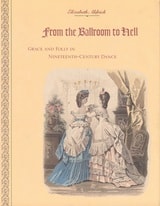
cover of From the Ballroom to Hell: Grace and Folly in Nineteenth-Century Dance

From the Ballroom to Hell

Grace and Folly in Nineteenth-Century Dance

Elizabeth Aldrich

Northwestern University Press, 1991

During the 1800s, dance and etiquette manuals provided ordinary men and women with the keys to becoming gentlemen and ladies—and thus advancing in society. Why dance? To the insecure and status-oriented upper middle class, the ballroom embodied the perfect setting in which to demonstrate one's fitness for membership in genteel society.

From the Ballroom to Hell collects over 100 little-known excerpts from dance, etiquette, beauty, and fashion manuals from the nineteenth century. Included are instructions for performing various dances, as well as musical scores, costume patterns, and the proper way to hold one's posture, fork, gloves, and fan. While of particular interest to dancers, dance historians, and choreographers, anyone fascinated by the ways and mores of the period will find From the Ballroom to Hell an endearing and informative glimpse of America's past.

[more]
cover of In Pursuit of Civility: Manners and Civilization in Early Modern England

In Pursuit of Civility

Manners and Civilization in Early Modern England

Keith Thomas

Brandeis University Press, 2018

Keith Thomas’s earlier studies in the ethnography of early modern England, Religion and the Decline of Magic, Man and the Natural World, and The Ends of Life, were all attempts to explore beliefs, values, and social practices in the centuries from 1500 to 1800. In Pursuit of Civility continues this quest by examining what English people thought it meant to be “civilized” and how that condition differed from being “barbarous” or “savage.” Thomas shows that the upper ranks of society sought to distinguish themselves from their social inferiors by distinctive ways of moving, speaking, and comporting themselves, and that the common people developed their own form of civility. The belief of the English in their superior civility shaped their relations with the Welsh, the Scots, and the Irish, and was fundamental to their dealings with the native peoples of North America, India, and Australia. Yet not everyone shared this belief in the superiority of Western civilization; the book sheds light on the origins of both anticolonialism and cultural relativism. Thomas has written an accessible history based on wide reading, abounding in fresh insights, and illustrated by many striking quotations and anecdotes from contemporary sources.
[more]
cover of The Ladies' Etiquette Handbook: The Importance of Being Refined in the 1880s

The Ladies' Etiquette Handbook

The Importance of Being Refined in the 1880s

David E. Schoonover

University of Iowa Press, 2001
Prior to the late nineteenth century, most Americans viewed dining as a utilitarian duty characterized by common “meat and potato” dishes and complemented by little, if any, polite conversation. With the boom in industrialism and the sudden growth of the middle class in the 1880s, America's interest in social etiquette rose dramatically.
Consisting of two separate publications—The Ladies' Handbook and Household Assistant(1886) and Short Hints on Social Etiquette (1887)—The Ladies' Etiquette Handbook can be read as a testament to the growing division between social classes and, at the same time, as a reflection of the middle class' overwhelming desire to cross social lines through the graces of fine etiquette.
Written by a Methodist women's church group in Manchester, New Hampshire, The Ladies' Handbook and Household Assistant provides advice on subjects such as church etiquette and the proper handling of cutlery as well as recipes for the socially active household. Short Hints on Social Etiquette, published as a promotional piece by a Philadelphia soap manufacturer—including descriptions of lavish meals, advice on proper word pronunciation, and illustrations of tasteful calling cards—strives to bring “aristocratic” values into the “republican” home.
The foreword by Kenneth Cmiel, professor of history at the University of Iowa, provides an overview of the historic and social trends leading up to the publication of both handbooks and traces the creation and ultimate development of modern social etiquette.
[more]
cover of Troping the Body: Gender, Etiquette, and Performance

Troping the Body

Gender, Etiquette, and Performance

Gwendolyn Audrey Foster

Southern Illinois University Press, 2000

Troping the Body: Gender, Etiquette, and Performance is an interdisciplinary study of etiquette texts, conduct literature, and advice books and films. GwendolynAudrey Foster analyzes the work of such women authors as Emily Post, Christine de Pizan, Hannah Webster Foster, Emily Brontë, Frances E. W. Harper, and Martha Stewart as well as such women filmmakers as Lois Weber and Kasi Lemmons.

“Specifically,” Foster notes, “I was interested in the possibility of locating power and agency in the voices of popular etiquette writers.” Her investigation led her to analyze etiquette and conduct literature from the Middle Ages to the present. Within this wide scope, she redefines the boundaries of conduct literature through a theoretical examination of the gendered body as it is positioned in conduct books, etiquette texts, poetry, fiction, and film.

Drawing on Bakhtin, Gates, Foucault, and the new school of performative feminism to develop an interdisciplinary approach to conduct literature—and literature as conduct—Foster brings a unique perspective to the analysis of ways in which the body has been gendered, raced, and constructed in terms of class and sexuality.

Even though women writers have been actively writing conduct and etiquette texts since the medieval period, few critical examinations of such literature exist in the fields of cultural studies and literary criticism. Thus, Foster’s study fills a gap and does so uniquely in the existing literature. In examining these voices of authority over the body, Foster identifies the dialogic in the texts of this discipline that both supports and disrupts the hegemonic discourse of a gendered social order.

[more]