Results by title
2 books match the query 'Etruscan'
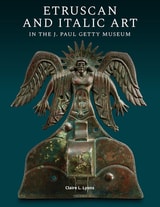
Etruscan and Italic Art in the J. Paul Getty Museum
Claire L. Lyons
J. Paul Getty Trust, The, 0
Featuring in-depth research on almost 500 objects, this richly illustrated open-access catalogue showcases the J. Paul Getty Museum’s exceptional collection of Etruscan and Italic art.
The Etruscans and neighboring pre-Roman cultures dominated central and northern Italy from 900 to 100 BCE. The J. Paul Getty Museum’s collection of Etruscan and Italic art—bronze and terracotta sculpture, wall paintings, bucchero and figured pottery, gold and amber jewelry, and carved gemstones—is among the most renowned in North America. This richly illustrated catalogue brings together the latest research on nearly 500 objects. Prefaced by a history of Etruria’s culture and artistic innovations, it features recent results of scientific analysis, provenance histories, and an extensive bibliography.
- Offers a study of the multicultural Mediterranean—Etruria sat along trade routes linking West Asia, Greece, Europe, and North Africa.
- Includes detailed catalogue entries accompanied by spectacular photography—nearly 600 illustrations in all.
- Contains up-to-date research from international scholars spanning the disciplines of archaeology, art, and the languages of pre-Roman Italy, as well as conservation science.
A comprehensive guide to an extraordinary collection, this publication is an invaluable resource for archaeologists, art historians, classicists, conservators, curators, and enthusiasts of the ancient world.
The free online edition of this open-access publication is available at www.getty.edu/publications/etruscan-art/ and features zoomable, high-resolution illustrations. Free PDF and EPUB editions are available, as well as JPG downloads of the main catalogue images. This publication was created using Quire, a multiformat publishing tool from Getty.
Monumentality in Etruscan and Early Roman Architecture
Ideology and InnovationEdited by Michael L. Thomas and Gretchen E. Meyers
University of Texas Press, 2012
Every society builds, and many, if not all, utilize architectural structures as markers to define place, patron, or experience. Often we consider these architectural markers as “monuments” or “monumental” buildings. Ancient Rome, in particular, is a society recognized for the monumentality of its buildings. While few would deny that the term “monumental” is appropriate for ancient Roman architecture, the nature of this characterization and its development in pre-Roman Italy is rarely considered carefully. What is “monumental” about Etruscan and early Roman architecture?
Delving into the crucial period before the zenith of Imperial Roman building, Monumentality in Etruscan and Early Roman Architecture addresses such questions as, “What factors drove the emergence of scale as a defining element of ancient Italian architecture?” and “How did monumentality arise as a key feature of Roman architecture?” Contributors Elizabeth Colantoni, Anthony Tuck, Nancy A. Winter, P. Gregory Warden, John N. Hopkins, Penelope J. E. Davies, and Ingrid Edlund-Berry reflect on the ways in which ancient Etruscans and Romans utilized the concepts of commemoration, durability, and visibility to achieve monumentality. The editors’ preface and introduction underscore the notion of architectural evolution toward monumentality as being connected to the changing social and political strategies of the ruling elites.
By also considering technical components, this collection emphasizes the development and the ideological significance of Etruscan and early Roman monumentality from a variety of viewpoints and disciplines. The result is a broad range of interpretations celebrating both ancient and modern perspectives.